
The great Mystery Behind Earth’s Most Epic Migration
Unraveling the Enigma: Decoding the Spectacle of Earth's Extraordinary Migration


The notion of Earth's greatest animal migrations usually brings to mind images of immense herds making their annual journey across the Serengeti or transcontinental flights filling the sky with orange hues. However, the most substantial mass migration on Earth occurs every night, and it's happening underwater. During World War II, Sonar detected dense signals emerging from the depths of the ocean, giving the impression that parts of the ocean floor were moving up and down by approximately 3,000 feet. In actuality, the sonar was detecting enormous clusters of tiny creatures known as zooplankton, ascending and descending from the depths to the surface each night. This phenomenon occurs in every ocean, every night, and has left scientists bewildered. The reason for these nearly microscopic plankton making such an incredible journey daily could potentially be linked to biological clocks and climate change. This is the story of Earth's greatest and most mysterious migration. Vertical migration in the ocean is the most extensive animal movement on our planet, an extraordinary fact. As a senior scientist at MBARI, the Monterey Bay Aquarium Research Institute, I use sound to study the lives of ocean animals. Firstly, one must comprehend how small zooplankton are. They are smaller than the tip of a crayon but travel vast distances in the ocean, especially for their size. If we were to scale the migrations to humans, it would be equivalent to running a 10K twice a day, once to get breakfast and once before bed, all while swimming twice the speed of an Olympic marathon runner. It's an impressive feat that occurs daily. If we tally up all the vertical migration occurring in all the oceans and lakes on earth, we estimate 10 billion tons of biomass, equivalent to 25 times the mass of all humans on earth, moving between the surface and the depths every night. This is known as diel vertical migration or DVM. But why do they go to such great lengths? Vertical migration is one of the most common behaviors observed in the ocean. It occurs with animals of all sizes, but the most abundant migrators, in terms of biomass, are small fish like bristlemouths and lantern fish following the vertical migrations of the zooplankton. This is a different way of thinking since we have always viewed plankton, all of them, as wanderers like the Greek word for plankton defines them. However, they are capable of making decisions.
The mesopelagic zone is a semi-deep water region that only receives approximately 20% of the light that is available on the surface. The animals that inhabit this zone have a difficult task of balancing their need for food, which is more abundant on the surface, with the need to avoid being preyed upon. To minimize their chances of becoming dinner, these animals tend to stay deep in the dark during the day and migrate up to the surface at sunset before descending again at sunrise. This movement is triggered by small changes in light, which prompt them to move up and down the water column. Researchers have observed reverse diel vertical migrations, in which zooplankton move up and down the water column in response to clouds passing overhead. This suggests that these organisms are highly sensitive to light. However, scientists believe there is more to this phenomenon than just changes in sunlight. By using sound to track the movements of animals in this zone, scientists have gained a better understanding of their behavior. Combining sonar observations with low-tech tools like nets and new techniques like DNA analysis, scientists are able to get a more complete picture of what is happening in this region. Through these studies, scientists have discovered that changes in light are not the only triggers for diel vertical migration. For example, during the dark winter months in the Arctic, zooplankton respond to moonlight instead. This new information has significantly changed what we know about plankton and the mesopelagic zone. Phytoplankton, a unique class of plankton, is responsible for photosynthesis and provides most of the oxygen we breathe. Some phytoplankton undergo vertical movements, controlling their buoyancy and swimming with organs to take advantage of sunlight during the day and nutrient-rich deeper water at night. This balance between light and nutrients is essential for their growth, and studying their daily vertical migration (DVM) could help us understand our own circadian rhythm. Circadian rhythms control many of our day-to-day behaviors, from sleep to hunger to fertility, and are triggered by light or the lack of light. While we know how these rhythms work in land organisms, they were a mystery for aquatic organisms like plankton. However, researchers studying zooplankton in 2017 discovered that they also migrate even when the lights are off, suggesting that they might have circadian rhythms just like us. Understanding DVM could even help tackle climate change, one of humanity's biggest challenges.
Vertical migration has a significant role in the biological carbon pump. Organisms that photosynthesise at the ocean's surface remove CO2 from the atmosphere. If it just stays on the surface it will be re-released back into the atmosphere, but if it sinks to the deep sea, it can remain there for thousands of years, thus taking the carbon out of the atmosphere and reducing the effect of climate change. The ocean is very efficient in this regard, absorbing about 25% of the CO2 we release and sequestering it. Vertical migration is a very fast way for this process to occur, as animals rise to the surface to take in the CO2.
About the Creator
Asmae El assri
Hi! I’m a passionate creator sharing free stock photos, royalty-free images, and quality PNGs.
Explore my curated collections and download high-quality images with no watermark at https://freestockphotoshub.blogspot.com/
Keep reading
More stories from Asmae El assri and writers in Earth and other communities.
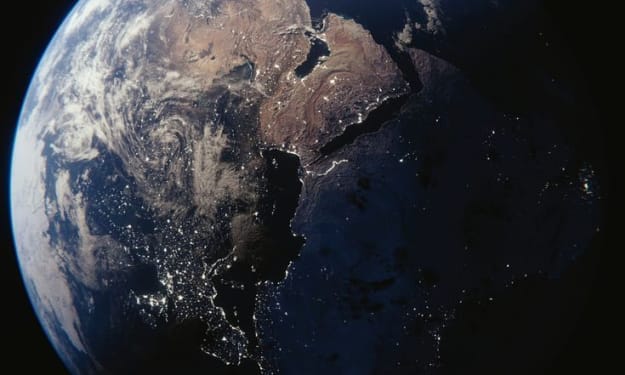
The Earth With Half Land and Half Water
imagine earth with an indeed 50 50 split between mainlands and abysses our earth covered half by land and half by water how would this change the earth as you know it what new kinds of recesses could this make possible for you and what does the color of your pee have to do with this this is what if and then is what would be if the earth was partial land and half water when it comes to making life possible on a earth water is an absolute have that is why we look for alien life on worlds where liquid water could live when it comes to our own earth 71 of its face is covered by water utmost of that's in our five abysses together they form one global ocean now if you replaced nearly a quarter of our ocean water with land how soon would earth turn into just another breathless gemstone in space thanks to global warming earth's ocean situations are presently rising but if you wanted to balance the earth's land to water rate you'd see the ocean situations absolutely dip and not just a many measures but around three kilometers earth would look veritably different the regions around both the north and south poles would be fully dried out and every mainland on the earth would expand and not just a little either all this recently surfaced home around the world would be roughly equal to the current face areas of Asia Europe Africa and north America combined that would be an enormous quantum of unused space everything extending off the old beachfronts would be fairly flat but some of the areas that used to be deep ocean would reveal vast corridors and steep crevasses as you explored this new land you'd discover that the one global ocean would be no more all of the abysses would be separated from each other and all of the mainlands would be one connected mainland and this would be good news for elaboration early humans did not have any vessels or aeroplanes
By Asmae El assri3 years ago in Earth
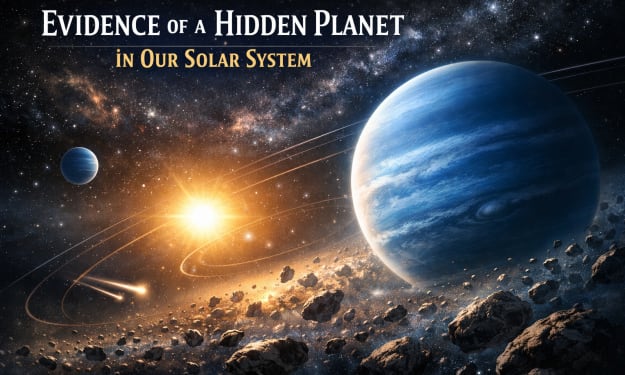
Evidence Suggests a Large Hidden Planet May Exist in Our Solar System
For centuries, scientists believed the major members of our Solar System were fully known. From the rocky inner planets to the gas giants and icy bodies beyond, astronomers thought they had mapped most of the significant objects orbiting the Sun. However, new research by American scientists suggests that a large, hidden planet may still be lurking in the distant reaches of our Solar System.
By Irshad Abbasi 7 days ago in Earth


Comments