
The Giants with Tiny Brains: The Secret Life of Rhinos
Discover the strength, survival, and struggles of the world’s last five rhino species

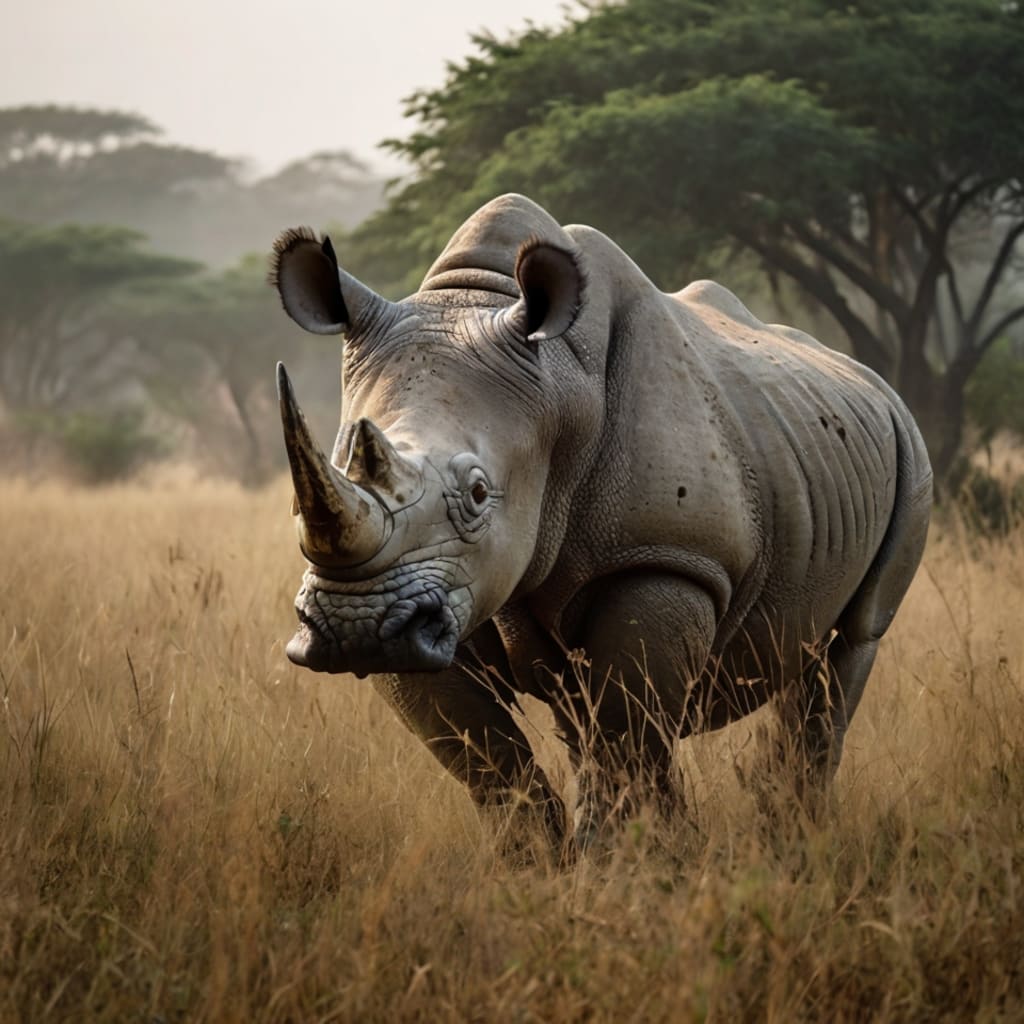
The World of Rhinos: Giants with Tiny Brains
BY: Khan
Rhinos are among the most iconic animals on our planet—massive, powerful, and ancient. Today, only five species of rhinos remain, and although they all share the same signature traits—a large body, a unique way of standing and walking, and one or two horns on their snouts—each species lives in a different part of the world and has its own story of survival.
One of the most surprising facts about rhinos is that despite their enormous size, their brains are unusually small. A fully grown rhino, towering over most other land animals and weighing several tons, carries a brain that weighs only about a pound and a half. For comparison, an elephant’s brain is nearly five times larger. This tiny brain is not necessarily a flaw—it is common among animals that evolved powerful, natural defenses. Rhinos rely on their strength, armor-like skin, and horns rather than intelligence to survive, just as heavily armored animals in nature often do.
The Five Surviving Rhino Species
The five remaining species of rhinos include the White Rhino, Black Rhino, Indian Rhino, Javan Rhino, and Sumatran Rhino. Each one faces the constant threat of habitat loss and poaching, yet each one continues to fight for its place in the wild.
The White Rhino is the largest of them all, and it has two subspecies: the Southern White Rhino and the Northern White Rhino. Their fates, however, could not be more different.
The Southern White Rhino lives in some of Africa’s most well-protected and wildlife-rich regions. Thanks to years of conservation efforts, nearly 20,000 individuals survive today in the wild. They represent one of the most successful recovery stories in wildlife conservation.
The Northern White Rhino, on the other hand, is a heartbreaking symbol of what happens when a species loses the battle against poaching and war. It once roamed the grasslands of Central Africa, but today it stands on the edge of extinction. Only a few individuals survive, all of them living not in the wild, but in sanctuaries and zoological reserves under round-the-clock protection. Their survival depends entirely on humans, and scientists continue to explore advanced reproductive technologies in a desperate attempt to bring the subspecies back from the brink.
One mystery still surrounds the White Rhino: Why is it called “white” when its skin is actually gray? No one knows for certain. Some believe the name comes from the Dutch word “wijd,” meaning “wide,” referring to the animal’s broad mouth. Over time, “wijd” may have been misunderstood as “white.” Others say it may come from the lighter shade of the rhino’s horn compared to other species. Whatever the origin, the name has stayed—and so has the confusion.
The Black Rhino: A Survivor Under Threat
Ironically, Black Rhinos are not black at all. Their color varies from brown to gray, depending on the soil of their habitat. Once plentiful across Southern and Central Africa, their numbers have dropped drastically. Today, they are only half as numerous as Southern White Rhinos.
Black Rhinos are smaller than their white cousins, rarely exceeding two tons in weight. They also differ in their diet. While White Rhinos graze on grasses, Black Rhinos are browsers, feeding mainly on shrubs, bushes, and tree branches. Their pointed, hook-shaped lips are perfectly designed for pulling leaves and twigs from thorny vegetation.
Black Rhinos once had several subspecies, but according to the International Union for Conservation of Nature (IUCN), only three subspecies remain, all critically endangered. Each one faces the same deadly threats: habitat destruction and relentless poaching for their horns.
The Power—and Danger—of a Charging Rhino
There are few moments in nature more terrifying than standing in the path of a frightened rhino. When threatened, a rhino can bolt forward at 30 miles per hour, turning its body into a living battering ram. With poor eyesight, a rhino may not clearly see what stands in its path—but it will run anyway, relying on instinct and momentum. For anyone unlucky enough to be in the way, the outcome can be devastating.
Despite their aggressive reputation, rhinos are not naturally violent. In fact, they are solitary creatures, preferring to live alone. The only strong and lasting bond in the life of a rhino is between a mother and her calf. A mother will protect her young fiercely, guiding it across dangerous terrain and teaching it how to avoid threats. This relationship may be the closest thing rhinos have to family or social life.
A World Worth Protecting
Rhinos have survived millions of years of evolution, changing landscapes, fierce predators, and natural disasters. Yet in just a few decades, human greed and carelessness have pushed them to the edge. Their size and strength were once enough to protect them—now they depend on us.
Their story is a reminder of how fragile life on Earth can be, even for creatures built like armored tanks. Saving rhinos is not just about saving a species; it is about preserving the wild beauty and balance of our planet. Each rhino that survives is a symbol of hope—and a promise that the world still has room for giants.


Comments
There are no comments for this story
Be the first to respond and start the conversation.