
The Formation and Evolution of Earth: From the Big Bang to Life Emergence
Exploring the Processes and Forces that Shaped Our Planet over Billions of Years

Introduction
The formation of the Earth is a complex process that occurred over billions of years. Understanding how our planet came into existence requires a deep understanding of the early universe and the processes that led to the formation of our solar system.
The Origin of the Universe
The universe began with the Big Bang, a massive explosion that occurred around 13.8 billion years ago. At the moment of the Big Bang, the universe was a hot and dense singularity, containing all of the matter and energy in the universe.
As the universe expanded, it cooled, allowing particles to come together and form atoms. These atoms eventually combined to form galaxies, including our own Milky Way.
The Formation of the Solar System
Our solar system began to form around 4.6 billion years ago, as a cloud of gas and dust began to collapse under its own gravity. This cloud was composed mostly of hydrogen and helium, the two lightest elements in the universe, as well as small amounts of heavier elements like carbon, nitrogen, and oxygen.
As the cloud shrank, it began to spin faster, forming a disk with a central star at its core. This disk, called the protoplanetary disk, was the birthplace of the planets in our solar system.
Accretion and Differentiation
Within the protoplanetary disk, clumps of matter began to form and merge, creating the building blocks of planets. These early bodies were small, rocky, and uninhabitable, but they were the foundation for what would eventually become our home.
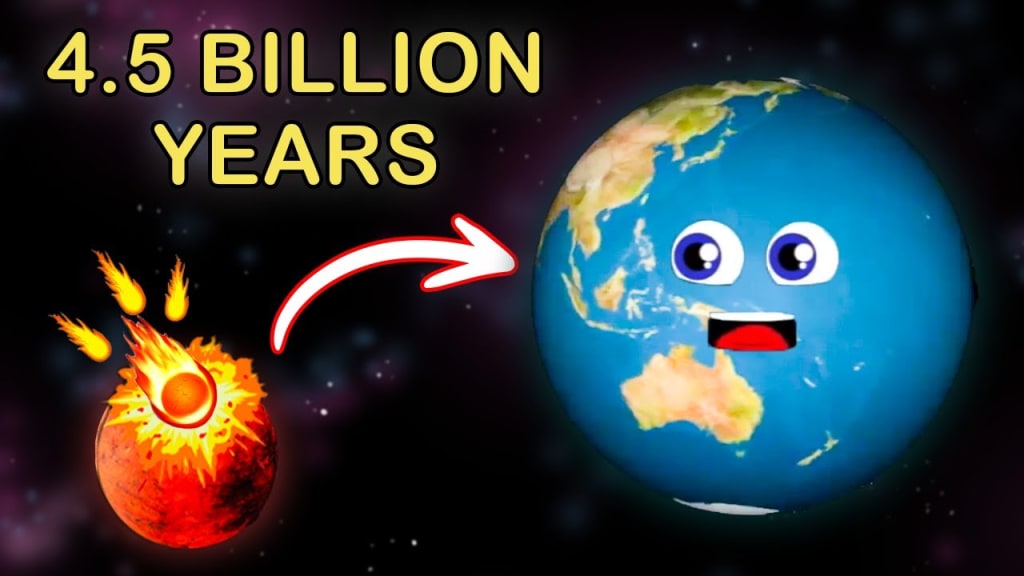
Over millions of years, these protoplanets collided and merged, growing in size and mass until they became the massive planets we know today. The formation of Earth occurred as a result of a process called accretion, where small particles gradually clumped together to form larger and larger objects.
As the early Earth grew in size, its interior became heated by the process of radioactive decay. This caused the planet to become partially molten, with a metallic core and a rocky outer shell. Over time, the Earth's solid crust began to form, providing a stable foundation for the planet's growing atmosphere and the emergence of life.
The Role of Volcanism and Plate Tectonics
Early in its history, the Earth was a hot and molten ball of rock, constantly bombarded by comets and asteroids. These collisions added to the planet's mass, but also contributed to its intense volcanic activity, releasing massive amounts of gas into the atmosphere.
Volcanism played a critical role in the formation of the Earth's crust, releasing huge amounts of magma onto the surface of the planet. As this magma cooled, it solidified into rock, creating the first continents and oceanic plates.
Over time, the Earth's crust became divided into a series of tectonic plates, constantly moving and colliding against each other. These movements led to the formation of mountains, valleys, and oceans, shaping the planet's surface and creating habitats for countless species.
The Emergence of Life
Life on Earth began around 3.5 billion years ago, as simple single-celled organisms emerged in the planet's oceans. These early life forms slowly evolved and diversified, eventually leading to the development of more complex organisms like plants and animals.
The emergence of life on Earth is a complex and still largely unknown process. However, scientists believe that the presence of liquid water, organic molecules, and a stable environment all played critical roles in the development of life on our planet.
Conclusion
The formation of the Earth was a complex and dynamic process that occurred over billions of years. From a cloud of gas and dust to a solid planet capable of supporting life, the Earth has been shaped by countless forces and processes. Today, it continues to evolve and change, reminding us of the incredible power and beauty of our planet and the universe as a whole. As we continue to study and learn about the formation of the Earth, we deepen our understanding of the origins of life and the universe, and we gain greater appreciation for the delicate balance that allows us to call this planet home.
About the Creator
Keerthana Thirumalairaj
An Independent Solitude girl, who recently found the interests in writings and converts Facts and imaginations into writings.
Keep reading
More stories from Keerthana Thirumalairaj and writers in Earth and other communities.
Understanding Plate Tectonics
Introduction: Plate tectonics is the scientific theory that explains the structure and movement of the Earth's lithosphere, which is composed of large, rigid plates that float on the underlying, more ductile mantle. It is a unifying concept that explains a variety of geological phenomena, including the distribution of volcanoes and earthquakes, the formation of mountain ranges and ocean basins, and the evolution of the Earth's climate and biota.
By Keerthana Thirumalairaj3 years ago in Earth
At Least 22 Dead as Crane Collapses Onto Train in Thailand
Thailand has been plunged into mourning after a devastating accident in which a construction crane collapsed onto a moving passenger train, killing at least 22 people and injuring dozens more. The incident, described by officials as one of the deadliest infrastructure-related accidents in recent years, has raised urgent questions about construction safety, urban development, and oversight in the country.
By Aarif Lashari5 days ago in Earth
My New Book is Finally Here
My poetry collection Beautiful and Brutal Things is done. It's actually done and finally published over 270 pages. Over a year of my life went into this book. More than a year, really. Long days at my computer, sometimes seven days a week because I couldn't stop even when I probably should have. Then two months of editing that felt harder than the writing itself. But it's finished, and I'm still standing, and the book is real.
By Tim Carmichaela day ago in BookClub



Comments
There are no comments for this story
Be the first to respond and start the conversation.