
The Evolution of Humans: From Primates to Modern Day
The Story of Humans

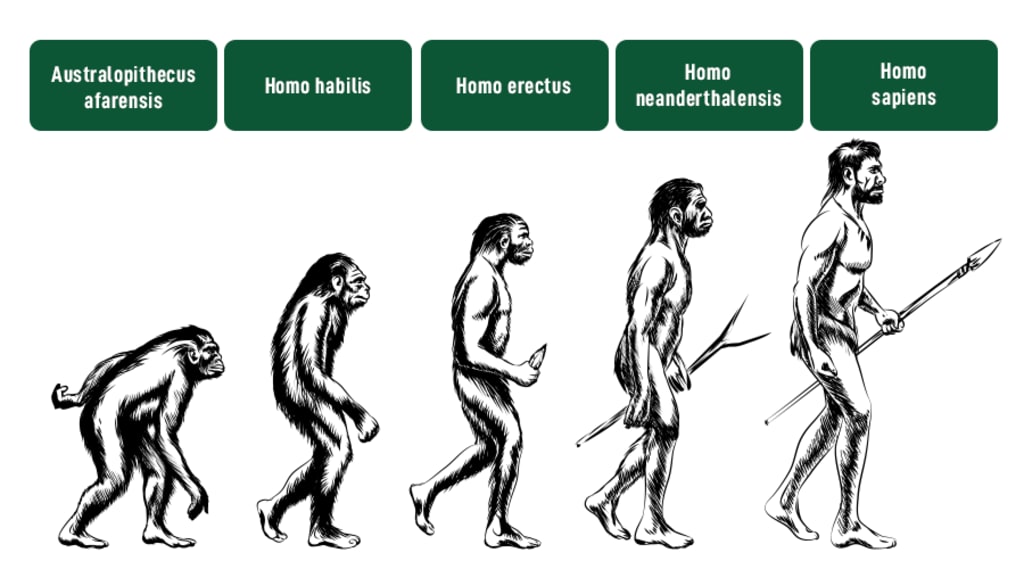
The Origins of Primates
As the Earth cooled and dried following the end of the last ice age, the first primates began to emerge. These early primates were small, agile creatures that lived in the trees, foraging for food and avoiding predators. They were adapted for life in the trees, with grasping hands and feet, keen senses, and a flexible spine that allowed them to move easily through the branches.
Over time, these early primates evolved into more specialized forms, adapting to different environments and developing new behaviours and characteristics. Some became herbivores, while others became carnivores. Some developed long, powerful arms and legs, while others developed shorter, more agile limbs. Some became arboreal, while others became terrestrial.
As the primates evolved, they began to diverge into different lineages, each adapting to its own unique environment and ecological niche. Some of these lineages gave rise to the great apes, while others gave rise to the monkeys and the prosimians.
The Emergence of Hominids
As the primates continued to evolve, one group of primates began to exhibit a suite of characteristics that set them apart from the others. These characteristics included an increased brain size, a more upright posture, and a greater reliance on tool use. This group of primates became known as the hominids, and they represented a major turning point in the evolution of humans.
The first hominids appeared around 6 million years ago, in what is now eastern Africa. They were small, bipedal creatures with long arms and short legs, and they walked with a distinctive gait that allowed them to balance their weight over their hind legs. They had a relatively small brain, but they were already exhibiting some of the cognitive abilities that would later become characteristic of humans, such as problem solving and tool use.
Over time, the hominids continued to evolve and adapt to their changing environment. They developed more complex social systems, and they began to use tools more regularly to hunt and gather food. They also began to migrate out of Africa, spreading across the globe and adapting to new environments and ecosystems.
The Evolution of Modern Humans
As the hominids continued to evolve, one group in particular began to stand out as the most successful and adaptive. This group was Homo sapiens, the modern humans.
Homo sapiens appeared on the scene around 300,000 years ago, and they quickly spread across the globe, adapting to a wide range of environments and ecosystems. They were characterized by their large brains, advanced cognitive abilities, and sophisticated tool use. They also had a more refined and efficient anatomy, with a more upright posture and longer legs that allowed them to walk and run more efficiently.
As Homo sapiens spread across the globe, they encountered other hominids, such as Homo neanderthalensis and Homo erectus. These hominids were already well adapted to their environments, and they had their own unique characteristics and behaviours. However, Homo sapiens were able to outcompete these other hominids, and eventually they became the dominant species on Earth.
The Rise of Civilization
As Homo sapiens continued to evolve and adapt, they began to develop more complex societies and cultures. They formed communities and began to engage in trade, agriculture, and other forms of social and economic organization. They also developed new technologies, such as writing, agriculture, and metallurgy, which allowed them to expand their reach and influence even further.
With the rise of civilization, humans began to transform the Earth in ways that no other species had before. They built cities and developed new forms of transportation, communication, and entertainment. They also began to engage in more complex forms of social and political organization, including governments, religions, and systems of law.
As humans continued to evolve and adapt, they also began to face new challenges and conflicts. They struggled with issues of inequality, conflict, and environmental degradation, as well as the impact of new technologies and social changes. However, despite these challenges, humans continued to thrive and adapt, building on the successes of the past and looking towards a bright future.
The Future of Human Evolution
As humans continue to evolve and adapt, it is difficult to predict exactly what the future will hold. However, humans will continue to face new challenges and opportunities as they adapt to a rapidly changing world.
One of the biggest challenges facing humans in the future is the impact of climate change and environmental degradation. As the Earth's climate continues to change and resources become scarcer, humans will need to find ways to adapt and mitigate the impacts of these changes. This will require the development of new technologies and systems of governance, as well as a greater understanding of the impacts of human activity on the natural world.
Despite these challenges, it is also clear that humans have an incredible capacity for resilience and adaptation. With the right strategies and technologies, humans can continue to thrive and evolve into the future, building on the successes of the past and creating a brighter, more sustainable world for all.
Conclusion
In conclusion, the evolution of humans has been a complex and fascinating journey, shaped by a wide range of factors including environmental change, natural selection, and the emergence of new technologies and behaviours. From the earliest primates to modern day Homo sapiens, humans have continually adapted and evolved, developing new skills and abilities that have allowed them to thrive in a wide range of environments.
As we move forward into the future, it is clear that humans will continue to face new challenges and opportunities as they adapt to a rapidly changing world. However, with their incredible capacity for resilience and innovation, it is likely that humans will continue to thrive and evolve in ways that we can only begin to imagine. Whether we are facing the impacts of climate change, the rise of new technologies, or the emergence of new social and political systems, one thing is certain: the evolution of humans will continue to be a fascinating and dynamic process, shaping the world we live in for generations to come.
About the Creator
Trump’s Proposed Ban on Buying Single-Family Homes Introduces Uncertainty for Family Offices
Former President Donald Trump has proposed a controversial measure that would ban certain investors from purchasing single-family homes, sparking concern among family offices, real estate professionals, and affluent households across the United States. While the proposal is still in its early stages, it highlights tensions between housing affordability, investment strategies, and government regulation. Family offices—private wealth management firms that handle investments for high-net-worth families—are particularly affected, as single-family homes often form a key part of their diversified portfolios. Understanding the Proposed Ban The proposed policy aims to limit institutional investors and large-scale buyers from purchasing single-family homes, a move intended to increase housing availability for individual homebuyers and first-time families. Proponents argue that investment firms and private equity groups have increasingly dominated the single-family housing market, driving up prices and limiting access for ordinary buyers. Trump’s proposal, however, extends concerns to family offices. Unlike institutional investors, family offices often operate with smaller scale and focus on preserving wealth while generating steady returns. By restricting their ability to purchase single-family homes, the policy could inadvertently impact legitimate private wealth management strategies. Family Offices and Real Estate Family offices typically manage wealth for ultra-high-net-worth families, investing in a mix of assets including stocks, bonds, private equity, and real estate. Single-family homes are attractive for several reasons: Diversification: Real estate offers a hedge against market volatility. Stable Cash Flow: Rental properties provide recurring income. Appreciation Potential: Over time, well-chosen properties can increase in value. Legacy Planning: Homes are often used for long-term wealth transfer within families. By restricting access to single-family homes, family offices may need to rethink asset allocation and seek alternative investment avenues, potentially increasing reliance on commercial real estate, REITs, or other asset classes. Implications for the Housing Market A ban on single-family home purchases by certain investors could have both positive and negative effects on the housing market: Potential Benefits: Limiting investor activity might improve affordability and access for first-time homebuyers. In areas where institutional buyers have been driving prices up, the policy could reduce competition and slow price growth. Potential Drawbacks: Reduced investor activity might decrease liquidity in the market. Family offices and private investors often maintain properties, ensuring maintenance and stable rental supply. Limiting their participation could inadvertently reduce housing quality or slow new housing development. Moreover, uncertainty surrounding the proposal may influence market behavior, as buyers, sellers, and investors wait to understand regulatory details. This could temporarily cool investment activity, affect home valuations, and complicate financing decisions. Legal and Regulatory Considerations Implementing a ban of this scale would require complex legislation and enforcement mechanisms. Regulators would need to define which entities are restricted, how to monitor compliance, and what penalties would apply for violations. Family offices often operate in a hybrid space, blending private investment strategies with professional management structures. Defining which offices fall under restrictions could be legally challenging and may lead to lengthy court battles if policy implementation is unclear or inconsistent. Additionally, the proposal raises questions about federal vs. state authority in regulating housing markets. Real estate has traditionally been a mix of local zoning laws, state property rights, and federal regulations. A sweeping ban could create conflicts and require careful coordination across multiple levels of government. Reactions from Stakeholders Family Offices Family offices are expressing concern about the potential disruption to investment strategies and wealth management practices. Many offices rely on predictable legal frameworks to make long-term decisions. A sudden restriction could force them to divest existing holdings or abandon planned acquisitions, potentially reducing returns for families who depend on these investments. Real Estate Professionals Real estate brokers, developers, and property managers are also watching closely. While some welcome policies that improve access for individual buyers, others warn that restricting investment could reduce overall market activity. “We need to balance affordability with investment incentives,” says Sarah Jenkins, a real estate analyst. “Family offices and private investors play an important role in maintaining the housing supply and keeping rental markets stable.” Homebuyers and Advocacy Groups First-time homebuyers and housing advocacy groups largely support efforts to reduce institutional competition for single-family homes. Limiting large-scale investors could make it easier for ordinary buyers to compete in popular markets. However, the impact on wealthy private investors, like family offices, remains a point of debate. Broader Economic Considerations The proposed ban highlights the tension between housing affordability and private wealth management. Single-family homes are not only a place to live—they are also investment assets. Policies that affect one group of buyers may have unintended consequences for another. For family offices, the shift could prompt a broader reevaluation of asset allocation strategies, leading to increased focus on commercial real estate, international property markets, or alternative investments like private equity and infrastructure. This could ripple through financial markets, affecting liquidity, valuations, and even lending practices. Conclusion Trump’s proposed ban on purchasing single-family homes introduces significant uncertainty for family offices and other private investors. While the policy aims to improve housing accessibility for first-time buyers, it also poses challenges for wealthy families relying on real estate as a key component of their investment strategy. Navigating this uncertainty requires careful analysis, proactive planning, and legal guidance. Family offices may need to diversify holdings, explore alternative asset classes, or reconsider long-term strategies to ensure stability in an evolving regulatory environment. Ultimately, the proposal underscores a broader debate in the U.S. housing market: how to balance affordability, private investment, and the preservation of wealth in a way that supports both communities and investors. The coming months will be critical in shaping the future of housing policy and its impact on family offices nationwide.
By Muhammad Hassanabout an hour ago in Earth
Nature’s Hidden Gems: Discovering the Rarest Flowers on Earth
Introduction: When Beauty Meets Rarity Nature is filled with wonders, but few are as captivating—and as elusive—as the rarest flowers on Earth. From enormous parasitic blooms to delicate orchids that appear only under precise conditions, these plants challenge our understanding of survival, evolution, and beauty.
By Ahmed aldeabellaa day ago in Earth
Silver Screen Magic with Mae West
American actress and singer Mae West became a popular film actress during the Great Depression. She started entertaining in vaudeville, then performed on Broadway, and finally went to Hollywood. She signed up with Paramount Pictures and made her debut in the 1932 film “Night After Night.” She also starred in musicals, comedies, and crime dramas. The American Film Institute named her one of the best classic Hollywood actresses.
By Rasma Raisters3 days ago in Geeks



Comments
There are no comments for this story
Be the first to respond and start the conversation.