
The Enigmatic Mount Kailash
A Tapestry of Myth and Mystery

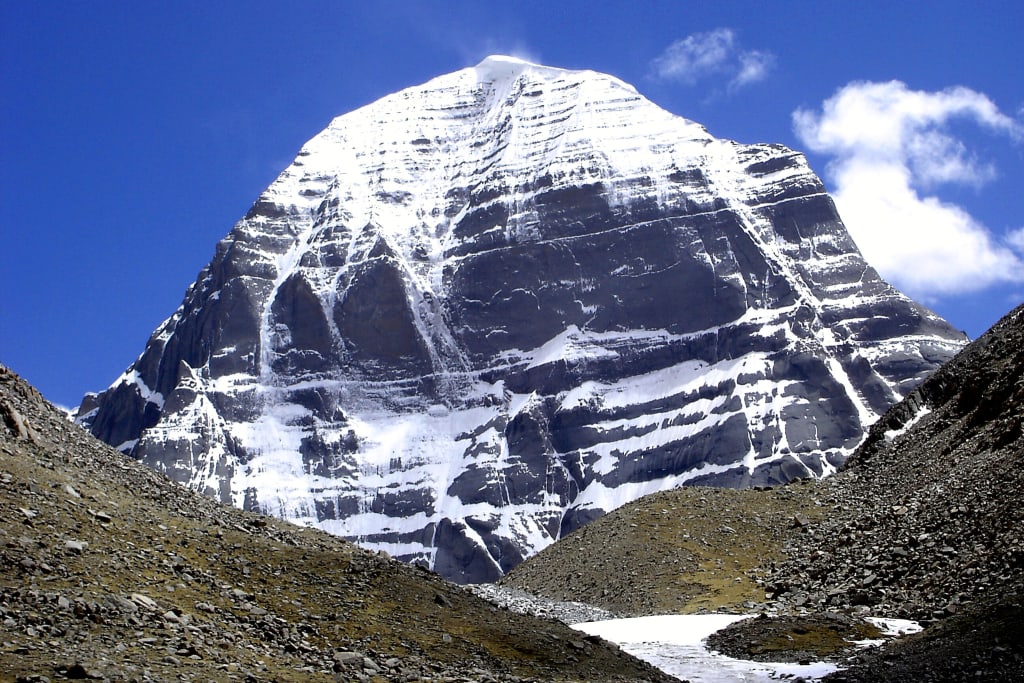
Tucked away in the breathtaking Himalayas, Mount Kailash is a massive mystery that has the attention of explorers, scientists, and spiritual seekers in equal measure. The religions of Buddhism, Jainism, Hinduism, and Bon have all venerated this spectacular summit for millennia as a sacred location, creating elaborate mythological narratives around its mysterious shape.
A Mountain of Divine Abode
According to Hindu mythology, Lord Shiva, the strong god connected to creation, destruction, and metamorphosis, resides atop Mount Kailash. It is thought that Shiva lives here in perpetual meditation, encircled by a halo of celestial light. Many people view the stark, pyramidal shape of the mountain as a representation of the deity's cosmic omnipotence. The significance of the mountain is further enhanced by the belief that the holy Manasarovar lake, which is situated close to Kailash, is the source of the four major rivers of Asia, namely the Indus, Ganges, Brahmaputra, and Yarlung Tsangpo.
Mount Kailash is referred to the Buddhists as Kang Rinpoche, or the "Precious Jewel of the Snow." It is regarded as the axis mundi, the universe's center, and the site of a deep spiritual awakening. The strenuous kora circumambulation is undertaken by pilgrims as a means of purification and enlightenment. It is thought that the voyage purges one's karma and bestows divine favors.
Jainism also has great regard for Mount Kailash, also known as Astapada. It is thought to be the location of the first Tirthankara, Lord Rishabhanatha's enlightenment. Walking around the mountain, according to Jains, results in spiritual freedom and a deeper encounter with the holy.
The Forbidden Peak
Mount Kailash is one of the few mountains on Earth that has never been conquered, despite its enormous spiritual significance. Its slopes have been attempted by many, but none have succeeded. Legends and beliefs from the area foretell terrible outcomes for anyone who dares to violate the mountain's hallowed status. While some climbers have claimed to have seen otherworldly phenomena, others have described feeling unexplainable forces keeping them from ascending.
The mountain's inaccessibility has led to conjecture regarding its provenance. According to certain theories, Mount Kailash is a man-made structure that may have been constructed by a highly developed ancient civilization rather than a natural formation. This theory has been supported by the mountain's pyramidal shape and the discovery of additional, smaller pyramids nearby. But there isn't any hard data from science to back up this assertion.
Scientific Anomalies
Scientists have also been fascinated by Mount Kailash's peculiar features, even outside the domains of mythology and conjecture. Anomalies in the area, including accelerated aging, peculiar air conditions, and abnormal gravitational forces, have been noted by certain researchers. Even though these statements are intriguing, more research and scientific confirmation are needed.
A Tapestry of Beliefs
The enigma surrounding Mount Kailash is evidence of the creative potential of people and their persistent search for spiritual fulfillment. The mountain never fails to enthrall and inspire, regardless of its perception as a heavenly dwelling, a hallowed destination, or an incomprehensible act of nature. It's possible that the mysteries surrounding Mount Kailash will eventually be revealed as technology develops and our comprehension of the universe grows. Until then, the mountain will continue to represent the unknown and a location where the lines separating myth from reality are blurred.
The Enigmatic Mount Kailash: A Deeper Dive
Though steeped in mythical and religious significance, scientists and adventurers have also taken an interest in Mount Kailash. Numerous hypotheses and expeditions have been inspired by the mountain's unusual shape, unique geographical location, and surrounding environment.
A highly intriguing scientific feature of Mount Kailash is its purported "pyramid shape." Though not an exact pyramid, the mountain's symmetrical shape has prompted significant conjecture over its formation. According to certain ideas, it might be a man-made construction from a highly developed, ancient society. Geological research, on the other hand, has mainly discounted this theory and instead attributes the mountain's structure to organic geological processes.
The region's unique atmospheric conditions are also of scientific significance. There have been rumors of quicker aging, strange weather patterns, and even abnormalities in how people perceive time. There is continuous investigation into the region's distinct geophysical features, such as its high altitude, closeness to the Tibetan Plateau, and the impact of jet streams, even though some of these assertions are anecdotal.
The Pilgrimage of Kora
The kora pilgrimage is important to the spiritual importance of Mount Kailash. In the faiths of Buddhism, Hinduism, Jainism, and Bon, walking around the mountain is regarded as a sacred ritual. This is a difficult journey that devotees from all over the world take on, frequently braving severe weather and high heights.
Trekking the mountain and the sacred Manasarovar Lake usually takes 52 kilometers, which is the length of the kora route. Completing the kora, according to pilgrims, results in spiritual purification, blessings from the gods, and a stronger bond with the divine. Many times, the journey is accompanied by devotional acts, mantras, and prayers.
The spiritual journey of the kora is just as important as the physical demands. During the journey, pilgrims frequently speak of feeling at ease, having a spiritual awakening, and experiencing tranquility. The seclusion of the high-altitude setting and the emphasis on spiritual activities produce a potent environment for self-examination and growth.
Cultural and Religious Significance
As was previously said, Mount Kailash is extremely significant to Buddhism, Bon, Jainism, and Hinduism. Every religion has specific legends, customs, and beliefs related to the mountain.
Hinduism: As the abode of Lord Shiva, Mount Kailash is considered the holiest site in the Hindu world. The mountain's association with creation, preservation, and destruction is deeply ingrained in Hindu cosmology.
Buddhism: In Tibetan Buddhism, Kailash is known as Kang Rinpoche and is considered the axis mundi. Pilgrims from Tibet, Nepal, and other Buddhist countries undertake the kora with great devotion.
Jainism: For Jains, Mount Kailash is revered as Astapada, the place where Lord Rishabhanatha attained enlightenment. The mountain is a significant pilgrimage site for Jains, and the kora is seen as a path to spiritual liberation.
Bon: The indigenous religion of Tibet, Bon, also considers Mount Kailash sacred. Bon practitioners believe that the mountain is the center of the universe and a place of great spiritual power.
These various religions' common respect for Mount Kailash is evidence of both its enduring allure and the significant influence it has had on human spirituality.
About the Creator
Richard Weber
So many strange things pop into my head. This is where I share a lot of this information. Call it a curse or a blessing. I call it an escape from reality. Come and take a peek into my brain.
Keep reading
More stories from Richard Weber and writers in Earth and other communities.
The Mystery of the Oakville Blobs
An Unusual Rainfall A strange event that occurred on August 7, 1994 in the little Washingtonian hamlet of Oakville has perplexed locals and scientists for decades. Rather than the typical downpour, the sky released translucent, gelatinous lumps that resembled rice grains. Over the course of three weeks, this odd event affected an area that was around twenty square miles, and it happened more than once.
By Richard Weber2 years ago in Earth



Comments (1)
Oooo, this was so fascinating! I've hever heard of Bon before. Thank you so much for sharing!