
The End of Everything: Exploring the Possible Fates of the Universe
From Galactic Collisions to the Big Crunch and the Expansion of the Universe, What Could Bring About the End of Everything?
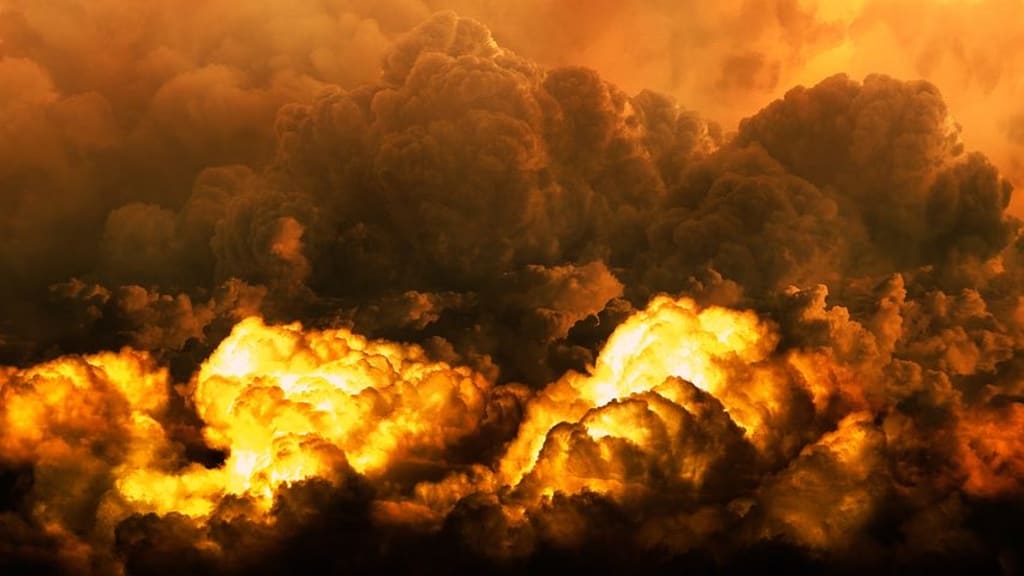
The end of the world, as we know it, is a topic that has fascinated humans for centuries. In recent years, astrophysicists have been studying the end of everything, and their findings are both fascinating and terrifying. Our sun is predicted to swell into a red giant, boiling away the oceans and scorching the planet. Scientists are certain that this will happen, but not for another four to five billion years. However, the question remains, could everything in the universe end, and the answer is yes, it probably will.
The universe is a vast and complex system, and its fate is determined by a variety of factors. One of the most significant is the Big Crunch, which occurs when the universe stops expanding and starts contracting. This contraction causes the space between galaxies to shrink, and as a result, collisions between galaxies become more frequent. Stars and planets are flung out of orbit, and black holes ignite and merge, becoming even more massive. Matter is sucked into these giant black holes and superheated by friction, emitting jets of radiation that scorch anything in their path.
During these galactic crashes, some new stars will be born, and even new planets, some of which might have the chance to develop life, if they're not in the path of a sterilizing X-ray beam. But eventually, all of these will be destroyed by fire. As the universe collapses, all of the energy that's ever been emitted by every star or drawn into any black hole will be squished into a smaller space and squeezed into higher energy wavelengths. This concentrated radiation will become so intense that the temperature of space will rise until nuclear explosions rip stars and planets apart, leaving space full of hot plasma.
At this point, the universe resembles the early moments after the Big Bang. The temperatures and densities are so high that we don't have a way to describe them except as really, really hot. But what if the Big Crunch never happens? Today, we think the universe isn't likely to snap back on itself, which is not such good news either. In the early days of the universe, things were close together, and so gravitational attraction slowed the outward push of the expansion from the Big Bang. Expansion was slowing down, just like a falling ball, for a while. But in 1998, scientists discovered that about five billion years ago, the expansion of the universe started speeding up, and it's still speeding up. It's like throwing a ball up in the air, and it keeps going faster.
The universe is expanding, and it's doing so at an accelerating rate. This acceleration is caused by a mysterious force called dark energy, which we don't fully understand. We can't see dark energy, but we can measure its effects. Scientists believe that dark energy is responsible for 68% of the total energy density of the universe. Dark matter, another mysterious substance, makes up 27%, and normal matter, the stuff we can see, only makes up 5%.
So what happens when the universe keeps expanding? The answer is that eventually, the expansion will cause galaxies to drift so far apart that they'll be beyond each other's gravitational reach. Stars will burn out, and no new ones will form. Black holes will evaporate, and the universe will be dark and empty. This is known as the Heat Death, and it's a fate that's far less dramatic than the Big Crunch, but no less terrifying.
In conclusion, the end of the universe is a fascinating and terrifying subject. Astrophysicists have been studying it for years, and their findings suggest that the universe will eventually end. Whether it's through the Big Crunch or the Heat Death, the universe will eventually cease to exist. But don't worry, it won't happen for another four to five
About the Creator
Yeghia Coxon
Welcome to my corner of Vocal media! I am a passionate story creator who loves nothing more than sharing my thoughts, experiences, and insights.
Thank you for taking the time to visit my profile, let's create something amazing together!
Keep reading
More stories from Yeghia Coxon and writers in Earth and other communities.
Bank Failures and the Government Response: Understanding the Recent Wave of Bank Runs in the US
The previous month, two of the largest bank failures in history occurred. However, before discussing the reasons behind the collapses, it is worth asking why Jim Cramer is so good at being bad at his without government intervention. This is why there was a push for the government to step in and offer some form of bailout.
By Yeghia Coxon3 years ago in Trader
Severe Geomagnetic Storm Could Bring Northern Lights Across Much of the U.S.
On Monday evening, skywatchers from the Pacific Northwest to the Midwest got ready for something out of the ordinary: a celestial display that typically occurs at high northern latitudes. Americans who provide forecasts as a powerful cloud of charged particles from the sun accelerates toward the Earth's magnetic field, the National Oceanic and Atmospheric Administration (NOAA) has issued a "G4 (Severe) geomagnetic storm watch."
By Raviha Imrana day ago in Earth
Greenland News
Greenland News Greenland has increasingly drawn global attention in recent years due to its political developments, environmental changes, and growing strategic importance. As the world looks more closely at the Arctic region, news from Greenland reflects a unique mix of local priorities and international interest. From climate-related challenges to economic opportunities and governance issues, Greenland continues to shape its own path while remaining closely connected to global affairs.
By America today 3 days ago in Earth



Comments
There are no comments for this story
Be the first to respond and start the conversation.