
The Distance Between Earth and the Moon
Understanding the vast space that separates our planet from its natural satellite


For many thousands of years, people have looked up at the sky and seen a bright, glowing ball shining at night. This glowing ball is the Moon, Earth's closest neighbor in space. Even though it looks close, the Moon is actually very far away. The distance between Earth and the Moon is about 384,400 kilometers, which is equal to 238,855 miles. This number is so large that it is hard to imagine how far that really is.
People long ago did not know much about the Moon. They believed many stories and myths about it. Some thought the Moon was a spirit or a god. Others thought it was a shining light that could change its shape. But over time, as people learned more about science and space, they began to understand what the Moon really is.
The Earth is a beautiful planet full of life. It has water in its oceans, air to breathe, plants growing on its land, and animals living everywhere. The Moon is very different. It does not have water, air, or life. The surface of the Moon is dry and covered with dust and rocks. There are many craters on the Moon, which are deep holes made by space rocks hitting its surface.
One of the most important things about the Moon is that it affects life on Earth. The Moon’s gravity pulls on the Earth’s water, which causes the tides. The ocean’s water rises and falls every day because of the Moon’s pull. This movement of water is important for many creatures living in the ocean. Also, the Moon helps keep the Earth’s axis, or tilt, stable. This tilt gives us the different seasons like winter, spring, summer, and fall.
The idea of traveling to the Moon has always been exciting. People dreamed about it for many years. In the 20th century, with new technology, humans were finally able to make the journey. In 1969, astronauts from the United States became the first people to walk on the Moon. This was a huge achievement for all mankind. The spacecraft called Apollo 11 carried the astronauts on their journey.
Traveling from Earth to the Moon is not easy. Even though the Moon seems close when we look up at night, it takes about three days for a spaceship to get there. The astronauts travel very fast, but space is very big and empty. There is no air or sound in space, and the temperatures can be very hot or very cold.
The Moon has no air or water, so it is a difficult place for humans to live. The sunlight on the Moon is very strong during the day, and the nights are very cold. Scientists and engineers are working hard to find ways to help people live on the Moon in the future. They want to build bases where astronauts can live and work for longer periods.
The Moon is also a place where many important scientific studies happen. By learning about the Moon’s rocks and surface, scientists learn more about the history of our solar system. The Moon holds many secrets about the past that can help us understand how planets were formed.
Even today, people continue to explore the Moon. New missions and robots visit the Moon to collect samples and take pictures. These missions help prepare for future trips that may include living on the Moon or even using it as a base to travel further into space.
The distance between Earth and the Moon is a symbol of the vastness of space. It reminds us how big the universe is and how small we are in it. But it also shows us how close we can get to other worlds with the help of science and technology.
Looking at the Moon can bring feelings of wonder and curiosity. It inspires people to learn, to dream, and to explore. The Moon has been a friend to Earth for billions of years, and it will continue to shine in the night sky for many years to come.
About the Creator
Bilal Mohammadi
welcome to Bilal Mohammadi articles please follow my page
Keep reading
More stories from Bilal Mohammadi and writers in Earth and other communities.
The Night Without the Moon
It was a peaceful evening in the small town of Elmsville. The sun had just set behind the hills, and the sky was slowly turning dark. People in the town were finishing their day. Children played their last games outside. Mothers called their kids to come inside. Shops closed their doors. The world was getting ready to sleep.
By Bilal Mohammadi9 months ago in Earth
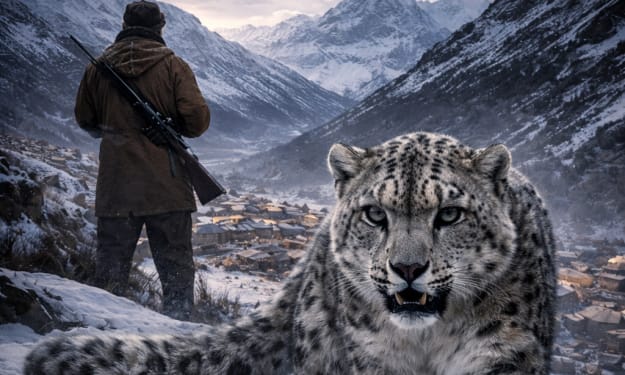
Human Revenge: A Hidden Cause Behind the Decline of Snow Leopards
High in the rugged mountains of Central and South Asia lives one of the world’s most mysterious and beautiful big cats—the snow leopard. Known for its thick grey-white fur, long tail, and incredible ability to blend into rocky landscapes, this elusive predator has fascinated scientists and wildlife lovers for decades. Yet despite its beauty and ecological importance, the snow leopard faces a growing threat: human revenge.
By Irshad Abbasi a day ago in Earth



Comments
There are no comments for this story
Be the first to respond and start the conversation.