
The Day the Crying Elephant Broke My Heart
Bandra's story - Chained and alone

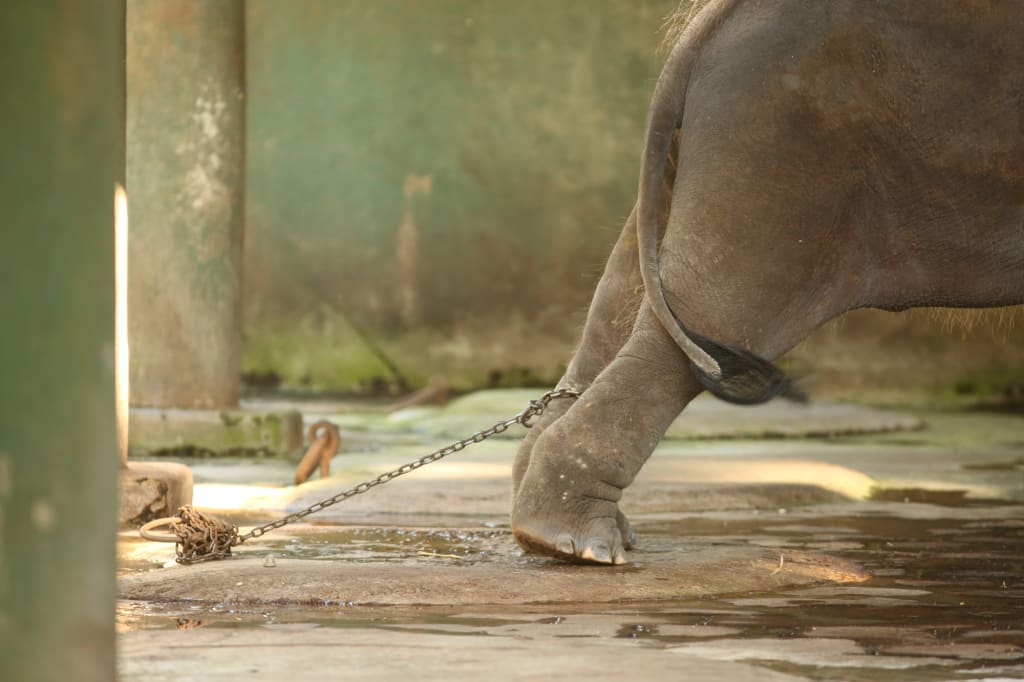
Bandra’s Story
“There is no creature among all the Beasts of the world which hath so great and ample demonstration of the power and wisdom of Almighty God as the Elephant.” — Edward Topsell.
What an excellent statement about these gentle giants.
Elephants are the world’s largest living land animals. Adult African males can weigh up to 6,800 kilograms (15,000 pounds). The only living animals bigger than elephants are whales.
Elephants can also live as long as humans, with Asian elephants living into their 80s.
Bandra’s Sad Tale Begins
I was on a work assignment auditing a company in Brunei. As is often the case in these audits, there is a strong social element. Asian people like to make you feel welcome.
My host for the day was very proud of her country. She took me to visit sites, including a deserted theme park. Well, one of the wealthy Brunei royal family owned it, so it was not really deserted.
On days when he fancied, he would open the park. He'd pay vendors to run the rides and shows to entertain his friends.
We were walking through the park to get to lunch. Then, we saw an enclosure with one tree and a lonely-looking elephant.
I swear she was crying!
She told me her name was Bandra. I asked her why she was chained to the tree by herself.
Her reply sickened me.
She said she was a ‘pet’ of one of the royal children but had tried to get out of her enclosure, so they had chained her to the tree.
All she had was the tree and a tub of water.
Big Feet, Big Hearts
Elephants can hear through their feet, detecting vibrations in the earth. They use mechanoreceptors in their feet and toes to decipher secret underground messages. The receptors are very sensitive to vibrations.
They produce a range of vocalizations, from trumpets and barks to many types of rumbles. These rumbles are low-frequency sounds that vary greatly. They can travel through the ground and last from half a second to 12 seconds.
Researchers have found that elephants can address others with specific vocalizations or names. Certain key sounds (rumbles, trumpets, and other high noises) trigger a response in only one or several other elephants, depending on the tone.
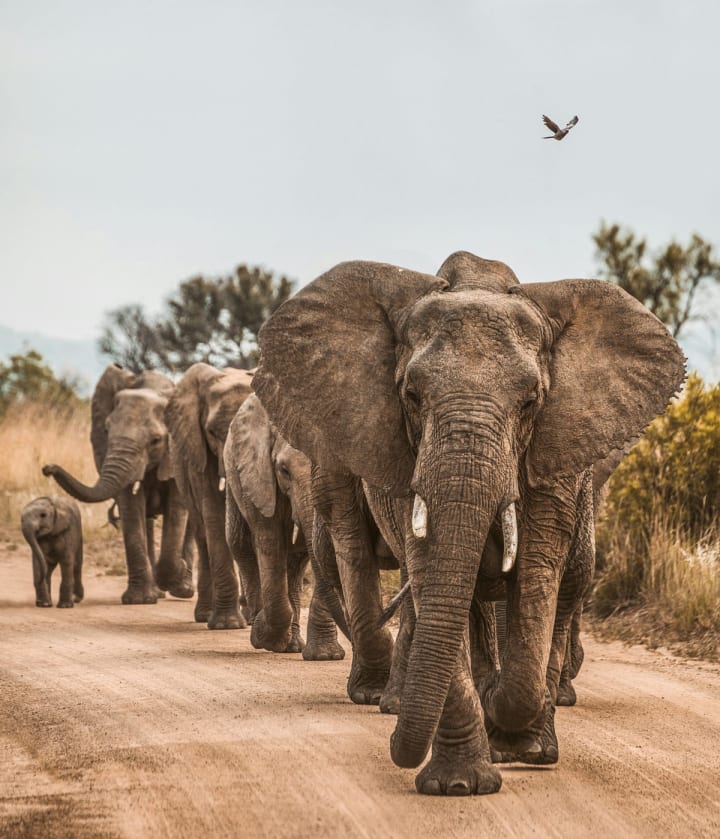
Elephants’ social dynamics are very structured. The oldest female, the 'matriarch,' leads the herds. They consist of mothers, their young, sisters, aunts, and grandmothers. They sometimes change herds during the day. They rejoin their original family at night.
Males usually hang out with other blokes in separate ‘bachelor groups.’
Among the most sensitive wildlife, they show compassion and self-awareness. They grieve and respond to other elephants' pain and sadness.
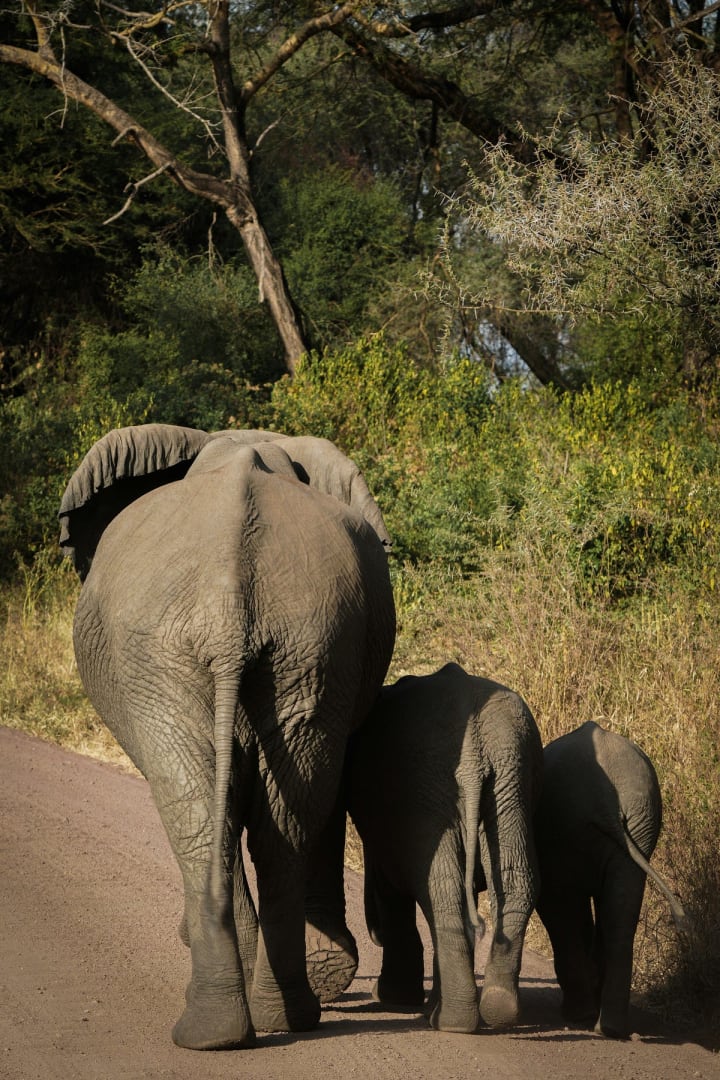
For instance, when a herd member injures itself, the rest will walk more slowly to ensure they can keep up. Elephants have been seen lifting injured, sick members with their trunks and tusks. They also make distress calls.
Most importantly, going back to Bandra, they need company. Much of an elephant’s brain stimulation in the wild comes from other elephants. Constantly moving — listening, sniffing, playing — captive, solitary elephants do not. They stand still.
Bandra was as depressed as an elephant could be. She stood there, robbed of social interaction and stimulation.
Compassion is their middle name.
Elephants are also among the most empathetic animals alive. Non-birth mothers will protect elephant calves from danger. They will chase away predators and stop aggressive play-fighting.
Known to grieve and mourn their dead, elephants often visit carcasses repeatedly. They spend varying amounts of time with the bodies. Their behavior goes beyond curiosity. They stand with inactive trunks, almost reverently, like humans at a funeral.
Upon finding a dead elephant, they stop and watch. They often smell and touch the bones with their trunks.
If an elephant calf loses its mother before it is two, it will likely not survive. People have seen six-month-old calves nuzzling their mother's corpse. They wander around confused, then return to the carcass. Tragically, they die within a few months.
They feel compassion for their kind and for other distressed species.
They help one another in adversity and miss absent loved ones. When you know them well, you can see they even smile when having fun and are happy.
Burials are rare in the animal kingdom. Both African and Asian elephants cover their dead with foliage. In 2022 and 2023, different herds were seen dragging their dead babies to irrigation ditches in northern Bengal, India, and burying them there.
Researchers found the calves' legs sticking up from the ground. Soil covered their heads, trunks, and backs.
Back to Bandra
We estimated that Bandra was still a young elephant, 5–10 years at most. She was clearly undernourished and lacked social contact. She needed some contact with other elephants and even humans, to complete her life.
Instead, they punished her for trying to ‘find a life.’
I wanted to jump the fence and chew off her chain. It was one of the most depressing sites I have seen.
We do so much harm.
I am sure there are many more places like Bandra worldwide.
Mankind continues to abuse these beautiful animals. We chain them up and subject them to unnatural acts in circuses and keep them as solitary animals in zoos.
If that is not enough, poachers persecute them for the illegal ivory trade. Poachers kill over 25,000 elephants each year. They are now among the most endangered animals on Earth.
Every day, poachers kill 100 elephants illegally in Africa. This is to feed an insatiable demand for ivory, mainly from Asia. The kill rate exceeds the birth rate. If this trend continues, it will lead to extinction.
Will we ever learn to respect the wonderful creatures of this world (and I don’t include humans in that pot)?
Till next time,
Calvin
About the Creator
Calvin London
I write fiction, non-fiction and poetry about all things weird and wonderful, past and present. Life is full of different things to spark your imagination. All you have to do is embrace it - join me on my journey.
Keep reading
More stories from Calvin London and writers in Earth and other communities.
Cyclone Bears Down on Koalas
As Queensland, Australia, begins cleaning up from cyclone Alfred, consider the animals affected. We measure damage from natural disasters by looking at human life loss and property damage. Consider the animals left without homes after these events. They have nowhere to go and no safe place to live.
By Calvin London10 months ago in Earth
The Reality of the Illusion of Time
Recently, as I strolled along the short stretch to my strength training session, I aimlessly took in the row of tatty shops and shabby buildings along the route and passed an off-street, in which one of my sisters used to live, around thirteen years ago.
By Chantal Christie Weiss2 days ago in Earth
Why Putin Went Quiet When Challenged by Trump Over Venezuela
When U.S. forces captured Venezuelan President Nicolás Maduro in early January 2026, the world was stunned. Venezuela has long been a Russian ally, yet Russian President Vladimir Putin remained almost completely silent when challenged directly by U.S. President Donald Trump. Why would a leader so often outspoken on the world stage hold back in such a dramatic moment? Let’s unpack the story and explore what it means for global politics. A Bold Move That Shocked the World On January 3, U.S. forces executed a daring operation in Venezuela, taking Maduro into custody in New York to face charges including drug trafficking and narco‑terrorism. The operation was framed by the U.S. as a step to enforce justice, but critics saw it as an extraordinary overreach of power. Venezuela is no ordinary country for Russia. Since the days of Hugo Chávez, Moscow has cultivated close ties with Caracas, offering military support, energy deals, and diplomatic backing on the global stage. Past actions included Russian bombers visiting Venezuela and high-profile defense agreements. Given this history, many expected a fiery response from Putin. Yet, the Kremlin remained calm, issuing measured statements rather than sharp threats. Why Silence Was Strategic Experts suggest there are several reasons for Putin’s muted reaction, each revealing the careful calculation behind the Kremlin’s foreign policy. 1. Focus on the War in Ukraine Russia’s primary priority remains Ukraine. Engaged in a high-stakes military and diplomatic battle, Putin cannot afford distractions or new confrontations far from home. Escalating tensions with the United States over Venezuela could jeopardize Moscow’s position in Europe. A New York Times report highlighted that Russia is “subordinating all other interests to the war in Ukraine,” suggesting that even a high-profile ally like Venezuela takes a back seat to Moscow’s strategic goals. 2. Limited Military Options While Russia’s alliance with Venezuela is longstanding, much of the support has been symbolic rather than operational. Defense systems and military cooperation exist on paper, but Russia lacks the immediate ability to counter a U.S. operation thousands of miles away. Putin may have recognized that responding aggressively would be both ineffective and costly, potentially risking military and economic consequences that Moscow cannot afford. 3. Maintaining Diplomatic Channels with Washington With Donald Trump back in the White House since 2025, there has been cautious optimism in Moscow about recalibrating U.S.–Russia relations. Avoiding a dramatic confrontation over Venezuela keeps diplomatic channels open, allowing Russia to negotiate on other high-priority issues like Ukraine and sanctions relief. In other words, silence can be a calculated strategy, signaling restraint rather than weakness. 4. Russia’s Global Influence Is Waning The Maduro episode also highlights a broader geopolitical reality: Russia’s global reach has limits. Since the 2022 invasion of Ukraine, Moscow’s influence in regions like the Middle East and parts of the former Soviet Union has weakened. Venezuela remains one of its few high-profile allies outside Europe, but even there, Russia’s power is largely symbolic. By not escalating, Putin is acknowledging a practical truth: Russia cannot be everywhere at once, and some battles are not worth fighting. 5. Choosing Battles Wisely Some analysts emphasize that Putin’s quiet response is more about strategic prioritization than capitulation. In a world dominated by nuclear powers and volatile global politics, direct confrontation with the United States over Venezuela could spiral into a far larger crisis. By staying silent, the Kremlin may be signaling that it picks its battles carefully, focusing resources on Ukraine, where the stakes are highest. What This Means for the World Putin’s silence sends several messages: Russia is currently stretched, economically and militarily. Moscow is prioritizing Ukraine over symbolic allies. Strategic restraint is sometimes more powerful than public confrontation. The limits of Russian influence are becoming more visible to the world. This episode reflects a new reality in geopolitics: power is as much about choosing when not to act as when to assert force. The Bigger Picture The capture of Maduro is a defining moment not just for Venezuela, but for global politics. It shows the United States asserting power in a way not seen for decades, while Russia’s quiet reaction underscores its current limits and priorities. For observers, Putin’s silence is a lesson in modern geopolitics: even the most assertive leaders exercise restraint when stakes are high and risks are global. In the end, the Maduro affair reminds us that in today’s world, the loudest response is not always the most effective one — sometimes, quiet calculation speaks volumes. Sources and Further Reading The US capture of Maduro reveals Russia’s weakness – Atlantic Council ‘It sends a horrible signal’: US politicians react to capture of Nicolás Maduro – The Guardian Russia slams 'neocolonial threats' against Venezuela – Reuters
By Muhammad Hassan5 days ago in Earth
Getting Serious About Comedy (Part I)
If I were asked to remark on my life and the childhood that paved some road leading me to this point, I would have to say something about all the funny people who surrounded me for the last 26,872 days (and counting). Somewhere along that road, I became a big fan of laughter and the comedy that spawns it – and, I mean not only my own laughter, but the laughter of others, some of which I have actually been responsible for inducing.
By John Oliver Smith7 days ago in Humor



Comments
There are no comments for this story
Be the first to respond and start the conversation.