
The Creature That Laughs at Pain: Unveiling the Naked Mole-Rat’s Bizarre Superpower
In the darkest tunnels beneath East Africa, a hairless, wrinkled rodent defies the rules of pain—literally.

In a world teeming with sensory responses, pain is often the body's way of saying something's wrong. For most creatures, a stubbed toe, a pinched finger, or even a whiff of spicy food would trigger some level of discomfort. But hidden beneath the dry, cracked soil of East Africa lies a creature that doesn’t flinch, doesn’t whimper, and quite literally doesn’t care. Meet the naked mole-rat—the wrinkled, pink, almost alien-looking rodent that rewrites everything we thought we knew about pain.
At first glance, the naked mole-rat is hardly impressive. It’s small, almost blind, with skin that looks like it’s several sizes too big. It lives underground, in colonies that resemble insect hives more than mammalian communities. But don’t let its humble appearance fool you—this tiny digger has secrets that would make a superhero jealous.
A Life Underground
The naked mole-rat (Heterocephalus glaber) is no ordinary rodent. Living in colonies of up to 300 individuals, they spend their entire lives underground, tunneling through the earth with their large protruding teeth. These colonies are ruled by a single breeding queen—yes, just like ants and bees—and the rest of the mole-rats fall into castes: workers, soldiers, and caretakers.
In the darkness of their subterranean world, oxygen is scarce, temperatures can be extreme, and escape routes are tight. Evolution, it seems, had to get creative.
And in doing so, it did something rather extraordinary—it turned off the pain.
The Pain That Was Never There
Scientists have long been fascinated by the naked mole-rat’s apparent indifference to pain. In particular, these animals show a remarkable resistance to types of pain that would be unbearable to other mammals. One example? Acid.
If you or any ordinary rodent were exposed to acid or capsaicin—the compound that gives chili peppers their heat—you’d feel a burning sensation. Nerve endings would scream, and your body would react with inflammation and discomfort. But the naked mole-rat? Nothing. Not a twitch. Not a flinch. Just a blank stare and maybe a shuffle to the other side of the tunnel.
This isn't numbness or tolerance. It's a total biological absence of specific pain pathways.
The Genetic Switch
What causes this odd superpower? Researchers discovered that naked mole-rats lack a key neurotransmitter called Substance P in their skin. This molecule is crucial in transmitting pain signals related to acid and capsaicin to the brain.
Without it, those particular pain signals simply don’t get delivered. It’s as if the mailman was fired before the letter could arrive. The message of pain—“danger, something’s wrong!”—never reaches the brain.
But why would a creature evolve to feel less pain?
Evolution’s Strange Gift
Living underground in cramped, low-oxygen environments comes with challenges. High levels of carbon dioxide accumulate quickly in tunnels with little air circulation. This CO₂ can mix with moisture to form carbonic acid, which would normally irritate the eyes, nose, and skin of most mammals.
But not for the naked mole-rat.
By turning off the receptors that respond to this type of irritation, the naked mole-rat adapted to its harsh environment in a way no other mammal has. Pain, in this context, wasn’t helpful—it was simply a distraction.
This evolutionary trait didn’t just help them survive—it made them stronger in their own weird way.
Not All Pain is Gone
It’s important to note that naked mole-rats do feel certain types of pain. They respond to mechanical injury, burns, and extreme cold. If you poke one with a needle, it will react. But they’ve evolved a very selective pain tolerance—one that filters out what’s unnecessary in their environment while keeping the essential warnings intact.
This unique filtering system is what makes them such fascinating subjects in scientific research.
More Than Just Pain-Free
The naked mole-rat isn’t just a master of pain control. It’s also one of the longest-living rodents in the world—some living more than 30 years—and they show remarkable resistance to cancer. They almost never develop tumors. Their cells have mechanisms that stop mutated cells from growing uncontrollably, which continues to baffle scientists.
And if that’s not enough, they can survive without oxygen for up to 18 minutes by slowing their metabolism and switching to a form of energy production more like a plant than a mammal.
It’s as if nature crafted them to be little biological anomalies—small creatures that defy the rules of mammalian biology.
Nature’s Quiet Rebel
In a world where pain is constant and sometimes overwhelming, the naked mole-rat waddles along in silence. It digs, eats, defends its colony, and raises its young—unbothered by the burn of acid, unaffected by the sting of spice. It doesn’t seek attention, yet it holds the answers to questions science is still asking.
Could its biology help us develop new painkillers? Maybe. Could its cancer resistance lead to new treatments? Possibly. But more importantly, it reminds us of one profound truth:
- Nature is full of surprises. And sometimes, the most powerful creatures are the ones that don’t roar—but dig quietly, feel less, and live longer than anyone expects.
If you ever wondered what it means to live life without fear of pain, just look underground. There, in the silence of the soil, the naked mole-rat lives proof that sometimes, feeling nothing can mean surviving everything.
About the Creator
Tiny Lion Cubs Struggle To Keep Up With Mom
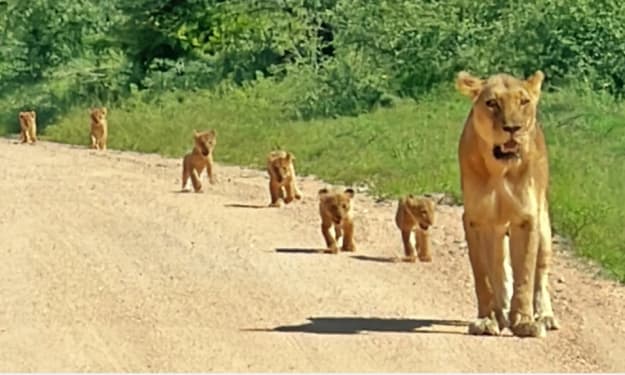
In the heart of the African savannah, life is a constant lesson for young animals. Few scenes are as endearing — or as heartwarming — as tiny lion cubs trying to keep pace with their mother. These little bundles of fur face a world full of challenges, from learning to hunt to avoiding dangers, all while depending on the guidance and protection of their experienced mom. Watching cubs wobble and tumble as they attempt to keep up with their mother reminds us that growing up, even in the wild, is a journey full of struggle, determination, and adorable missteps. The Early Days of Lion Cubs Lion cubs are born blind and helpless, usually in litters of two to six. For the first few weeks, they rely entirely on their mother for warmth, food, and safety. Even after opening their eyes and beginning to explore, the cubs are far from independent. The first months are crucial. Cubs learn social cues, hunting basics, and survival skills simply by watching their mother and the pride. But as anyone who has observed them knows, there’s often a huge gap between observation and action. Tiny cubs often struggle to match their mother’s pace, especially when she moves through long stretches of savannah or leads the family on patrols. A Mother’s Role in the Wild For a lioness, raising cubs is a full-time commitment. She hunts, defends her territory, and teaches her young, all while staying alert to predators such as hyenas, leopards, and even rival lions. The cubs, meanwhile, attempt to mimic her every move — often with clumsy yet charming results. A mother lion’s patience is remarkable; she frequently slows down, nudges them along, or stops to ensure no cub is left behind. These moments, while stressful for the tiny cubs, are vital learning opportunities. Struggling to Keep Up: Why It’s So Hard There are several reasons why tiny lion cubs have trouble keeping pace with their mother: Short Legs, Big Steps: Lion cubs’ legs are tiny and their coordination is limited, making it difficult to cover the same distance as an adult lioness. Curiosity: Cubs are naturally curious. A single butterfly or rustling bush can distract them, leaving mom to pause repeatedly. Energy Levels: Young lions tire quickly. Even with frequent naps, the cubs’ stamina is far lower than their mother’s. Learning Through Play: Play is not just fun; it teaches hunting, balance, and social skills. Running off to pounce on a sibling or chase an insect is all part of their education. Despite these challenges, the cubs’ determination to keep up demonstrates their resilience and growing understanding of the wild world. Lessons in Teamwork and Survival Every cub struggling to keep up is also learning crucial survival skills. The journey across the savannah is more than a test of speed — it’s a lesson in: Coordination: Cubs learn how to move efficiently across different terrains. Patience: They begin to understand the rhythms of adult life and the pace required for survival. Social Skills: Staying with the group teaches cubs how to interact with siblings and the pride, which is essential for their future roles. Observation: By following their mother, cubs study hunting techniques, territorial behavior, and predator awareness. Even the moments when cubs stumble or lag behind are essential for their development. These experiences prepare them for independence, which comes sooner than many might expect. The Cutest Moments in the Wild Anyone who has watched tiny lion cubs knows that their struggles are often irresistibly cute. Video clips from wildlife reserves frequently show cubs toddling along, tumbling over each other, or getting distracted mid-step. Observers often comment that these little stumbles reveal personality, determination, and playfulness, making them one of nature’s most heartwarming spectacles. While their mother is serious and focused, the cubs inject a sense of humor and lightness into life on the savannah. Why This Matters The struggles of lion cubs aren’t just adorable — they’re vital for understanding wildlife behavior. Conservationists and animal behaviorists use these moments to study growth patterns, social structures, and survival strategies in lion populations. These observations also highlight the importance of preserving natural habitats. Cubs must learn in a safe environment to survive; habitat loss, poaching, and climate change make these early struggles even more dangerous. Protecting the African savannah ensures that future generations of lions can experience the same lessons and playful tumbles. The Road to Independence Within a year, these tiny cubs will be more agile, faster, and more confident. By the time they reach two to three years old, males may begin to leave the pride, while females often stay and become caretakers themselves. Every misstep, tumble, and lagging moment is part of the journey toward strength, coordination, and independence. Watching them now gives us a glimpse of the challenges they will overcome, and the survival skills they will carry for life. A Celebration of Motherhood Ultimately, these scenes remind us of the incredible bond between mother and cubs. Her patience, vigilance, and teaching are the foundations of their future. The cubs’ struggles highlight the trials of growing up, while their determination showcases the resilience and beauty of wildlife. For those observing, it’s a powerful lesson in care, guidance, and perseverance, not just in lions but in the natural world as a whole. Final Thoughts Watching tiny lion cubs try to keep up with their mother is both entertaining and enlightening. It’s a story of growth, struggle, and resilience — a reminder that even the fiercest creatures start small, learning step by step. These little lions capture hearts while teaching life lessons: patience, determination, teamwork, and the importance of guidance. As they tumble and waddle across the savannah, they show us that growth is a process, one adorable misstep at a time. For wildlife enthusiasts, animal lovers, and anyone enchanted by nature, these tiny cubs are proof that even in the wild, love, care, and persistence are universal truths.
By Aarif Lashariabout an hour ago in Earth
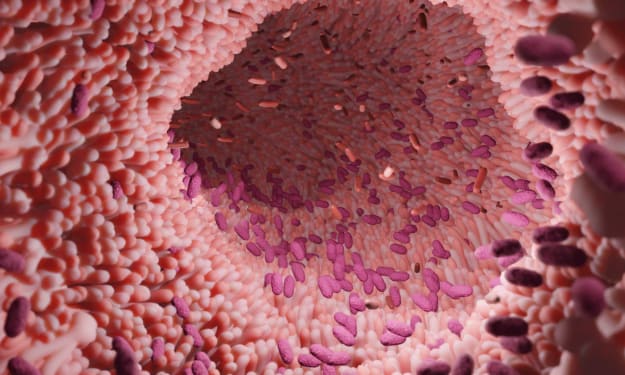
Microbiota, microbiome or microflora: how to speak correctly and why it is for health.
You've probably heard the phrase, "We are what we eat." But modern science says more precisely: we are also those who live in us. Until 2016, it was believed that there are many times more bacteria in our body than our own cells. The latest calculations by mathematicians show that we divide the body with our microorganisms by about 50/50: about 30 trillion of our cells versus 38 trillion bacterial ones.
By Yaroslav Gorohov4 days ago in Earth


Comments
There are no comments for this story
Be the first to respond and start the conversation.