
The Cosmic Journey: Exploring the Vastness of Our Universe
From Earth to the Edge of the Observable Universe

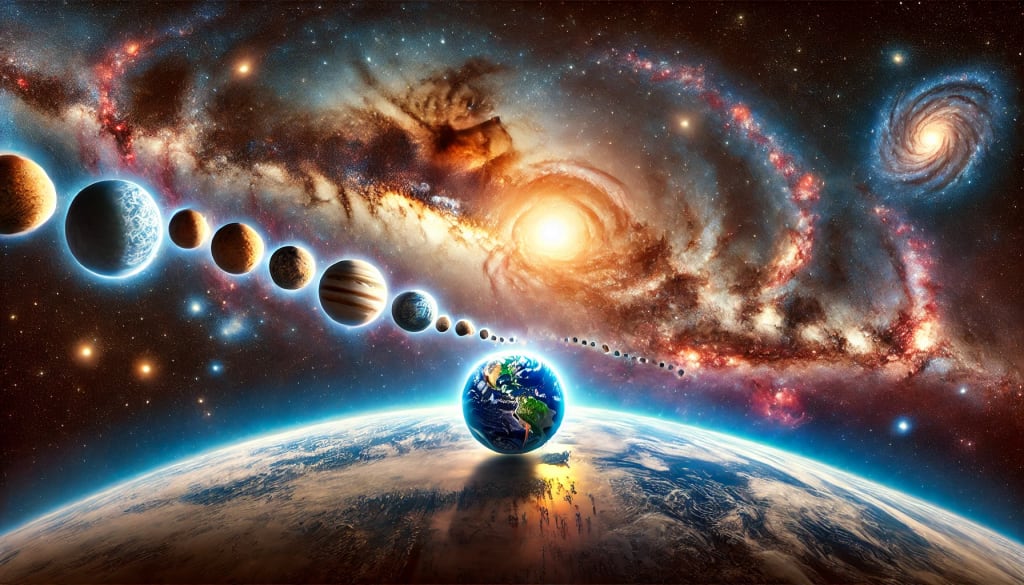
Earth, our home, is a small blue world floating in the vastness of space. It is where every human who ever lived took their first steps, where every story ever told unfolded. But as we move beyond our atmosphere and venture outward, we begin an extraordinary journey—one that reveals the immense scale of the cosmos.
The First Steps Beyond Earth
Our first milestone in space is the Moon, Earth's only natural satellite. It lies about 384,000 kilometers away, a distance so great that driving at a steady 100 km per hour would take over 160 days to reach it. From the Moon, Earth appears as a delicate sphere, a fragile oasis of life against the darkness of space.
Moving farther, we reach the Sun, our source of warmth and energy. It sits approximately 150 million kilometers from Earth—one astronomical unit (AU). Light from the Sun, traveling at 300,000 kilometers per second, takes about 8 minutes and 20 seconds to reach us. If a commercial jet were to make the journey, it would take 19 years to arrive at the Sun. This immense distance highlights the vastness of space, even within our own solar system.
The Journey to Mars and the Outer Planets
Next, we set our sights on Mars, the Red Planet, which at its closest is about 54.6 million kilometers from Earth. However, when Earth and Mars are on opposite sides of the Sun, this distance stretches to over 400 million kilometers. Traveling to Mars in a commercial jet would take upwards of 50 years, making human exploration a significant challenge.
Beyond Mars lie the gas giants—Jupiter and Saturn—followed by the ice giants, Uranus and Neptune. Neptune, the farthest known planet in our solar system, is about 4.5 billion kilometers from Earth. Sunlight takes over four hours to reach Neptune, emphasizing the sheer scale of our solar neighborhood.
Voyager 1: Humanity's Farthest Explorer
In 1977, NASA launched Voyager 1, a spacecraft designed to explore the outer planets. Over four decades later, Voyager 1 has traveled more than 22 billion kilometers, making it the most distant human-made object. In 1990, at the suggestion of astronomer Carl Sagan, Voyager 1 turned its camera back toward Earth and captured the now-iconic "Pale Blue Dot" image. From a distance of 6 billion kilometers, Earth appeared as a tiny, faint speck—reminding us of our smallness in the grand cosmos.
Beyond Voyager 1 lies the Oort Cloud, a vast theoretical sphere of icy objects that marks the boundary of our solar system. This region extends up to 100,000 AU, nearly two light-years away. Here, the Sun's influence fades, and interstellar space begins.
The Nearest Stars and the Milky Way Galaxy
Moving beyond our solar system, we reach Alpha Centauri, the closest star system to our Sun. It lies 4.4 light-years away, or about 41.3 trillion kilometers. Even at Voyager 1’s speed of 17 km per second, it would take over 70,000 years to reach this neighboring star system—highlighting the immense distances between stars.
Zooming out further, we encounter the Milky Way, our home galaxy, a vast spiral structure spanning about 100,000 light-years. Within it, hundreds of billions of stars, each potentially hosting planets, form a complex celestial tapestry. Surrounding Earth is a 100-light-year-wide sphere known as the human radio bubble—the farthest distance our radio and television signals have traveled. Beyond this, it is as if humanity never existed, as our signals have yet to reach most of the galaxy.
Beyond the Milky Way: The Universe on a Grand Scale
Leaving the Milky Way, we enter intergalactic space, where galaxies drift like islands in a cosmic ocean. Our galaxy belongs to the Local Group, a cluster of more than 50 galaxies spanning about 10 million light-years. The Local Group is just a small part of the Virgo Supercluster, a massive collection of thousands of galaxies spread across 110 million light-years.
Yet, even the Virgo Supercluster is just a piece of something larger—the Laniakea Supercluster, a vast structure encompassing hundreds of thousands of galaxies and stretching over 500 million light-years. At its heart lies the Great Attractor, a mysterious region exerting a massive gravitational pull on surrounding galaxies.
The Observable Universe: A Limitless Horizon
At the ultimate edge of our journey lies the observable universe, spanning 93 billion light-years. Despite the universe being only 13.8 billion years old, cosmic expansion has stretched space to this incredible scale. Beyond this observable boundary, galaxies are moving away faster than the speed of light, forever beyond our reach. The true size of the universe remains unknown—possibly infinite.
As we stand on Earth, gazing at the night sky, we are reminded of our place in this vast and mysterious cosmos. Our journey through space has shown us the staggering scale of the universe, from our small blue planet to the boundless depths beyond. Yet, amidst this grandeur, Earth remains our only home—a tiny, precious world in the immense expanse of space.
About the Creator
Lisa Ann Bastiaan
Fueled by curiosity and a passion for truth, I delve into mysteries, science, and human psychology. Through storytelling, I uncover the unknown, spark discovery, and ignite meaningful conversations about the fascinating.
Keep reading
More stories from Lisa Ann Bastiaan and writers in Earth and other communities.
Sharks: Ancient Predators of the Deep
Sharks have long been a source of both fascination and fear. With their sleek, hydrodynamic bodies and razor-sharp teeth, these ancient creatures have ruled the oceans for millions of years. They glide through the water with a grace that belies their powerful nature, evoking a sense of awe and mystery. Some are feared as apex predators, while others, like the enormous yet gentle whale shark, remind us of the vast diversity within the shark family.
By Lisa Ann Bastiaan12 months ago in Earth
Philippines Paper Bags Market: Packaging Shifts, Environmental Policy & Changing Consumption Patterns
Philippines Paper Bags Market Overview The Philippines paper bags market is undergoing a structural shift as environmental regulation, packaging reform and consumer awareness increasingly influence material choices across industries. According to IMARC Group, The Philippines paper bags market size was valued at USD 28.59 Million in 2025 and is projected to reach USD 46.95 Million by 2034, growing at a compound annual growth rate of 5.66% from 2026-2034. This expansion reflects gradual but consistent changes in packaging practices rather than a single disruptive trend.
By Manisha Dixit3 days ago in Earth
How, Too
Many people wonder how, too. You are not alone, and I am an expert. I will teach you how, too! First, you need to remit a small application fee and fill out an application describing the nature of your financial situation and how often payments will be made, as this will have great bearing on how well I teach you how, too.
By Harper Lewis7 days ago in Fiction




Comments
There are no comments for this story
Be the first to respond and start the conversation.