
“The Cobra: Nature’s Silent King of Venom”
Uncover the truth, myths, and mysteries behind one of the world’s most feared yet fascinating snakes.

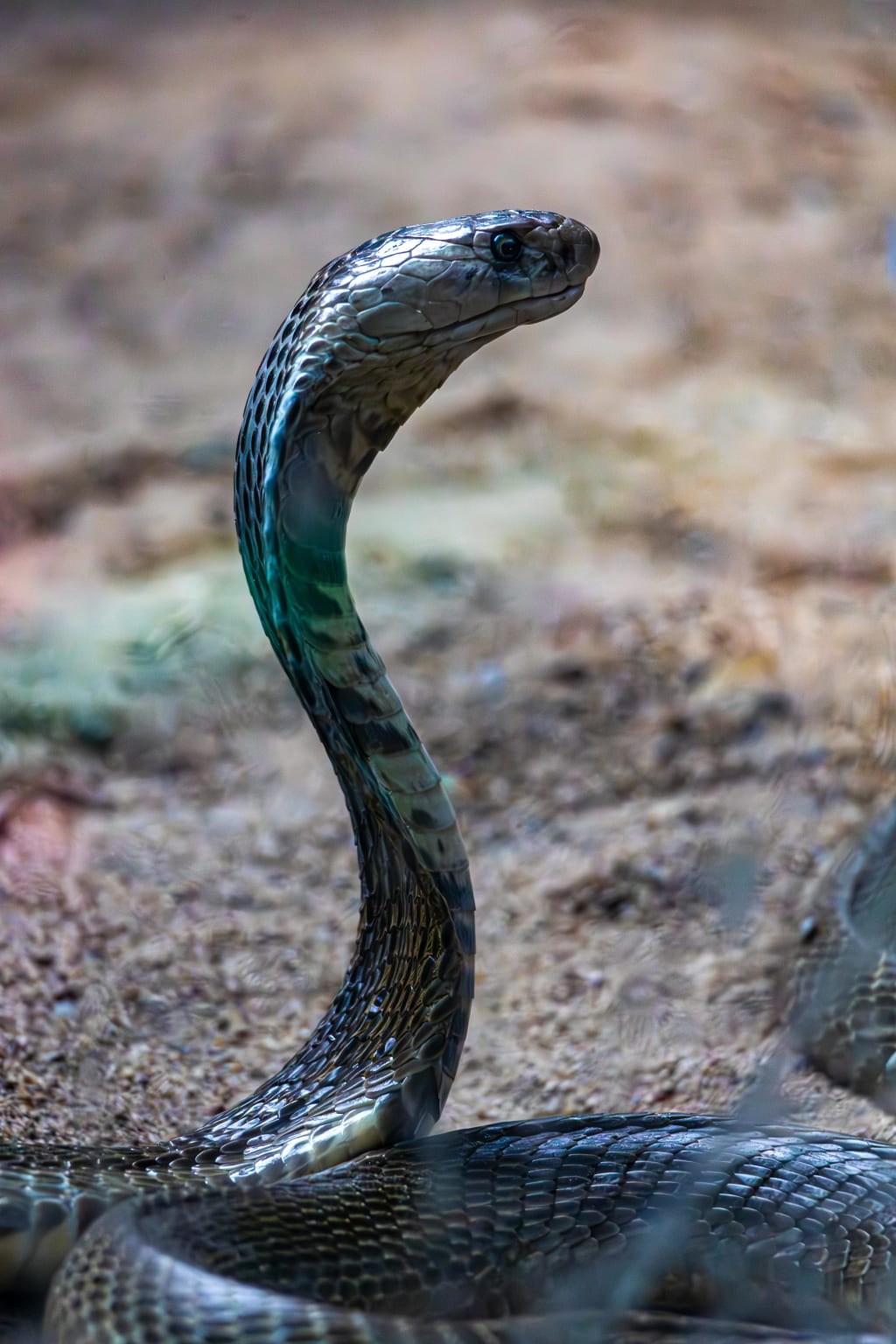
Cobra snakes are among the most fascinating and feared reptiles on Earth. Found mostly in Asia and Africa, cobras are well-known for their unique hood, venomous bite, and legendary presence in culture, religion, and myths. But behind the fear lies a creature full of mystery, intelligence, and survival skills.
There are more than 20 species of cobras, with the most popular being the Indian cobra, king cobra, and Egyptian cobra. Each species has different behaviors and features, but they all belong to the family Elapidae — a group of highly venomous snakes.
One of the most iconic features of a cobra is its hood — the flared extension of skin around its neck. When the cobra feels threatened, it lifts the front of its body and expands its hood to appear larger and more dangerous. This is a defense mechanism used to scare away predators like mongoose, birds of prey, or humans. The hood is made possible by elongated ribs behind the cobra’s head that spread out the skin like a fan.
Cobras are venomous, not constrictors. They inject their venom through their fangs when they bite. The venom is a neurotoxin — it attacks the nervous system, leading to paralysis, respiratory failure, and death in severe cases. However, most cobras will avoid biting unless provoked or cornered. They would rather warn, hiss, and display their hood before attacking.
The King Cobra (Ophiophagus hannah) is the longest venomous snake in the world, growing up to 18 feet (5.5 meters) in length. Despite its size and power, it is shy and prefers to escape rather than fight. Unlike other snakes, the king cobra also shows some intelligence and memory — it can recognize intruders in its territory and actively defends its eggs, which is rare among snakes.
Cobras are carnivores, feeding on small animals like rodents, frogs, lizards, birds, and even other snakes. The king cobra, in fact, mostly eats other snakes, including venomous ones. After catching their prey, they bite it and wait until the venom paralyzes it, then swallow it whole.
One amazing fact is how cobras sense the world around them. Since snakes are deaf to airborne sounds, cobras don’t “hear” in the normal sense. Instead, they pick up vibrations through the ground and sense movement through their sensitive skin. Their forked tongue collects scent particles from the air and delivers them to a special organ called the Jacobson’s organ, which helps them “smell” the world.
Cobras have long been part of human culture and mythology. In India, the cobra is sacred and associated with Lord Shiva. In ancient Egypt, cobras were symbols of power and protection — even worn on the crowns of pharaohs. The Egyptian cobra is believed to be the snake that Cleopatra used to take her own life.
In many rural parts of Asia and Africa, cobras are both feared and respected. Snake charmers often use Indian cobras in street performances, although this is controversial and often harmful to the snake. It's important to note: the cobra doesn’t dance to music — it follows the movement of the charmer’s flute, mistaking it for a threat.
Though feared, cobras play a vital role in the ecosystem. They control rodent populations, reducing the spread of disease and protecting crops. Sadly, many cobra species are now under threat due to habitat loss, road killings, and illegal wildlife trade. Some cobras are killed for their skin, while others are hunted for use in traditional medicines.
Conservation groups are now working to protect cobra habitats, raise awareness, and discourage illegal capture. Snakes are a key part of the natural balance, and losing them would affect many other species, including humans.
To conclude, the cobra is not just a creature of fear but of elegance, importance, and intelligence. With their powerful venom, graceful movement, and cultural mystery, cobras remind us that nature is both beautiful and dangerous — and that respect is more powerful than fear.
About the Creator
Keep reading
More stories from Shahab Khan and writers in Earth and other communities.
The Camel: The Miracle of the Desert
🌍 Introduction The camel is one of the most unique and useful animals in the world. It is often called: ✔️ “The Ship of the Desert” because it can walk long distances across hot deserts without getting tired. Camels have helped humans for thousands of years for traveling, carrying goods, farming, and even as a source of food and milk. In Islam, the camel is also mentioned with respect — as a sign of Allah’s creation and power. 🧬 Types of Camels There are two main types of camels: 1️⃣ Dromedary Camel (Arabian Camel) ✔️ Has one hump ✔️ Lives mostly in the Middle East, Africa, and South Asia ✔️ Makes up 90% of the world’s camel population 2️⃣ Bactrian Camel ✔️ Has two humps ✔️ Lives in Central Asia (China, Mongolia, Kazakhstan) ✔️ Can survive in extremely cold deserts too 🏜️ Why Do Camels Have Humps? Many people think humps are filled with water, but that’s not true. 🟡 The hump stores fat — like a food bank. When the camel does not find food, its body uses this stored fat for energy. ✔️ Because of this, camels can survive many days without eating much. When the fat is used up, the hump becomes smaller and softer, and when the camel eats again, the hump returns to normal shape. 💧 How Do Camels Survive Without Water? Camels are water-saving champions. They can: ✔️ Drink up to 100 liters of water in one day when thirsty ✔️ Survive 7–10 days without water (sometimes more) Their bodies are designed specially: 🔹 Their blood cells are oval-shaped — so they can stretch and hold more water 🔹 They sweat very little — saving water 🔹 They can drink very fast without getting sick 🌡️ Adapting to Desert Heat The desert can reach 50°C (122°F) — yet camels remain calm. Here’s how: 🐪 Thick fur on top protects from sunlight 🐪 Thin fur below keeps heat away 🐪 Long legs keep body away from hot sand 🐪 Wide feet stop them from sinking into sand 🐪 Nose closes during sandstorms 🐪 Long eyelashes protect eyes from sand Allah نے انہیں ایسے خاص طریقے سے بنایا ہے کہ وہ ریت، گرمی اور تیز ہوا سب برداشت کر سکیں۔ 🍃 What Do Camels Eat? Camels are herbivores. They eat: ✔️ Dry grass ✔️ Leaves ✔️ Thorny bushes ✔️ Desert plants Their mouths are very tough — so even thorny plants don’t hurt them. They chew food slowly and can digest rough plants easily. 👨👩👧 Relation With Humans For thousands of years, camels have helped people in: ✔️ Traveling ✔️ Carrying goods ✔️ Farming ✔️ Transporting water ✔️ Providing milk ✔️ Providing meat ✔️ Providing leather & wool In many countries like Saudi Arabia, UAE, Pakistan, India, Somalia, Sudan, Egypt, and Mongolia, camels are still very important. 🍼 Camel Milk Camel milk is considered very healthy: ✔️ Rich in vitamins ✔️ Easier to digest than cow’s milk ✔️ Good for immunity ✔️ Naturally low in fat In some cultures, it is used as traditional medicine. 🕊️ Camels in Islam The camel is mentioned in the Qur’an as a sign of Allah’s creation: Allah asks humans to reflect: “Do they not look at the camel — how it was created?” This teaches us that every creation has wisdom and purpose. Also, during Hajj & historical travel, camels were used for transport. 🧠 Intelligence & Behavior Camels are: ✔️ Intelligent ✔️ Calm ✔️ Loyal ✔️ Good at remembering routes They live in groups and listen to their leader. They make different sounds to express hunger, anger, or calling their babies. 🐾 Baby Camels A baby camel is called a calf. ✔️ It can stand and walk within a few hours after birth ✔️ Drinks only mother’s milk for months ✔️ Stays close to the herd 👣 Lifespan Camels usually live 40–50 years. 🌎 Where Do They Live? Camels mostly live in: ✔️ Middle East ✔️ North Africa ✔️ Central Asia ✔️ South Asia ✔️ Australia (wild camels too) ⚖️ Size & Strength A camel can weigh 400–650 kg (880–1400 lbs) and can carry 200–300 kg for long distances. That’s why they are called Desert Trucks. ❤️ Why People Respect Camels People admire camels because they teach us: 🌟 Patience 🌟 Strength 🌟 Simplicity 🌟 Endurance 🌟 Gratitude They are peaceful creatures that help humans without harm. 🏁 Conclusion The camel is not just an animal — it is a miracle of design and wisdom. It shows how perfectly Allah has created every creature for its environment. From deserts to cold lands, from history to modern life, camels continue to serve humanity with loyalty and strength.
By Shahab Khan3 months ago in Earth
How Bad Is AI for the Environment, Really?
Artificial intelligence is rapidly becoming part of everyday life. From chatbots and image generators to recommendation algorithms and automated customer service, AI systems are now embedded in countless digital tools.
By Navigating the Worlda day ago in Earth


Comments
There are no comments for this story
Be the first to respond and start the conversation.