Shahab Khan
Bio
Stories (55)
Filter by community
“The Words That Could Save a Life: A Story About Advice, Ego, and the Hearts We Forget”. AI-Generated.
There is an old saying: “A wise person learns from advice. A proud person learns from regret.” This is a story about both. There once was a boy who grew up hearing advice from everyone around him. His parents, teachers, elders, and friends — all of them tried to guide him. They warned him about choosing the wrong friends. They reminded him to respect time. They told him not to let anger, ego, and selfishness poison his heart. But like many of us, he believed he already knew everything. Whenever someone advised him, he smiled politely on the outside — but inside he thought: “I’m different. I’ll be fine. Nothing bad will happen to me.” So he ignored the small warnings of life. He cut off people over small arguments. He shouted instead of listening. He lied to escape responsibility. He chose friends who laughed at rules and mocked wisdom. He stopped spending time with family because he thought they didn’t “understand” him. He thought freedom meant doing whatever he wanted — without consequences. But life is patient. And life always teaches — one way or another. Slowly, he began losing the people who once stood closest to him. His best friend moved away after a fight that was never healed. His parents stopped advising him — not because they didn’t care, but because their hearts were tired. His teachers gave up correcting him because he rejected every word. From the outside, his life looked normal. But inside, something was missing — peace. One night, he finally sat alone in silence… and silence can be loud. Thoughts began replaying in his mind like a film. He remembered every moment someone tried to guide him. Every warning. Every soft reminder. Every gentle voice that said, “This path will hurt you.” And for the first time, he asked himself: “Why didn’t I listen?” It wasn’t lack of knowledge. It wasn’t lack of love. It was ego. Ego had whispered inside him: “You don’t need advice. You’re always right. You’re smarter than them.” But ego is a beautiful liar. It makes you feel strong while quietly destroying your relationships, your discipline, and your peace. That night, he realized something powerful: Wisdom doesn’t come from age. Wisdom comes from humility — the ability to listen. The next day, he did something difficult — something most people never do. He apologized. He apologized to his parents, not because they demanded it, but because his heart finally understood their worry. He apologized to friends he had hurt. He apologized to himself — for not valuing his own future. And slowly… life softened again. His parents’ voices became warm again. His friendships began to heal. His mind felt lighter. He started listening before reacting. He didn’t change overnight — but he had finally begun the journey. He changed not because the world forced him — but because advice finally reached his heart. That day, he promised himself: 🕊️ “Whenever someone gives me sincere advice, I will not fight it. I will think about it. I will learn from it.” Because the truth is simple: The people who advise you are not trying to control you. They are trying to protect the version of you that you have not yet become. And one more truth: Advice always arrives before regret. Regret arrives when advice is ignored. Moral / Life Lesson • Advice is not a restriction — it is protection. • Ego is the biggest enemy of growth. • Listening is not weakness — it is wisdom. • The people who correct you are the people who care. One day, you will look back and realize: The words you once ignored… were the very words that could have saved you. So when life sends you guidance — through parents, teachers, faith, friends, or even strangers — don’t shut your heart. Because the doors of wisdom only open… for those willing to listen.
By Shahab Khan2 months ago in Motivation
4 January 2025 vs 4 January 2026 — How Much The World Changed In Just One Year. AI-Generated.
There is something powerful about looking back at a single date and realizing how much has changed in just one year. Today is 4 February 2026. One year ago, it was 4 February 2025—the same date, the same calendar page, the same world spinning under the same sky. And yet, everything feels different. In 2025, many of us were already stressed, tired, and busy. But somehow, 2026 feels heavier. People talk less but worry more. We are more connected online, but more disconnected in real life. Our screens are full — but our hearts often feel empty. Time kept moving — and so did life Between these two dates, millions of stories quietly happened. Some people lost loved ones. Some started new jobs. Some broke relationships. Some found faith again. Some lost themselves trying to survive. And many of us simply kept waking up every day, pretending everything was fine — even when it wasn’t. The world feels faster now. News spreads quicker. Opinions are louder. People are more divided. And somewhere in the middle of all this noise… love, peace, and human connection started to fade. Why is everyone so stressed now? Ask anyone today how they are doing, and most people will say the same word: “Busy.” Busy surviving. Busy working. Busy scrolling. Busy worrying about the future. Even children feel pressure now. Teenagers feel lost. Adults feel tired. Elderly people feel forgotten. We compare our lives with others online. We judge ourselves. We chase success, money, status, and validation — and still feel incomplete. And the saddest part? We rarely stop to ask ourselves why. Where did love and relationships go? A year ago, families were already struggling to spend time together. But today, it feels even harder. People text more — but talk less. People follow each other — but don’t truly know each other. People post love — but forget to practice it. Real love needs time, patience, presence, listening, and compassion. But today’s world pushes us to move so fast that we forget to slow down for the people who matter. Sometimes the biggest distance is not between two cities — but between two people living in the same house. And yet… there is still hope Even in this busy, noisy, stressful world — we still see kindness. A friend checking on you. A mother making dua for her child. A stranger smiling. A message saying, “I’m here for you.” Humanity is not gone. Love is not gone. Faith is not gone. We are just… distracted. 4 February 2025 vs 4 February 2026 taught us one lesson Time does not slow down for anyone. Years will pass. Faces will change. Priorities will shift. People will leave. New people will come. But what truly matters is what remains inside us: • kindness • faith • gratitude • patience • and the ability to love sincerely If this past year has taught us anything, it is this: 👉 Value people while they are still here. 👉 Speak kindly — you don’t know someone’s hidden struggles. 👉 Spend time with family — before time takes that chance away. 👉 Take care of your heart, your faith, and your relationships. Because one day, we will look back and realize that the real success in life was never money or fame. It was peace. And peace lives where love, faith, and humanity live. So today, on 4 February 2026, pause for a moment. Think about where you were one year ago. Think about who you were. Think about what you lost — and what you gained. And then ask yourself: Have I moved closer to peace — or further away from it? Because time will continue to move anyway. But meaning — that is something we must choose to create.
By Shahab Khan2 months ago in Motivation
“The Last 6 Hours of 2025 — A Reminder About Time and Faith”. AI-Generated.
There is a quiet moment that arrives near the end of every year. The streets still look the same, the sun still rises every morning, and our daily routines continue like usual. But deep inside, something feels different. We look back and realize that another year has passed — not loudly, not dramatically — but silently, like a shadow slipping across the floor. Most of us began this year with dreams. Some wanted a better future for their families. Some prayed for health. Others hoped for peace in a world that often feels confused and uncertain. We planned, we worked, we worried, and we tried our best — even when no one noticed. And while we were busy living, time kept moving. There were moments this year that made us smile — a kind message from a friend, a small success, a answered prayer, or simply a peaceful day. There were also challenges — stress, losses, disappointments, and news from around the world that reminded us how fragile life really is. Weeks turned into months. Then one day, we woke up and realized: Another year is gone — and we are not the same people anymore. What surprises me most is not how quickly the year passed — but how quietly it changed us. Time never asks permission. It doesn’t knock on the door before leaving. It simply moves forward, and we move with it, whether we realize it or not. But inside this quiet passing of time, something meaningful happens. We grow. Sometimes growth is invisible. No trophies. No applause. No big celebrations. Just small internal changes — more patience, more understanding, more faith, more gratitude. Maybe we learned to trust Allah more. Maybe we learned to value family. Maybe we learned that success is not measured in money or popularity — but in character, faith, kindness, and consistency. Across the world — whether someone lives in Pakistan, the Middle East, Africa, Europe, Canada, or America — one truth remains the same: Time is precious — and once it passes, it never returns. So the real question is not, “How fast did the year go?” The real question is, “How deeply did it shape us?” For Muslims — and for people of faith everywhere — the end of a year is a reminder. We begin to think about how often we forgot to be grateful. How many prayers we delayed. How many simple blessings we ignored — like health, food, family, peace, or the ability to sleep at night without fear. Yet this is not a message of regret. It is a message of hope. Because as long as we are alive, we still have time to improve — even if our steps are small. Maybe this year you struggled. Maybe your plans failed. Maybe you felt unseen, unheard, or left behind. But remember this: Progress is not always loud. Sometimes surviving is also a victory. If you stood back up after falling… If you chose patience over anger… If you kept faith alive in your heart… Then you did not fail. As we move toward a new year, let’s not only think about what we lost or gained. Let’s think about what we learned: We learned that kindness still matters. We learned that faith gives strength when nothing else does. We learned that real happiness is simple — family, peace, faith, and purpose. And maybe the most powerful lesson is this: Screens cannot replace real life — and time spent with loved ones is never wasted. The coming year will also pass. Another calendar will end. And once again, we will look back and see how silently life moved forward. But today — right now — we still have this moment. A moment to forgive. A moment to pray. A moment to say “Alhamdulillah.” A moment to become just a little better than yesterday. So pause. Take a breath. Reflect. Be grateful. And remind yourself: Time does not stay. But meaning does. Live in a way that when another year ends, your heart is not full of regret — but filled with gratitude, faith, and peace. Because the real success in life is not how long we live… It is how beautifully we live.
By Shahab Khan2 months ago in Motivation
One Simple Advice From My Mother That Quietly Changed My Life
Mothers don’t always teach through long speeches. Sometimes they teach through a single sentence — spoken softly, almost casually — that follows you for the rest of your life. For me, that life-changing sentence was this: “Never rush your life. What is meant for you will reach you — but only when you are ready for it.” At that time, it sounded simple. Ordinary. Just another one of those comforting lines parents say when we’re stressed. But as the years passed, I began to understand how deep — and how powerful — those words really were. Because like most people, I grew up racing against time. I wanted success fast. Results fast. Recognition fast. Healing fast. Everything — fast. If something didn’t happen when I expected it to, I would panic. I would blame myself. I would compare my journey to others and feel like I was falling behind in a race that never truly existed. And every time I felt lost, my mother gently repeated the same sentence: “Beta, jo tumhare liye likha hai, woh tum tak zaroor pohanchay ga — lekin us waqt jab tum us ke liye taiyar ho.” (What is written for you will surely reach you — but only when you are ready for it.) Gradually, I began to see what she meant. Life has its own timing. A flower doesn’t bloom because we shout at it to open. It blooms when the season is right. A fruit doesn’t ripen just because we’re hungry. It ripens when the time arrives. And a person doesn’t grow simply because they want to. They grow when life has taught them enough to understand the meaning of what they receive. My mother used to say, “Getting things early is not always a blessing.” And she was right. Some people get money before wisdom — and lose both. Some get power before character — and misuse it. Some find relationships before maturity — and break what could have lasted. It’s not that life is unfair. It’s that we sometimes arrive at our blessings before we’ve become the person capable of protecting them. So instead of asking, “Why hasn’t this happened yet?” My mother taught me to ask a better question: “What is life trying to prepare me for right now?” Because delays are not always denials. Sometimes delays are training. They teach patience. They build strength. They help us grow into someone who can handle what we’re praying for. And this lesson changed my entire mindset. I stopped comparing my journey with others. I stopped rushing milestones. I stopped treating life like a competition. Instead, I started appreciating the season I was currently in. If it was a learning season — I learned. If it was a waiting season — I waited. If it was a healing season — I healed. And slowly, something beautiful happened. I began to feel lighter. I began to trust life — and the One who controls it. I began to understand that every “not yet” was protecting me, not punishing me. My mother’s advice also carried another hidden message: “Work hard — but don’t force destiny.” We’re responsible for effort — not the outcome. We plant the seed — but we do not command the rain. We prepare our hearts — but we cannot rush the timing. And when things finally did start happening for me, they didn’t come with panic or fear. They came with peace — because I was finally ready to carry them. Today, whenever life feels slow, I remember my mother sitting beside me, saying gently: “When it is meant for you — nothing will stop it. And when it is not — nothing will force it.” So if you’re reading this and feeling behind, let this be your reminder: You are not late. You are not failing. You are simply becoming. And when the right door opens, you will understand why every other door stayed closed. Because timing is not just about when you receive something — it’s about who you have become by the time it reaches you. And that, perhaps, is the greatest gift of all.
By Shahab Khan2 months ago in Humans
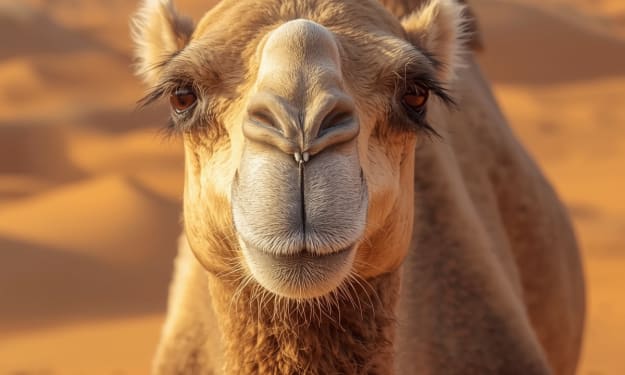
The Camel: The Miracle of the Desert
🌍 Introduction The camel is one of the most unique and useful animals in the world. It is often called: ✔️ “The Ship of the Desert” because it can walk long distances across hot deserts without getting tired. Camels have helped humans for thousands of years for traveling, carrying goods, farming, and even as a source of food and milk. In Islam, the camel is also mentioned with respect — as a sign of Allah’s creation and power. 🧬 Types of Camels There are two main types of camels: 1️⃣ Dromedary Camel (Arabian Camel) ✔️ Has one hump ✔️ Lives mostly in the Middle East, Africa, and South Asia ✔️ Makes up 90% of the world’s camel population 2️⃣ Bactrian Camel ✔️ Has two humps ✔️ Lives in Central Asia (China, Mongolia, Kazakhstan) ✔️ Can survive in extremely cold deserts too 🏜️ Why Do Camels Have Humps? Many people think humps are filled with water, but that’s not true. 🟡 The hump stores fat — like a food bank. When the camel does not find food, its body uses this stored fat for energy. ✔️ Because of this, camels can survive many days without eating much. When the fat is used up, the hump becomes smaller and softer, and when the camel eats again, the hump returns to normal shape. 💧 How Do Camels Survive Without Water? Camels are water-saving champions. They can: ✔️ Drink up to 100 liters of water in one day when thirsty ✔️ Survive 7–10 days without water (sometimes more) Their bodies are designed specially: 🔹 Their blood cells are oval-shaped — so they can stretch and hold more water 🔹 They sweat very little — saving water 🔹 They can drink very fast without getting sick 🌡️ Adapting to Desert Heat The desert can reach 50°C (122°F) — yet camels remain calm. Here’s how: 🐪 Thick fur on top protects from sunlight 🐪 Thin fur below keeps heat away 🐪 Long legs keep body away from hot sand 🐪 Wide feet stop them from sinking into sand 🐪 Nose closes during sandstorms 🐪 Long eyelashes protect eyes from sand Allah نے انہیں ایسے خاص طریقے سے بنایا ہے کہ وہ ریت، گرمی اور تیز ہوا سب برداشت کر سکیں۔ 🍃 What Do Camels Eat? Camels are herbivores. They eat: ✔️ Dry grass ✔️ Leaves ✔️ Thorny bushes ✔️ Desert plants Their mouths are very tough — so even thorny plants don’t hurt them. They chew food slowly and can digest rough plants easily. 👨👩👧 Relation With Humans For thousands of years, camels have helped people in: ✔️ Traveling ✔️ Carrying goods ✔️ Farming ✔️ Transporting water ✔️ Providing milk ✔️ Providing meat ✔️ Providing leather & wool In many countries like Saudi Arabia, UAE, Pakistan, India, Somalia, Sudan, Egypt, and Mongolia, camels are still very important. 🍼 Camel Milk Camel milk is considered very healthy: ✔️ Rich in vitamins ✔️ Easier to digest than cow’s milk ✔️ Good for immunity ✔️ Naturally low in fat In some cultures, it is used as traditional medicine. 🕊️ Camels in Islam The camel is mentioned in the Qur’an as a sign of Allah’s creation: Allah asks humans to reflect: “Do they not look at the camel — how it was created?” This teaches us that every creation has wisdom and purpose. Also, during Hajj & historical travel, camels were used for transport. 🧠 Intelligence & Behavior Camels are: ✔️ Intelligent ✔️ Calm ✔️ Loyal ✔️ Good at remembering routes They live in groups and listen to their leader. They make different sounds to express hunger, anger, or calling their babies. 🐾 Baby Camels A baby camel is called a calf. ✔️ It can stand and walk within a few hours after birth ✔️ Drinks only mother’s milk for months ✔️ Stays close to the herd 👣 Lifespan Camels usually live 40–50 years. 🌎 Where Do They Live? Camels mostly live in: ✔️ Middle East ✔️ North Africa ✔️ Central Asia ✔️ South Asia ✔️ Australia (wild camels too) ⚖️ Size & Strength A camel can weigh 400–650 kg (880–1400 lbs) and can carry 200–300 kg for long distances. That’s why they are called Desert Trucks. ❤️ Why People Respect Camels People admire camels because they teach us: 🌟 Patience 🌟 Strength 🌟 Simplicity 🌟 Endurance 🌟 Gratitude They are peaceful creatures that help humans without harm. 🏁 Conclusion The camel is not just an animal — it is a miracle of design and wisdom. It shows how perfectly Allah has created every creature for its environment. From deserts to cold lands, from history to modern life, camels continue to serve humanity with loyalty and strength.
By Shahab Khan2 months ago in Earth
The Year That Slipped Through Our Fingers: Reflections as 2025 Fades Away
There is something strange about the last days of a year. The calendar looks the same, the sun rises like always, and yet everything feels different. Now that 2025 is almost over, it feels as if the year quietly slipped through our fingers while we were busy scrolling, working, worrying, and planning the future. When the year began, many of us had dreams and goals. Some wanted a better job. Some prayed for good health. Some hoped for peace in their families, and others simply wanted to survive another year. We made resolutions, whispered prayers, and told ourselves, “This year will be different.” And then life happened. There were happy moments—new friendships, small victories, unexpected blessings. There were also challenges—financial stress, uncertainty, personal struggles, and news from around the world that reminded us how fragile life can be. Some people traveled; others stayed where they were, carrying responsibilities on their shoulders. Students continued their studies, parents kept working for their children, and countless people quietly fought battles no one else could see. Days turned into weeks. Weeks turned into months. Before we realized it, we were here—standing at the edge of another ending. What surprises me most is not how fast the year went by, but how silently it did so. Time doesn’t ask for permission. It doesn’t make noise when it leaves. One day you wake up and realize that an entire year is now a memory. 2025 also reminded us that the world is deeply connected. Whether someone lives in Pakistan, the Middle East, Africa, Europe, Canada, America, or anywhere else, we all feel the weight of time passing. We all face uncertainty. We all experience moments of gratitude and moments of fear. We all look at the sky sometimes and whisper a prayer, hoping someone out there is listening. For Muslims, and for people of faith around the world, this year also brought reflection. How much time did we spend chasing things that don’t last? How many prayers did we delay? How often did we forget to be thankful for simple blessings—like food, health, family, or the ability to breathe freely? And yet, this is not a story of regret. It is a reminder. Every ending carries a message: life is temporary, so make it meaningful. 2025 may not have been perfect. For many, it was difficult. But inside those difficulties, there were lessons. We learned that kindness still matters. A message to a friend, a smile to a stranger, a small act of charity—these things travel farther than we realize. We learned that faith gives strength when nothing else does. We learned that success is not always money or fame. Sometimes success is simply refusing to give up. As we step toward a new year, we should not only count what we lost or gained—we should count what we learned. Maybe we learned patience. Maybe we learned trust. Maybe we learned that scrolling through screens can never replace real conversations. Maybe we learned that family, whether near or far, is a blessing that should never be taken for granted. Time will continue to move. Another year will come, and one day it too will fade quietly like 2025. But we still have today. We still have a moment to change, to forgive, to improve, to pray, to love, and to become better than we were yesterday. So as the final days of 2025 pass, pause for a moment. Breathe. Think. Be grateful. Reflect on who you were at the beginning of the year and who you are now. Even if progress was small, it still matters. Because the real achievement is not how fast the year went—it is how deeply it changed you. And when the clock finally turns and the new year begins, carry one lesson with you: Time does not stay. But meaning does. Live in a way that when another year ends, your heart is not filled with regret—but with gratitude, faith, and peace.
By Shahab Khan2 months ago in Motivation
I Made My First Online Income After Months of Zero Results
For a long time, I believed online earning was either fake or only for lucky people. I was a student facing constant financial pressure, with limited resources, and big expectations from myself and my family. Every day, I saw screenshots on social media—people claiming they made money overnight. It looked easy. Too easy. I kept asking myself, “Why can’t it be that easy for me?” So I decided to try. I started with hope, motivation, and zero skills. I watched videos, read posts, and followed every “quick earning” idea I could find. Fiverr, YouTube, freelancing—everything sounded promising. But reality was very different. Days passed. Then weeks. Then months. No notifications. No payments. No success stories of my own. Every time I opened my phone, I felt disappointed. I questioned myself constantly. Maybe I wasn’t smart enough. Maybe online earning wasn’t real. Or maybe it just wasn’t for someone like me. The hardest part wasn’t the lack of money. It was the silence. No one talks about this stage—the phase where nothing happens. You work quietly, learn slowly, and fail repeatedly. People around you don’t see your effort, only your results. And when there are no results, they assume you are wasting time. At one point, I almost quit. I considered deleting all my accounts, giving up, and returning to normal life without trying anymore. But instead of quitting completely, I did something small yet important: I changed my approach. I stopped chasing money. Instead of jumping from one method to another, I chose one simple skill and focused on learning it properly. No rush. No unrealistic goals. Just daily improvement. Some days were productive; some days weren’t. But I stayed consistent. I reminded myself that progress is often invisible at first. I lowered my expectations and raised my patience. I celebrated even tiny wins—like completing a task without mistakes or learning something new. Weeks later, something unexpected happened. I received my first online earning. It wasn’t a big amount. It wasn’t life-changing money. But it felt different. That small earning meant more than cash. It was proof. Proof that online earning is real. Proof that consistency works. Proof that effort eventually shows results—even if it takes time. I remember staring at the screen for a long time, reading the confirmation again and again. It felt unreal, not because of the amount, but because of what it represented. Months of doubt, frustration, and quiet effort finally made sense. That moment changed my mindset completely. I realized that online earning is not about shortcuts. It’s about surviving the zero phase—the phase where nothing seems to work. Most people quit there. Not because they are incapable, but because they expect results too early. I learned three powerful lessons from this journey: First, online earning is real, but it is slow for beginners. Anyone promising instant success is selling a dream, not reality. Second, your first earning matters more than your biggest earning. It builds belief. And belief builds momentum. Third, consistency beats motivation. Motivation fades. Discipline stays. I am still learning. I am still growing. But now I move forward with clarity instead of confusion. I no longer chase viral success stories. I focus on progress, skill, and patience. If you are reading this while struggling, feeling stuck, or doubting yourself, know this: Your zero phase is not failure. It is preparation. And one day, your first earning—no matter how small—will remind you why you started, and it will make all the silent, unseen efforts worth it.
By Shahab Khan2 months ago in Motivation
“They Said Congratulations… But Never When I Needed Support”
It always begins in silence. When you decide to build something, chase a dream, or change your life — the world doesn’t clap for you. No one says “good luck.” Most people don’t even notice. You walk alone, with nothing but your own heartbeat echoing in your chest.
By Shahab Khan4 months ago in Motivation
The Night I Found Myself Again
It was past midnight, the kind when the world seems paused, and even your thoughts whisper softly. I sat alone in my small room, staring at the dim light of my screen, feeling the weight of everything I had carried for years. The quiet was comforting but also unsettling, like staring into the depths of my own mind and realizing just how far I had drifted from the person I wanted to be.
By Shahab Khan4 months ago in Writers
The Boy Who Chased Light
I had forgotten what sunlight felt like—until the diary reminded me that hope never truly dies. --- I fell to the streets of my broken city, the buildings around me hunched like tired giants. Silence had claimed every alley, every corner. I walked with my hands in my pockets, pretending that the darkness outside didn’t match the one inside my chest. Each step echoed on the cracked pavement, a reminder that the world had moved on while I remained frozen in shadows.
By Shahab Khan4 months ago in Fiction
“Whispers Between the Lines”
The first time I truly noticed the silence, it was already speaking. It wasn’t loud or harsh — it was subtle, weaving itself between words left unsaid, lingering like a shadow that refuses to fade. I had always believed that conversations carried meaning, but sometimes the pauses carry even more. The moments when hearts speak in the quiet — when eyes meet and understanding flows without a single syllable uttered — those are the moments that define us.
By Shahab Khan4 months ago in Poets