
🌲 The Children Beneath the Ice: Secrets of Alaska’s 11,500-Year-Old Burial Unearthed
A forgotten story preserved in frozen soil uncovers the roots of Native American ancestry and the journey of early humans.

In the late 1860s, a Swiss biochemist named Friedrich Miescher made a scientific breakthrough that would change how humanity understands its origins. While examining white blood cells, Miescher isolated a unique substance he called nuclein — what we now know as DNA.
That discovery laid the foundation for uncovering the deep genetic history of humankind. More than a century later, that same science would help researchers decode mysteries buried beneath Alaska’s frozen soil.
---
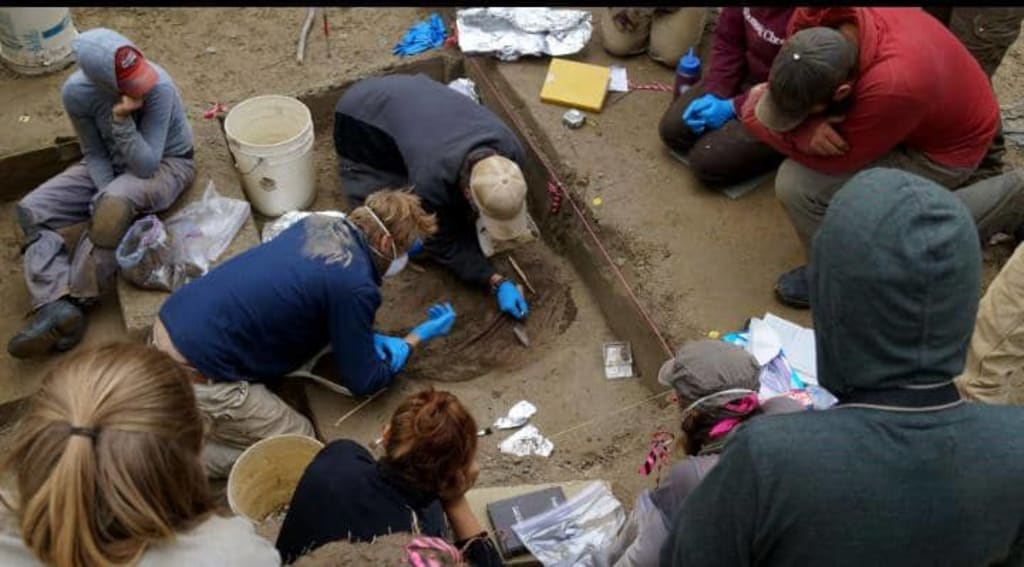
The Discovery of 11,500-Year-Old Infant Skeletons
In 2018, a team of archaeologists unearthed an extraordinary find — the remains of two Native American infants who lived around 11,500 years ago. The two were members of the same family and had been carefully buried together.
Their bones were so well-preserved that scientists were able to extract DNA, offering a rare glimpse into the genetic makeup of the earliest humans to set foot in North America.
This single discovery helped rewrite parts of early American history, confirming that human migration to the continent began much earlier than previously believed.
---
A Remote Alaskan Dig Site
The groundbreaking find took place at Upward Sun River, a secluded archaeological site about 50 miles from Fairbanks, Alaska. Reaching the location is no easy feat — it’s surrounded by dense forest and can only be accessed by helicopter.
In the early 2000s, Professor Ben Potter, an anthropologist at the University of Alaska, began exploring this region. Though remote, the area held unique geological clues suggesting that ancient humans once lived there when the world looked very different.
During prehistoric times, the continents were once joined as a massive landmass known as Pangea. As it gradually broke apart, natural land bridges formed between certain regions. One such corridor — Beringia — linked Siberia and Alaska, allowing early humans to travel between Asia and North America.
---
The Beringian Standstill Theory
Many scientists have long believed that North America’s first inhabitants crossed into the continent via the Bering Land Bridge roughly 34,000 years ago. However, the details of this migration remained uncertain.
To explain the gap, researchers proposed the Beringians Standstill Hypothesis — a theory suggesting that a group of ancient people, now called the Ancient Beringians, lived in isolation on Beringians thousands of years due to ice-covered landscapes and extreme weather.
According to archaeologist Jennifer Raff, these Beringians may have been the direct ancestors of all Native American populations living today. The genetic data retrieved from the Upward Sun River infants provided powerful evidence supporting this idea.
---
Cultural Roots Still Alive Today
The land where the excavation took place remains culturally significant. Modern Native Alaskan communities still inhabit the region surrounding the Upward Sun River.
The name “Upward Sun River” is actually a translation of the Athabascan term “Xaasaa Na’,” a language still spoken by Indigenous people in the area. For them, the discovery is not only a scientific milestone but also a sacred connection to their ancient ancestors and traditions.
---
A Link Between Past and Present
From Miescher’s discovery of DNA in the 19th century to the 21st-century excavation in Alaska, science continues to illuminate humanity’s ancient journey. The frozen ground of Alaska has preserved more than bones — it has preserved stories of migration, survival, and identity that stretch back over ten millennia.
These 11,500-year-old skeletons serve as a bridge between past and present, reminding us that every discovery brings us one step closer to understanding where we truly come from.
About the Creator
Ekwunife Deborah
🖋️ I weave words into worlds.
An online writer and storyteller who turns everyday moments into unforgettable tales. Here, stories don’t just live — they breathe, feel, and leave echoes behind.
Keep reading
More stories from Ekwunife Deborah and writers in Earth and other communities.
31 U.S. Lawmakers Applaud Trump for Naming Nigeria a “Country of Particular Concern”
🇺🇸 Lawmakers Praise Trump’s Bold Move Thirty-one members of the United States Congress have publicly commended former President Donald Trump for re-designating Nigeria as a Country of Particular Concern (CPC) due to reports of increasing violence against Christians.
By Ekwunife Deborah2 months ago in History
Things you don't know about Africa
Africa: What You Probably Didn’t Know Article No. 1671 Tuesday, 25 February 2020 By Wardah Baloch In terms of land area, Africa is the second-largest continent in the world. It covers nearly 22 percent of the world’s total landmass and about 6 percent of the Earth’s total surface area. Only Asia is larger than Africa in size.
By Sudais Zakwan5 days ago in Earth
USA vs Iran: A Military Mismatch in 2026
Comparing the U.S. and Iranian militaries is not about who would win a fair fight. It's about understanding two completely different ways of thinking about war. By 2026, the gap between their traditional strength will be wider than ever. The U.S. is a global superpower built to fight and win anywhere. Iran is a regional survivor, built to make an invasion so painful that no one would ever try.
By LegacyWords2 days ago in Earth




Comments
There are no comments for this story
Be the first to respond and start the conversation.