
The Amazon Jungle
A Journey Through Nature’s Greatest Wilderness and Its Role in Sustaining Life on Earth

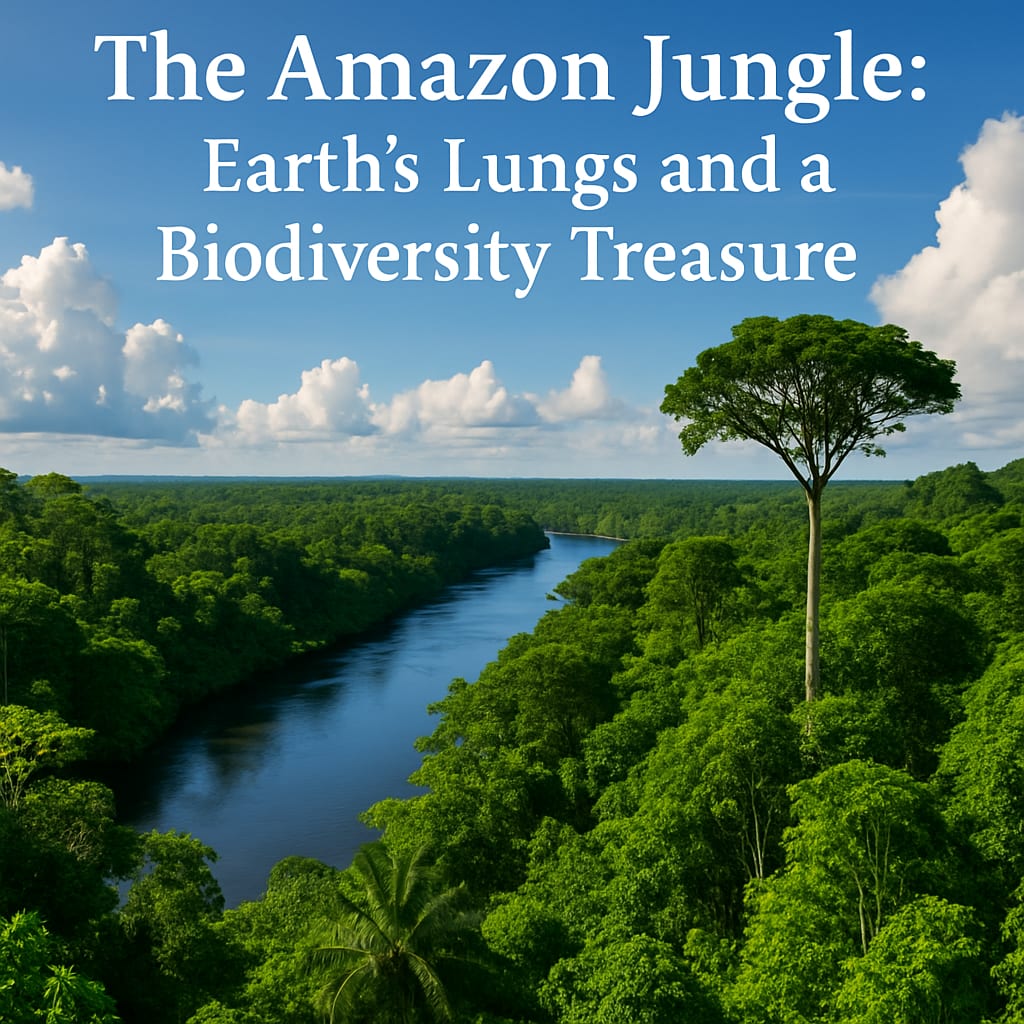
The Amazon Jungle, also known as the Amazon Rainforest, is one of the most magnificent natural wonders on Earth. It spans across nine countries in South America, covering an area of more than five and a half million square kilometers. Most of it lies within Brazil, but parts also stretch into Peru, Colombia, Venezuela, Ecuador, Bolivia, Guyana, Suriname, and French Guiana.
Often referred to as “the lungs of the Earth,” the Amazon produces about twenty percent of the world’s oxygen. But this vast green wilderness does far more than just generate air—it regulates the global climate, shelters millions of plant and animal species, and supports the lives of indigenous communities who have called it home for thousands of years.
A Living Tapestry of Life
The Amazon Rainforest is the most biodiverse region in the world. It is home to roughly ten percent of all known species. Scientists have documented over sixteen thousand different types of trees, and the forest contains an estimated three hundred ninety billion individual trees. From the ground level to the treetops, life thrives in every corner.
The Amazon shelters around two and a half million insect species, more than twelve hundred bird species, nearly four hundred reptiles, and over four hundred mammal species. Some of its most famous residents include jaguars, howler monkeys, capybaras, giant river otters, poison dart frogs, and the legendary anaconda—the heaviest snake in the world.
High above, harpy eagles glide through the treetops, while pink river dolphins swim gracefully through the Amazon River, which is the second-longest river in the world and by far the largest by water volume. The river system, with over a thousand tributaries, is a lifeline for the forest and its inhabitants.
Climate Control on a Global Scale
One of the most important roles of the Amazon Rainforest is its influence on the global climate. The trees absorb large amounts of carbon dioxide, a major greenhouse gas responsible for climate change. By doing so, the forest acts as a giant carbon sink, helping to slow the effects of global warming.
In addition to storing carbon, the Amazon releases enormous quantities of water vapor into the air through a process called transpiration. This vapor helps form clouds and brings rainfall—not just to South America, but even to other continents. Scientists have discovered that the Amazon plays a role in weather systems as far away as North America and Africa.
Losing even a part of this forest could increase global temperatures and reduce rainfall in many regions of the world. That is why protecting the Amazon is not just a local issue—it’s a global priority.
A Home to Indigenous Communities
The Amazon is also a cultural treasure. It is home to over four hundred indigenous groups, many of whom live in harmony with nature and depend on the forest for food, medicine, and shelter. Some tribes, like the Yanomami and the Kayapo, have lived in the rainforest for centuries.
Many of these communities have a deep understanding of the forest’s plants and animals. In fact, modern scientists have developed numerous medicines from plants discovered by indigenous people in the Amazon. These include treatments for malaria, heart disease, and certain types of cancer.
Supporting indigenous land rights is one of the most effective ways to protect the rainforest. Studies have shown that forest land managed by native communities tends to have lower rates of deforestation than other areas.
Threats to the Amazon
Despite its importance, the Amazon is under serious threat. The forest is being destroyed at an alarming rate due to human activities. One of the biggest causes is deforestation. Trees are cut down for logging, farming, and cattle grazing. This not only reduces the forest’s ability to absorb carbon dioxide but also destroys animal habitats and disrupts water cycles.
Fires, often set deliberately to clear land, are another major concern. These fires can get out of control and destroy vast areas of forest. In recent years, satellite images have shown thousands of fires burning across the Amazon during the dry season.
Mining is also a growing problem. Illegal gold mining pollutes rivers with toxic chemicals like mercury, which poisons fish and harms the people who depend on the river for water and food.
On top of all this, climate change is making the Amazon even more vulnerable. Warmer temperatures and longer dry seasons are reducing the forest’s ability to recover from damage. Scientists warn that if deforestation continues, the Amazon could reach a tipping point—where it turns from rainforest into dry savanna. This would be a disaster for the planet.
Efforts to Protect the Amazon
The good news is that many people, organizations, and governments are working to save the Amazon. Protected areas have been established across millions of hectares to stop illegal activities and preserve biodiversity. Reforestation projects are planting trees in areas that were once cleared.
Sustainable farming and logging practices are being promoted to help communities earn income without destroying the forest. Eco-tourism is also growing, offering visitors a chance to explore the rainforest while helping fund conservation efforts.
Consumers can help by choosing products that are certified as rainforest-friendly. Reducing meat consumption, especially beef, can also make a difference, as cattle ranching is one of the main drivers of deforestation.
A Future Worth Fighting For
The Amazon Jungle is more than just a forest. It is a symbol of life, diversity, and balance. It provides oxygen, stabilizes the climate, protects endangered species, and holds cultural wisdom that the world cannot afford to lose.
The choices we make today will determine the future of the Amazon. If we act with care, responsibility, and respect for nature, we can ensure that this incredible rainforest continues to thrive—for ourselves, and for generations to come.
About the Creator
Keep reading
More stories from Naeem Khan and writers in Earth and other communities.
Global Agreement to Limit Greenhouse Gases Enters into Force
A major step in the global fight against climate change has begun as countries around the world start implementing a landmark agreement designed to limit greenhouse gas emissions. The agreement represents years of negotiations, scientific warnings, and increasing public concern about the growing impacts of global warming on ecosystems, economies, and human life.
By Irshad Abbasi 2 days ago in Earth



Comments
There are no comments for this story
Be the first to respond and start the conversation.