

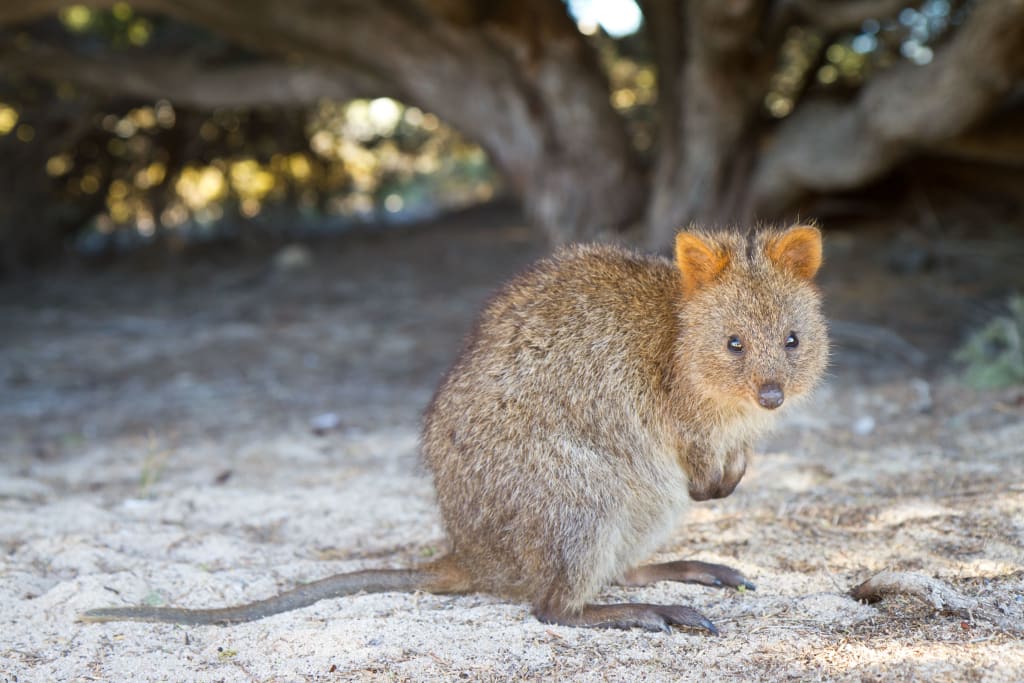
If you saw a quokka while traveling in Australia you might at first not be sure what you are seeing. These are tiny marsupials that make their homes in parts of southwest Australia and on two nearby islands in the Indian Ocean. One is Bald Island and the other Rottnest located near Perth, Australia. They're most likely relatives of the Rock Wallaby.
Quokkas have compact, rounded bodies with their hind legs and tails shorter than those of many wallaby species. With their tiny limbs, they can hop through dense foliage and tall grasses. Their fur thick, layered fur is coarse and brownish-grey in color with some red highlights around the head. Quokkas have small, rounded ears and rounded snouts.
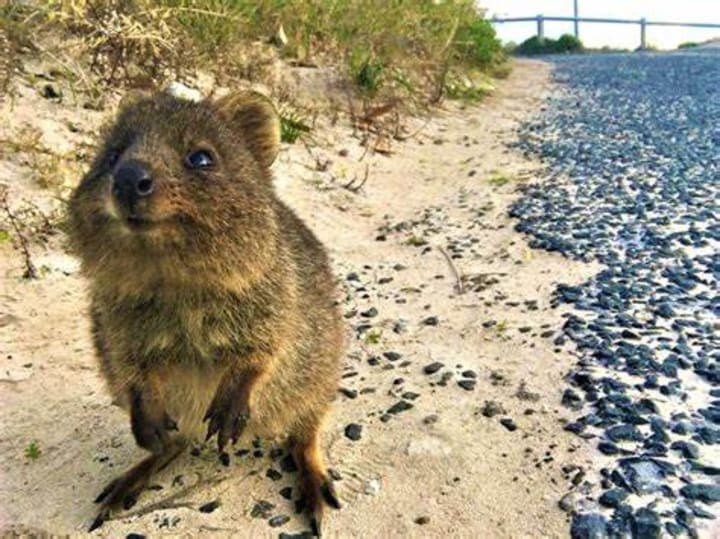
Quokkas mostly live on Rottnest and Bald Islands. Some inhabit the bushland surrounding Perth on the mainland. Their common habitats are found in thick forests, open woodland, and areas of scrub close to fresh water. Quokkas like to live close to the water and can also be found along edges of swamps.
They're sociable and friendly animals forming small family groups that are dominated by males. Home ranges include up to 150 individuals. On hot days they rest in the shade of trees. Being nocturnal animals they start looking for food during the night. Quokkas are vegetarians and exist on a herbivorous diet. They enjoy eating leaves, fruit, and berries. Once they have eaten they regurgitate undigested material in cud form and eat that as well. These animals don't need to drink a lot of water and can go for months without drinking anything.
Quokkas breeding season comes in cooler months between January and March. After a gestation period of one month, a single joey is born. Female quokkas have pouches into which the joey crawl. Joeys suckle from their mother's pouch for about six months as they develop. Then the joeys emerge and start exploring their surroundings while remaining close to mom and continue to suckle milk for another couple of months.
Quokka Interesting Facts
Quokkas were discovered by Europeans visiting Australia. In the 1600s Samuel Volckertzoon, a mariner found them on a sandy island and described them as “wild cats”.
Explorer Willem de Vlamingh thought they were “giant rats” so he named the island Rottnest Island after the Dutch phrase for “rat's nest”.
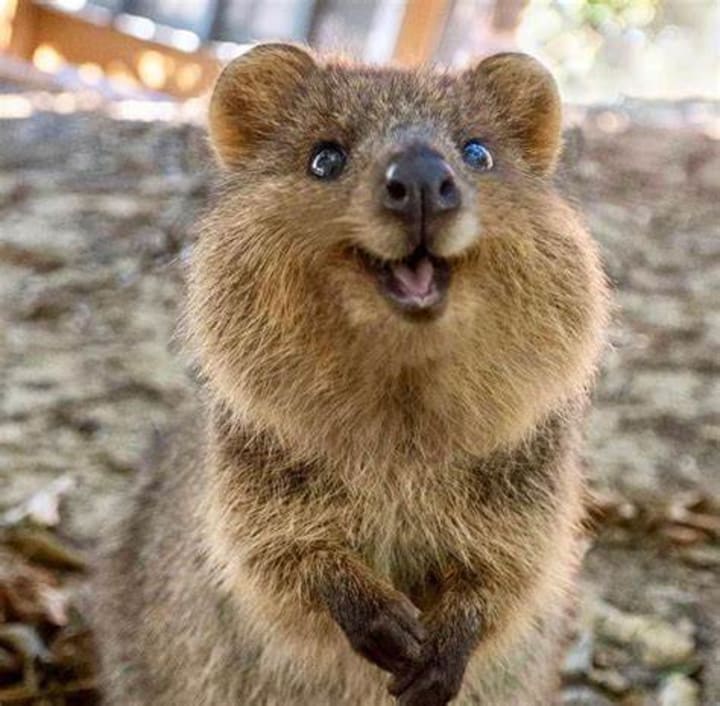
Even though quokkas are adorable, smile, and look friendly it is forbidden to touch or harm them. They're considered a vulnerable species by the IUCN, leading to regulations surrounding their habitat and human contact. They can inflict severe bites and transmit salmonella. The Australian Government will ask for large fines from anyone touching or harming them.
Remember the Australian government fines even though quokkas are friendly and approachable. The animals don't fear humans and will hop up to people who have stopped to look at them. This has made it possible for visitors to Rottnest Island to take selfies with quokkas. It is important to keep in mind quokkas are animals and there is much they don't understand so if they feel threatened they will bite. Their powerful hind legs can kick. Quokkas don't like to be handled since they are wild animals and not domesticated. They cannot be petted and you cannot feed them.
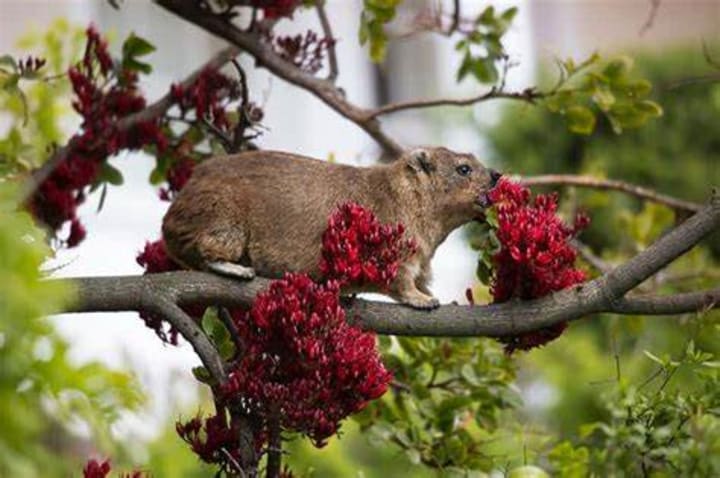
With strong hind legs and sharp claws, quokkas can climb trees. They're also able to swim by paddling through water.
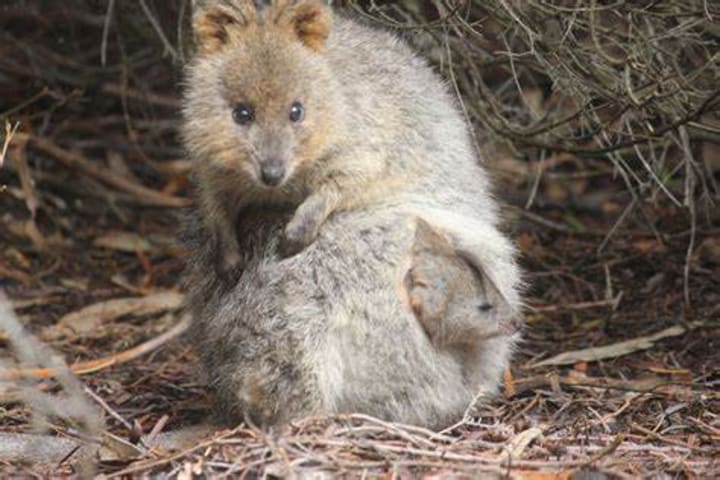
Female quokkas have pouches opening towards their rear legs. This feature makes it possible to prevent dirt and debris from getting into the pouch while the mother goes through thick vegetation and her joey stays clean and safe. The backward-facing pouch lets the joey nurse while Mom grazes.
Traveling in Australia you can also see quokkas at Australian zoos among them the Perth Zoo, Adelaide Zoo, Sydney Zoo, and Melbourne Zoo.
About the Creator
Rasma Raisters
My passions are writing and creating poetry. I write for several sites online and have four themed blogs on Wordpress. Please follow me on Twitter.
Keep reading
More stories from Rasma Raisters and writers in Earth and other communities.
Asian Animals Pakistan and The Philippines
Wildlife of Pakistan Pakistan is located on the Indian subcontinent and a Muslim-majority state. It shares land borders with Afghanistan, Iran, China, and India. The mountains of the Himalayas, the Karakoram, and the Hindu Kush dominate the north and west of the country, the southwest has the Balochistan Plateau, and the southeast has the Indus River Plain. The coastline of the Arabian Sea borders Pakistan to the south.
By Rasma Raisters12 months ago in Earth
New Bipartisan Congressional Bill Would Regulate Hemp Products, In Contrast To Ban Trump Signed
The debate over hemp regulation in the United States is once again taking center stage in Congress. A new bipartisan congressional bill aims to regulate hemp-derived products, marking a clear contrast with a previous ban signed by former President Donald Trump. This proposed legislation reflects a growing recognition among lawmakers that hemp is here to stay — and that regulation, not outright prohibition, may be the most effective way forward.
By Muhammad Hassan3 days ago in Earth
China Hacked Downing Street Phones for Years
Allegations of Long-Term Espionage Recent reports suggest that Chinese cyber operatives hacked into phones and communication networks at Downing Street, the seat of the UK government, over a period of several years. The revelations have triggered alarms in the British government and highlighted the growing threat of state-sponsored cyber espionage.
By Aarif Lashariabout 4 hours ago in Earth




Comments
There are no comments for this story
Be the first to respond and start the conversation.