
Talking about "A Brief History of Humanity": When the labels are stripped off, and pure life is left, who are we?
On "A Brief History of Humanity"


The first few chapters of the book "A Brief History of Humanity" are somewhat unexpected. In my impression, our ancestors, Homo sapiens, were struggling and hungry in nature, just like in "Crazy Primitives" In the same way, everyone fought against large carnivores with stones in order to protect themselves, and it was miserable. But the authors point out a key point. Whenever Homo sapiens moved to a new continent, the local large mammals and birds began to die off a cliff.
Before the beginning of agricultural society, Homo sapiens did not rely on smashing stones day and night to chase after the eater to get food, but to gather it. The author cites hunter-gatherers as surprisingly few hours per week, and at first I couldn't believe my eyes - 35-45 hours per week. Compared with the 996 of modern wage earners, who work 70-90 hours a week, perhaps Homo sapiens have a happier life. Now we have high-speed rail, which can travel thousands of miles in just 3 hours; with mobile phones, people on the other side of the ocean can receive our information without sending letters. We have so much higher technology than Homo sapiens, why are humans still unhappy?
As said in the book, we seem to be living our lives at 10 times the speed. We watch a 5-minute commentary and finish a 120-minute movie, and watch a TV series at 2 times the speed. We are anxious that 27-year-old recruitment will not prevail, and 35-year-olds will be eliminated. Complaining that the fast pace of short videos makes it impossible to concentrate the fragmented time, our own life is rolling at a non-stop speed. I always thought that an agricultural society was a remarkable progress for mankind. But the author points out that in an agricultural society, human beings are actually enslaved by plants.
Wheat, a species that was unremarkable thousands of years ago, has spread to every corner of the world overnight. In order for wheat to thrive, human beings have to pick large manures to fertilize and dig ditches to water them. People live in a fixed place because wheat cannot move with human beings. When people are stationed in one place, human beings become too dependent on the quality of the environment, and the food becomes single. During the collection period, Homo sapiens ingested a variety of foods and it was not easy to be malnourished. There is no evidence that humans are getting smarter, because in the era of gathering, humans had to be careful to identify various plants and animals.
The establishment of writing is not only about pure advantages and disadvantages, but it has gradually changed the way humans think and view the world. The free connection and holistic thinking of the past have been transformed into fragmented thinking, bureaucracy, and words have changed the way we think. My friend shared with me that when she first arrived at the company, there was a way of speaking within the company. As a screw, she has limited problems to solve. When she needs to connect with other departments, she will tell the other party "I want to solve 1234, you need to help me do 1234", which may also represent a kind of computer-like command-like language. This imperative language completely compresses the part of us as "humans", simply as parts of a huge factory machine, helping the machine to complete the characters more efficiently.
Money may also become our language, and everyone is labelled, defined, and lost in this wave. "With class, strangers don't have to waste time and energy to really understand each other, but also know how to know each other." In accelerated life, we meet every stranger and judge him from his brand, address, etc. The class determines whether they can communicate with each other and whether they have a common language. Are we not now? Everything is built on the basis of "believing that the future will be better". But when we put our thoughts on the idea of "the future will be better", we also give the fulcrum of our lives to the society and the outside world.
“The place racism used to occupy in imperial thought is now replaced by culturalism.” The ever-changing tourist attractions, every city has an ancient street that sells old Shanghai hand creams, silver jewelry and more. hand-made soap. All cities have McDonald's, KFC, old Beijing yogurt, and Chengdu old yogurt seems to have no essential difference. "Who am I?" has become extremely important in this era. But what exactly is culture?
Is culture really just a part of the human imaginary community, a tradition invented by humans to distinguish between "you" and "us"? is that so? I don't feel like that. The question asked at the end of the article is important, what are we going to evolve into? Evolution seems to be just to survive, but somehow I feel as if it should not be the case. Perhaps there are other things more important than living.
Many of the author's views are more metaphysical, and for China, where atheists are the majority, such views may be more appealing. Most life studies only acknowledge the existence of 'hedonic' deficits, and there are relatively easy ways to define and measure them. The right to life, liberty, and the pursuit of happiness are really just life and the pursuit of pleasure. But man can reach the heights of God. Just as Hongmeng has not yet been established, the universe is full of famine, and the atoms in our bodies already exist in the world. We are connected to each other. Just as we cannot now explain what gravity is, simply interpreting happiness as the pleasure of life is to lower the height of human beings. When we strip off the labels one by one, and we are left with a pure life, who are we?
About the Creator
daron mychal
Give you a whole new vision to see the world
Keep reading
More stories from daron mychal and writers in Earth and other communities.
New Zealand sheep farting, causing global warming? Experts adjust feed and breeding to cultivate little fart sheep
The dangers of global warming Yesterday, the US Environmental Protection Agency released the results of a study that confirmed for the first time that human activity is also part of the cause of global warming. Global warming has severely affected Earth's ecosystems, human security, housing and health.
By daron mychal3 years ago in Earth
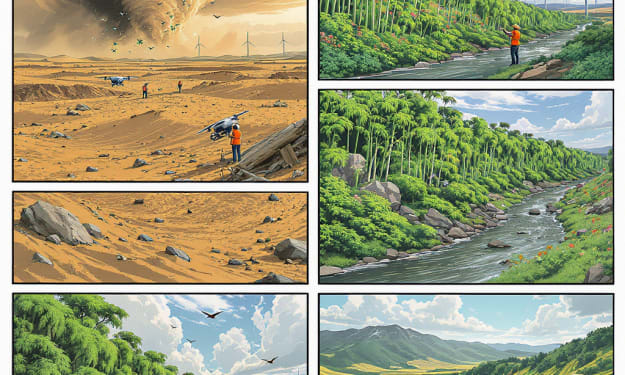
Chinese Planetary Engineering: The Great Green Wall and the Reclamation of Climate
There are junctures in history where a civilization no longer chooses between comfort and progress, but between adaptation and extinction. At the dawn of the new millennium, China hit one of those silent thresholds where geography ceases to be a backdrop and becomes an adversary. The desert was advancing, not as a metaphor for decay, but as a physical, methodical, and relentless force. Sand was devouring the horizon, winds grew heavy with dust, and the soil lost its fertile memory, taking with it the promise of social stability.
By Laurenceau Porte6 days ago in Earth
US Warns Airlines About Military Activity in Parts of Latin America
Commercial aviation is built on predictability—clearly defined airspace, coordinated air traffic control, and shared international rules. When that predictability is disrupted, even subtly, the ripple effects can stretch far beyond the cockpit. That is exactly why a recent warning from the United States has caught the attention of airlines, governments, and travelers alike. In early 2026, US aviation authorities issued an advisory warning airlines about military activity in parts of Latin America, urging pilots to exercise heightened caution when flying over certain regions. While no immediate restrictions or flight bans were imposed, the message itself was clear: something in the skies has changed, and the risks—however limited—can no longer be ignored. This development is not just about aviation safety. It reflects a growing intersection between geopolitics, military operations, and civilian infrastructure in a region that has long balanced cooperation with tension. What Exactly Did the US Warn About? The advisory, released through official aviation safety channels, highlighted concerns over potential military activity affecting airspace across parts of Mexico, Central America, South America, and nearby oceanic regions. Airlines were advised to remain vigilant during all phases of flight, including cruising at high altitudes, takeoff, and landing. Unlike routine notices related to weather systems or airport congestion, this warning explicitly referenced security-related risks. These include the possibility of unexpected military movements, temporary airspace disruptions, and interference with navigation systems that modern aircraft rely on for safe operations. Importantly, the warning did not accuse any specific country of wrongdoing, nor did it suggest an immediate danger to passengers. Instead, it served as a precaution—one designed to ensure airlines adjust flight planning, monitoring, and communication protocols accordingly. Why Military Activity Matters to Civil Aviation To the average traveler, military exercises or operations may seem distant from the experience of flying on a commercial jet. In reality, the two worlds often share the same skies. Civilian aircraft depend heavily on satellite navigation, coordinated air traffic control, and stable airspace rules. Military operations—especially those involving fast-moving aircraft, surveillance systems, or electronic equipment—can introduce uncertainty into that environment. Some of the key risks aviation authorities monitor include: Unplanned military aircraft movements that may not follow civilian flight patterns Temporary airspace closures or restrictions that require last-minute rerouting Navigation signal disruptions, whether accidental or intentional Increased congestion in strategic corridors used by both civilian and military flights While these risks are typically managed through coordination and communication, heightened military activity raises the stakes. The FAA’s advisory suggests that such activity has reached a level where additional caution is warranted. The Geopolitical Context Behind the Warning The timing of the advisory is not accidental. Latin America has seen a noticeable rise in security operations and military coordination involving the United States over the past year. These efforts are largely focused on counter-narcotics missions, maritime security, and regional stability, particularly in areas with strategic shipping routes or ongoing political tension. At the same time, broader global dynamics—ranging from great-power competition to shifting alliances—have increased the strategic importance of air and sea routes across the Western Hemisphere. From Washington’s perspective, issuing an aviation warning is not about alarmism. It is about acknowledging that military and security activities in the region may temporarily affect civilian systems, including aviation. How Airlines Are Responding For airlines, advisories like this are not unusual—but they are taken seriously. Most major carriers already operate with layered safety systems that allow them to respond quickly to changing conditions. In practical terms, this warning may lead to: Slight route adjustments to avoid specific airspace Enhanced pilot briefings before flights Increased coordination with air traffic controllers Closer monitoring of navigation and communication systems So far, there have been no widespread flight cancellations or suspensions linked directly to the warning. That suggests airlines view the risk as manageable, provided proper precautions are followed. Reactions from Latin American Governments Some governments in the region have been quick to reassure the public. Officials have emphasized that their national airspace remains safe and fully operational, and that civilian flights continue without disruption. This response highlights an important tension: while the US warning is precautionary, it can still affect public perception. Tourism, business travel, and investor confidence are all sensitive to suggestions of instability—even when no immediate danger exists. As a result, many countries are walking a careful line between cooperating on aviation safety and defending their reputation for stability. What This Means for Passengers For travelers, the key takeaway is simple: commercial aviation remains safe. Warnings like this are designed to prevent incidents, not predict them. Passengers flying through or over affected regions may experience slightly longer flight times or minor schedule adjustments, but there is no indication of increased danger to civilian aircraft. In fact, the existence of such advisories demonstrates how seriously aviation authorities take even low-probability risks. A Sign of a More Complex World The US warning to airlines is a reminder that modern air travel does not exist in a vacuum. As military operations, security concerns, and geopolitical rivalries evolve, civilian systems—from shipping lanes to flight paths—are increasingly affected. This moment underscores a broader reality: the skies are becoming more crowded, more contested, and more interconnected with global politics. Managing that complexity will require continued transparency, cooperation, and vigilance from governments, regulators, and airlines alike. For now, planes continue to fly, passengers continue to travel, and the system continues to work. But behind the scenes, aviation authorities are quietly adjusting to a world where safety is shaped not just by weather and mechanics—but by geopolitics as well.
By Muhammad Hassan3 days ago in Earth



Comments
There are no comments for this story
Be the first to respond and start the conversation.