short story
What really goes on in the Bermuda triangle
The Bermuda Triangle: A Persistent Mystery Introduction: The Enigma of the Bermuda Triangle One of the enduring mysteries of our world remains the Bermuda Triangle, a region infamous for unexplained disappearances of ships, boats, and planes. Rewinding history back about 600 years, we find the story of Christopher Columbus, an Italian explorer who inadvertently sailed through this mysterious area on his quest to reach Asia—a land rich with spices, silk, and minerals.
By Adebayo Mahmudabout a year ago in Earth
Undiscovered Stories About Bangladesh. Content Warning.
Bangladesh, a nation rich in cultural legacy, offers an intriguing contrast where modernity and tradition coexist in nuanced ways. It is one of the most populous countries in the world, with a population of over 160 million. Still, it faces serious social issues that have a big impact on people's lives, especially those of women and children.
By Themba Botiloabout a year ago in Earth
First Light's Promise
In a secluded valley where mountains kissed the sky and rivers whispered ancient songs, the villagers of Aurelion had a cherished belief. Each dawn, as the first light of the sun touched the highest peak, it was said to carry a promise—a blessing that would be granted to one who greeted it with a pure heart.
By Kingsley Egekeabout a year ago in Earth
Beyond the Fog
In a small coastal town shrouded in mist, the fog rolled in every evening, thick and impenetrable. The townspeople had learned to live with it, accepting that the world outside their homes would vanish into a gray nothingness each night. But there was one thing about the fog that no one could explain—it whispered.
By Kingsley Egekeabout a year ago in Earth
Mount Merapi
Volcanoes represent a persistent threat while simultaneously playing a crucial role in sustaining life on Earth. Their dual nature as both perilous and awe-inspiring necessitates ongoing efforts from rescue teams. A significant number of individuals reside in proximity to active volcanoes, underscoring the importance of being prepared for potential evacuations. In late October 2010, Mount Mori experienced a notable eruption, triggered by magma ascending to approximately one kilometer beneath the surface, which resulted in heightened seismic activity and volcanic tremors. The expansion of the lava dome created a significant risk, prompting the evacuation of 19,000 residents within a 10-kilometer radius. Eruptions within the Pacific Ring of Fire are primarily fueled by the explosive expansion of gases. This region has witnessed the majority of the most substantial eruptions over the past 12,000 years. In 2014, Japan's Mount Onake experienced a significant eruption that was not predicted. Volcanic eruptions can be both lethal and devastating, as superheated water and steam can lead to explosive bursts of hot water and rock fragments. Even volcanoes that appear relatively dormant, such as Kilauea in Hawaii, can still present significant risks. Different types of volcanoes exhibit varying levels of destructive potential. Shield volcanoes, with their gently sloping profiles, tend to be less destructive than the more iconic stratovolcanoes. Stratovolcanoes, characterized by their conical shapes, are formed from layers of lava and debris, resulting in particularly hazardous eruptions. Volcanic ash poses serious health risks and can endanger aviation. Composed of silicon, volcanic ash can irritate the eyes, nose, and throat, and inhalation may lead to a cement-like buildup in the lungs, displacing thousands of people and affecting aircraft operations. A volcanic eruption in 2010 had a significant impact on global air travel, incurring costs of approximately $1.7 billion, as it released 250 million cubic meters of ash into the atmosphere.
By Isaac Ekow Anyidohoabout a year ago in Earth
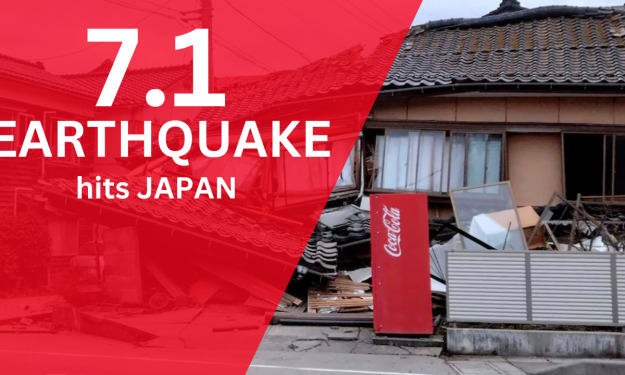
Unsettling Developments in Japan: The Earthquake That Shook More Than Just the Ground
On Thursday, southern Japan was rocked by a magnitude 7.1 earthquake that, at first glance, seemed to pass with little fanfare. The initial tremor, while significant in its own right, appeared to cause minimal damage and led to a quick scaling back of the tsunami warning. This seemed to signal a return to normalcy. However, beneath the surface of this seemingly ordinary seismic event lay a series of unsettling developments that have left the nation on edge.
By Cris Hibayaabout a year ago in Earth
The True nature of Beauty
**The True Nature Beauty** In the heart of a sprawling city, where skyscrapers kissed the sky and the noise of traffic was a constant hum, lived a young woman named Maya. Though she was surrounded by the wonders of modern life—technology, entertainment, and endless opportunities—something inside her always felt incomplete. The city's concrete jungle, with its artificial lights and polluted air, felt like a cage that kept her away from her true calling. She longed for something real, something pure that would rekindle the spark within her.
By Karl Nicken about a year ago in Earth
The Yellowstone volcano
Deep beneath Yellowstone National Park lies one of the world’s largest supervolcanoes, a force of nature responsible for the park’s famous geysers and hot springs. However, this geological marvel also conceals a massive magma chamber, a reservoir far larger than previously imagined. In 2015, researchers from the University of Utah made a startling discovery: not only was the magma chamber significantly more extensive than expected, but there was also a second, even larger reservoir beneath it. Together, these two chambers hold enough magma to fill the Grand Canyon 11 times over.
By David Shoremekun2 years ago in Earth
Journey through Human evolution.
There's an incredible place in Ethiopia, East Africa called Hadar. It's a treasure trove of ancient animal fossils, and among them, we made a remarkable discovery: the fossils of a creature known as *Australopithecus afarensis*. One of the most famous finds from this species is a nearly complete skeleton known as "Lucy," named after a Beatles song. Lucy was small, about the height of a kitchen counter, and lived around 3.2 million years ago. She became a huge sensation after her discovery in 1974, giving us significant insights into our early ancestors, the australopithecines.
By David Shoremekun2 years ago in Earth