
Storm Leonardo Triggers Mass Evacuations Across Spain and Portugal
Over 11,000 Residents Displaced as Flooding, High Winds, and Infrastructure Disruptions Grip Southwestern Europe

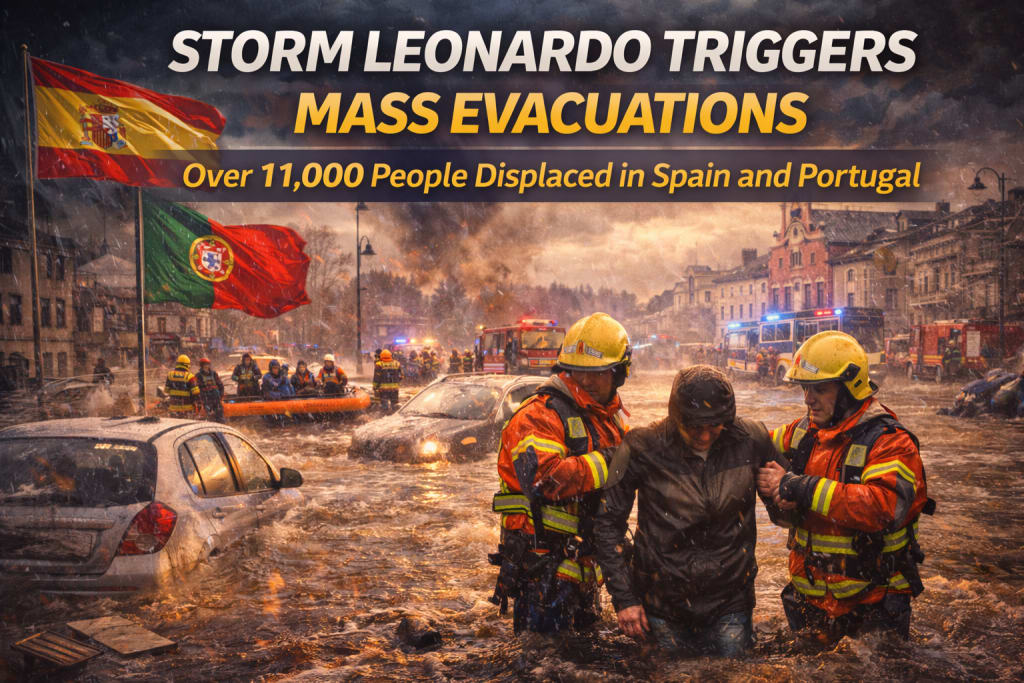
Storm Leonardo has unleashed severe weather across parts of Spain and Portugal, forcing authorities to evacuate more than 11,000 residents as flooding, powerful winds, and widespread disruption threaten public safety. Emergency services in both countries remain on high alert, warning that risks persist even as conditions show signs of gradual improvement.
The storm is part of a larger weather system sweeping through southwestern Europe, bringing prolonged rainfall and unstable atmospheric conditions. Officials say early evacuations were carried out to prevent injuries and loss of life as rivers swelled and infrastructure came under strain.
Regions Hit Hardest by Storm Leonardo
Spain: Rising Rivers and Flooded Neighborhoods
In Spain, Andalusia and parts of Extremadura were among the worst-affected regions. Torrential rainfall caused rivers to overflow, flooding roads and low-lying residential areas. Authorities ordered evacuations in vulnerable neighborhoods as water levels rose rapidly, leaving little time for residents to prepare.
Portugal: Central and Southern Areas Under Pressure
In Portugal, intense rain and strong winds battered central and southern regions, particularly flood-prone zones near riverbanks. Civil protection units relocated residents to temporary shelters as a precaution, citing the risk of flash flooding and structural damage.
More Than 11,000 Evacuated Overnight
Authorities confirmed that over 11,000 people were evacuated across both countries, many during overnight operations as weather conditions deteriorated. Local governments coordinated transport, emergency accommodation, and medical assistance to ensure the safe relocation of residents.
Temporary shelters were established in schools, sports halls, and community centers, where displaced families received food, bedding, and basic healthcare support.
Infrastructure and Transport Disruptions
Storm Leonardo caused widespread disruption to transportation and essential services:
- Road closures due to flooding, landslides, and fallen trees
- Rail services suspended in several affected regions
- Flight delays and cancellations at airports due to strong winds
- Power outages after downed power lines and flooded substations
Utility crews worked around the clock to restore electricity and secure damaged infrastructure where conditions allowed.
Emergency Response and Public Safety Measures
Firefighters, police, and civil protection units were deployed in large numbers, responding to calls involving flooded homes, stranded vehicles, and damaged public facilities. Authorities urged residents to:
- Avoid unnecessary travel
- Stay away from rivers and coastal areas
- Follow official guidance through local and national alerts
Public safety updates were broadcast regularly to keep communities informed as the situation evolved.
What’s Driving the Severe Weather?
Meteorological agencies reported that Storm Leonardo combined sustained heavy rainfall with gusty winds, significantly increasing the risk of flooding and landslides. Already saturated ground from earlier rainstorms worsened conditions, particularly in river basins and rural areas.
Forecasters warned that while overall conditions may stabilize, localized flooding risks could remain for days, especially near rivers and coastal zones.
Impact on Daily Life and Local Communities
The storm disrupted daily life across affected regions:
- Schools closed as a safety precaution
- Public events postponed or canceled
- Businesses temporarily shut down, particularly in flood-prone zones
Many residents described the evacuations as distressing but necessary. Local officials emphasized that early action helped minimize injuries and prevent fatalities.
Government Coordination and Emergency Funding
National and regional governments in Spain and Portugal coordinated response efforts, mobilizing emergency funds to support affected municipalities. Officials confirmed that damage assessments will begin once conditions allow, with priority given to restoring roads, utilities, and essential services.
A Growing Pattern of Extreme Weather in Southern Europe
Storm Leonardo adds to a growing list of severe weather events impacting southern Europe in recent years. The region has faced increasing storms, floods, and heatwaves, prompting governments to strengthen early-warning systems and emergency preparedness.
While scientists caution that no single storm can be directly attributed to climate change, many note that warmer global temperatures can intensify rainfall and extreme weather patterns.
Cross-Border Cooperation Proves Critical
Because Storm Leonardo affected multiple countries, Spanish and Portuguese authorities shared meteorological data and coordinated response strategies. Officials said this cross-border cooperation helped streamline emergency messaging and deploy resources more effectively.
Ongoing Risks and Recovery Efforts
Emergency agencies continue to monitor river levels and weather developments. Residents have been advised not to return home until safety inspections are completed.
Once conditions stabilize, recovery efforts will focus on:
- Clearing debris and floodwater
- Repairing damaged homes and infrastructure
- Supporting displaced residents until safe return is possible
Conclusion
Storm Leonardo has left a significant mark on Spain and Portugal, forcing the evacuation of more than 11,000 people and disrupting daily life across multiple regions. The response highlights the importance of early warnings, coordinated emergency services, and public cooperation during extreme weather events.
As recovery begins, authorities stress the need for continued preparedness as severe weather becomes an increasingly common challenge across southern Europe.
About the Creator
Adil Ali Khan
I’m a passionate writer who loves exploring trending news topics, sharing insights, and keeping readers updated on what’s happening around the world.
Keep reading
More stories from Adil Ali Khan and writers in Earth and other communities.
Polar Vortex Collapse Explained: Why Scientists Are Closely Watching This Dangerous Winter Phenomenon
Introduction: What Is the Polar Vortex and Why Is Everyone Talking About It? In recent years, the term “polar vortex” has become common in winter weather headlines. When extreme cold sweeps across North America or Europe, the polar vortex is often blamed. But many people still ask an important question: What exactly is the polar vortex, and why are scientists so concerned about its collapse?
By Adil Ali Khan3 days ago in Earth
Narrative Adventure ‘Indika’ Is Available Today With Xbox Game Pass (February 2)
Narrative adventure game Indika has officially become available on Xbox Game Pass as of February 2, offering players immediate access to one of the most unique story-driven gaming experiences in recent years. The game, which blends narrative exploration, psychological themes, and unconventional storytelling, has already attracted attention for its bold creative direction and distinctive atmosphere.
By Aarif Lashari5 days ago in Earth
Self Help: Grifters' Gospel
On Self-Help, Snake Oil, and the Illusion of Change Psychology professionals and students can be imagined on two opposite sides of a line called self-help books: likely a larger group opposes pop-science and step-by-step manuals filled with talk of success, journaling, and not giving a f**k; others love them, but they aren’t many.
By Avocado Nunzella BSc (Psych) -- M.A.P 6 days ago in BookClub


Comments
There are no comments for this story
Be the first to respond and start the conversation.