
Spring Cleaning: Unveiling the Marvels and Curiosities of Nature
From Venomous Octopuses to Fearless Honey Badgers - A Journey Through the Intriguing World of Wildlife
Ah, it's that season again - spring cleaning! You gather your duster and brush to dispose of those countless spider webs on your windows. However, this time, as you advance externally, you notice some oddly shaped mud stuck under the roof and the yard. What are these strange structures? It suddenly occurs to you that these must be mud dauber wasp homes. You might be thinking there's a multitude of them around with so many homes being one next to the other. Luckily, mud dauber wasps are solitary creatures. Those numerous small mud cottages are filled with paralyzed insects, sometimes even up to 500 bugs can be caught in these nests, awaiting the wasp's young to hatch.
If the home has openings, it might indicate that the home is inactive or old, as mud dauber wasps create openings when they leave the home. If you decide not to remove them, it's best to wait until evening time when they're less active. While they are generally peaceful, they won't hesitate to sting if they feel threatened. They might look like someone got partially through building one bug and forgot which part came next.
Another curious creature you might encounter during your spring cleaning is the mole cricket. This bug looks astonishing with paws like a mole, a cricket's body, and the head of a shrimp. This critter resembles the platypus of the bug world. Mole crickets are not venomous and will only bite if you trap them inside your hand. If you really annoy them, they have something else at their disposal - they can spit a putrid brown fluid from their body, just like a skunk. So, let them leave your home, and there won't be anything to clean up.
If you happen to visit rock pools, you'll be amazed at the diversity of plant and animal life found there. Starfish, seagrass, hermit crabs, tiny fish, and a variety of octopuses populate these pools. However, if you come across a tiny blue-ringed octopus, it's best to let it be. It flashes its neon blue color for a reason - this miniature octopus has a venomous bite that's ten times stronger than cyanide, and there's no known antidote. Don't poke it with a stick or attempt to pick it up; it's not worth a trip to the hospital or worse.
Snakes on land are scary, but sea snakes take fear to a whole new level. Found in the Indian and Pacific Oceans, there are around 50 different species of sea snakes, and they're as beautiful as they are dangerous. Fortunately, they don't seem to worry much about us. The Dubois' sea snake is arguably the most venomous snake in the sea, with the large sea snake not far behind. Their venom makes a cobra's bite seem like a walk in the park. However, their toxin takes hours to cause any symptoms in humans, so if they can't bite through your wetsuit, you're probably safe.
Now, let's delve into the fascinating world of insects and their peculiar behaviors. The scorpion fly, as its name suggests, has a curved tail that resembles a scorpion stinger. But don't worry; this is only used for mating. It also has a long, mouth-like head that is used for feeding. To find the perfect mate, they love to give what could be compared to a box of chocolates and flowers, except theirs is saliva - how romantic!
Moving to Africa, you might encounter the massive bird called the shoe-bill. If you're not paying attention, it might just casually stand as you walk right by. Standing up to five feet tall with an eight-foot wingspan, the shoe-bill might look like a dominant hunter, but it's anything but. Sculpture-like, the shoebill primarily eats fish near the water's surface - cool as a cucumber, this bird isn't afraid of humans at all.
When you hear a little squeaking sound in your garden, it could be a mouse, a squirrel, or a rhinoceros beetle telling you that you are too close. They love to make a racket when messed with, and with a giant, scary horn on top of their head, they could look like they're ready to defend themselves with it. But that's not the case at all; that's just to move leaves and sticks out of their way and to keep other males from encroaching on the female scarab's territory. Besides having a horn on their head, they've also got colossal strength, able to lift more than ten times their own weight - like you or me lifting 65 tons or 11 elephants. Quite impressive, right?
Found mainly in China, the little Tufted deer looks adorable with its tuft of hair. But watch out, when it turns around, oh my, it's a vampire deer! However, this creature doesn't want to taste your blood or wear a cape. Only males grow these fangs during the mating season, not for fighting over territories or female Tufted deer. These teeth are more like elephant tusks than sharp fangs. Additionally, they're known to bark like a dog and escape like a cat when they're scared.
Now, let's explore the wonders of the ocean, starting with the amazing world of fish. Did you know that creatures see the world differently from us? For example, pigeons have superior vision compared to humans, allowing them to see ultraviolet light, which helps them distinguish between males and females of their own species and navigate their environment better. Hawks and falcons have incredible focus and can spot a small mouse in a field up to a mile away.
Cows, on the other hand, don't see colors as well as humans do; they can't see red since they lack the necessary receptors for that hue. Instead, they see variations of blue and green. Horses have a blind spot right before their faces due to their eye position, so be careful not to approach them from behind suddenly.
Now, let's explore some curious marine life. Ever heard of the "strawberries and cream" or "bleeding tooth fungus"? This fungus, while not harmful, tastes so bitter that you'd think twice about trying some. When young and growing, this white mushroom seems to have red jam oozing from its pores. This sticky fluid is sap that's pushed up from taking on too much water. The adult mushroom is just a dull beige compared to the underside of the mushroom cap, where its spores are released, and it has a tooth-like structure.
When you think of the Tasmanian devil, you might imagine an aggressive and fierce animal. They are known as devils due to their teeth-baring, snarling, and perhaps one of the most terrifying screeches you'll ever hear. However, they won't attack people unless they feel threatened, fight other males, or need to assert dominance during mealtime. They have an incredible set of sharp teeth, strong jaws, and immense strength, making them formidable creatures in their own right.
As you clean, you might encounter the unlikely honey badger. Known for their "don't care" attitude, they fearlessly take food from panthers, lions, or hyenas. These tough relatives of the weasel aren't aggressive, but they are incredibly intelligent. They will even use tools like rakes, stones, and mud to escape from enclosures
About the Creator
Keep reading
More stories from Thene van Schalkwyk and writers in Earth and other communities.
Exoplanets vs. Earth: A Size Comparison
The Smooth Manner world is filled with an incredible number of outsider universes, and scientists have proactively confirmed the existence of over 5,000 of them. These exoplanets, as they are called, come in various sizes, including some as small as Kepler 37b. This tiny planet is even smaller than Mercury, the smallest planet in our local planetary group. Kepler 37b is just slightly larger than our Moon, and despite its size, it is located 208 light-years away from Earth, revolving around a star slightly smaller and cooler than our Sun.
By Thene van Schalkwyk3 years ago in Earth
The Reality of the Illusion of Time
Recently, as I strolled along the short stretch to my strength training session, I aimlessly took in the row of tatty shops and shabby buildings along the route and passed an off-street, in which one of my sisters used to live, around thirteen years ago.
By Chantal Christie Weiss3 days ago in Earth
Why Putin Went Quiet When Challenged by Trump Over Venezuela
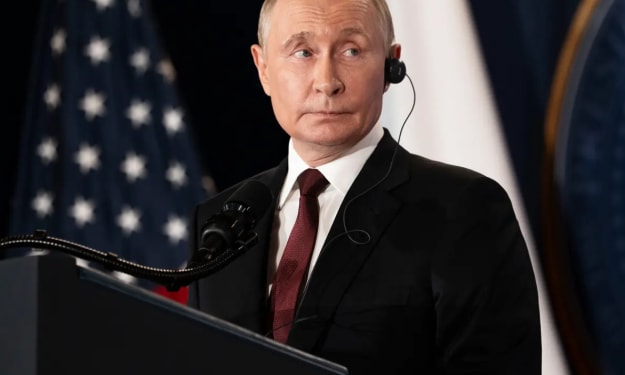
When U.S. forces captured Venezuelan President Nicolás Maduro in early January 2026, the world was stunned. Venezuela has long been a Russian ally, yet Russian President Vladimir Putin remained almost completely silent when challenged directly by U.S. President Donald Trump. Why would a leader so often outspoken on the world stage hold back in such a dramatic moment? Let’s unpack the story and explore what it means for global politics. A Bold Move That Shocked the World On January 3, U.S. forces executed a daring operation in Venezuela, taking Maduro into custody in New York to face charges including drug trafficking and narco‑terrorism. The operation was framed by the U.S. as a step to enforce justice, but critics saw it as an extraordinary overreach of power. Venezuela is no ordinary country for Russia. Since the days of Hugo Chávez, Moscow has cultivated close ties with Caracas, offering military support, energy deals, and diplomatic backing on the global stage. Past actions included Russian bombers visiting Venezuela and high-profile defense agreements. Given this history, many expected a fiery response from Putin. Yet, the Kremlin remained calm, issuing measured statements rather than sharp threats. Why Silence Was Strategic Experts suggest there are several reasons for Putin’s muted reaction, each revealing the careful calculation behind the Kremlin’s foreign policy. 1. Focus on the War in Ukraine Russia’s primary priority remains Ukraine. Engaged in a high-stakes military and diplomatic battle, Putin cannot afford distractions or new confrontations far from home. Escalating tensions with the United States over Venezuela could jeopardize Moscow’s position in Europe. A New York Times report highlighted that Russia is “subordinating all other interests to the war in Ukraine,” suggesting that even a high-profile ally like Venezuela takes a back seat to Moscow’s strategic goals. 2. Limited Military Options While Russia’s alliance with Venezuela is longstanding, much of the support has been symbolic rather than operational. Defense systems and military cooperation exist on paper, but Russia lacks the immediate ability to counter a U.S. operation thousands of miles away. Putin may have recognized that responding aggressively would be both ineffective and costly, potentially risking military and economic consequences that Moscow cannot afford. 3. Maintaining Diplomatic Channels with Washington With Donald Trump back in the White House since 2025, there has been cautious optimism in Moscow about recalibrating U.S.–Russia relations. Avoiding a dramatic confrontation over Venezuela keeps diplomatic channels open, allowing Russia to negotiate on other high-priority issues like Ukraine and sanctions relief. In other words, silence can be a calculated strategy, signaling restraint rather than weakness. 4. Russia’s Global Influence Is Waning The Maduro episode also highlights a broader geopolitical reality: Russia’s global reach has limits. Since the 2022 invasion of Ukraine, Moscow’s influence in regions like the Middle East and parts of the former Soviet Union has weakened. Venezuela remains one of its few high-profile allies outside Europe, but even there, Russia’s power is largely symbolic. By not escalating, Putin is acknowledging a practical truth: Russia cannot be everywhere at once, and some battles are not worth fighting. 5. Choosing Battles Wisely Some analysts emphasize that Putin’s quiet response is more about strategic prioritization than capitulation. In a world dominated by nuclear powers and volatile global politics, direct confrontation with the United States over Venezuela could spiral into a far larger crisis. By staying silent, the Kremlin may be signaling that it picks its battles carefully, focusing resources on Ukraine, where the stakes are highest. What This Means for the World Putin’s silence sends several messages: Russia is currently stretched, economically and militarily. Moscow is prioritizing Ukraine over symbolic allies. Strategic restraint is sometimes more powerful than public confrontation. The limits of Russian influence are becoming more visible to the world. This episode reflects a new reality in geopolitics: power is as much about choosing when not to act as when to assert force. The Bigger Picture The capture of Maduro is a defining moment not just for Venezuela, but for global politics. It shows the United States asserting power in a way not seen for decades, while Russia’s quiet reaction underscores its current limits and priorities. For observers, Putin’s silence is a lesson in modern geopolitics: even the most assertive leaders exercise restraint when stakes are high and risks are global. In the end, the Maduro affair reminds us that in today’s world, the loudest response is not always the most effective one — sometimes, quiet calculation speaks volumes. Sources and Further Reading The US capture of Maduro reveals Russia’s weakness – Atlantic Council ‘It sends a horrible signal’: US politicians react to capture of Nicolás Maduro – The Guardian Russia slams 'neocolonial threats' against Venezuela – Reuters
By Muhammad Hassan6 days ago in Earth



Comments
There are no comments for this story
Be the first to respond and start the conversation.