

SpaceNews
GPS disruption and satellite maneuvers now hallmarks of modern warfare
CSIS in its 2025 Space Threat Assessment concludes that space is becoming “a more dangerous place.”
by Sandra Erwin April 25, 2025
U.S. military forces rely on GPS for positioning, navigation and timing. Credit: U.S. Army
WASHINGTON — Interference with Global Positioning System satellite signals has become a routine feature of military conflict across the Middle East, Eastern Europe, and parts of Asia, according to a new report by the Center for Strategic and International Studies. The findings signal rising risks for both commercial and military actors in orbit.
CSIS on April 25 released its latest Space Threat Assessment report, outlining trends in so-called “counterspace” activity — efforts by nations to disrupt, degrade or destroy satellites. It identifies Russia and Israel as primary actors in widespread GPS spoofing campaigns tied to ongoing military operations in Ukraine and Gaza.
“The past year mostly witnessed a continuation of the worrisome trends discussed in prior reports,” CSIS said, including sophisticated jamming and spoofing, more advanced satellite maneuvering, and mounting threats to commercial space systems used by governments.
GPS spoofing — where false signals are broadcast to mislead navigation systems — has been widely reported in areas near conflict zones, disrupting civilian and military operations alike. The tactic, once rare, is now a normalized tool of hybrid warfare.
In low and geostationary orbits, Chinese and Russian satellites continue to demonstrate precise and complex maneuvers that signal growing operator proficiency. These tactics, CSIS said, have clear implications for space warfighting and may enable nations to conduct covert surveillance or disrupt rival systems.
Worries about nukes in space
One of the more alarming developments cited in the report is Russia’s suspected testing of a space-based nuclear anti-satellite weapon. Satellite Cosmos-2553 is believed to have served as a testbed. If deployed, such a weapon could cripple large portions of low Earth orbit, potentially rendering the region unusable “for some period of time.”
Commercial companies supporting government users — especially those contracted by defense agencies — are increasingly being treated as military targets. The report notes that Russia has openly warned that it considers such assets legitimate during conflict, reflecting a broader trend where the line between civilian and military infrastructure in space is blurring.
State-sponsored cyber threats from Iran, China, and North Korea also featured in the report, including espionage efforts and supply chain attacks targeting the space industry. CSIS cautioned that attributing such operations remains difficult, complicating response strategies.
As space becomes more contested, U.S. policy is shifting. The U.S. Space Force has stepped up its rhetoric, signaling a readiness to conduct both defensive and offensive operations in orbit. “The normalization of space as a military operational domain and its integral role in joint operations mean that space is fair game during conflict,” the report states.
CSIS concludes that space is becoming “a more dangerous place,” increasingly intertwined with both peacetime and wartime strategies. With nations racing to develop dual-use systems and counterspace capabilities, the prospect of miscalculation or escalation is growing.
“Warfighting will happen in, through, and from space,” the report warns. “A future peer-on-peer conflict may very well bring disruption and destruction to space on the same scale that it would bring to other places closer to Earth.”
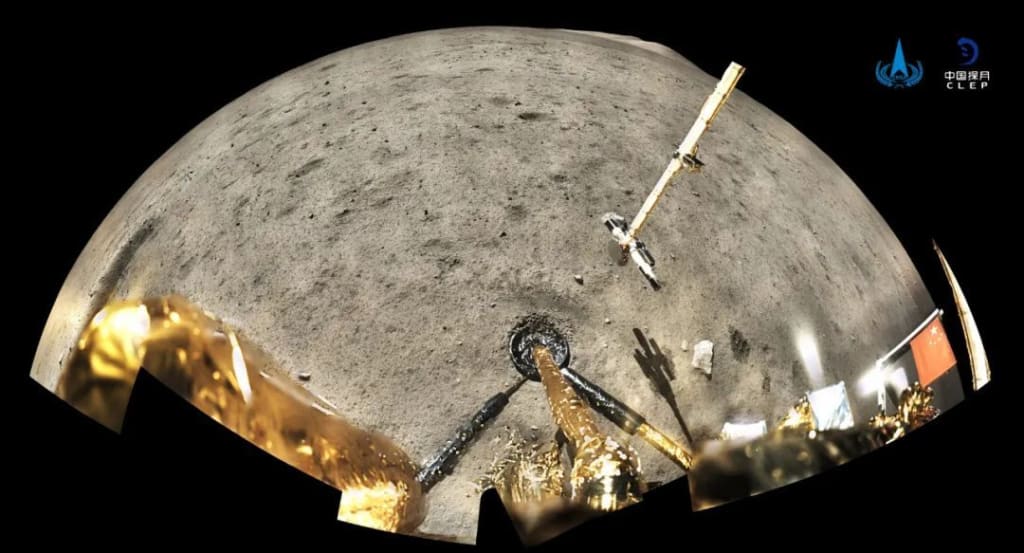
HELSINKI — NASA-funded researchers have been granted permission to apply for access to China’s Chang’e-5 lunar samples in an exception to a prohibition on bilateral activities.
An internal email sent Nov. 29 informed NASA researchers that they would be able to apply to the China National Space Administration (CNSA) for access to portions of samples collected by China’s Chang’e-5 mission.
“NASA has certified its intent to Congress to allow NASA-funded researchers to apply to the China National Space Administration for access to lunar samples returned to Earth on the Chang’e-5 mission and made available recently to the international scientific community for research purposes,” the email read.
The move opens the rare possibility of cooperation between China and NASA-funded entities and researchers. It also comes despite NASA Administrator Bill Nelson’s strong rhetoric towards China and his stated support for maintaining ongoing restrictions on collaboration.
About the Creator
Philippines Paper Bags Market: Packaging Shifts, Environmental Policy & Changing Consumption Patterns
Philippines Paper Bags Market Overview The Philippines paper bags market is undergoing a structural shift as environmental regulation, packaging reform and consumer awareness increasingly influence material choices across industries. According to IMARC Group, The Philippines paper bags market size was valued at USD 28.59 Million in 2025 and is projected to reach USD 46.95 Million by 2034, growing at a compound annual growth rate of 5.66% from 2026-2034. This expansion reflects gradual but consistent changes in packaging practices rather than a single disruptive trend.
By Manisha Dixita day ago in Earth
How, Too
Many people wonder how, too. You are not alone, and I am an expert. I will teach you how, too! First, you need to remit a small application fee and fill out an application describing the nature of your financial situation and how often payments will be made, as this will have great bearing on how well I teach you how, too.
By Harper Lewis6 days ago in Fiction




Comments
There are no comments for this story
Be the first to respond and start the conversation.