
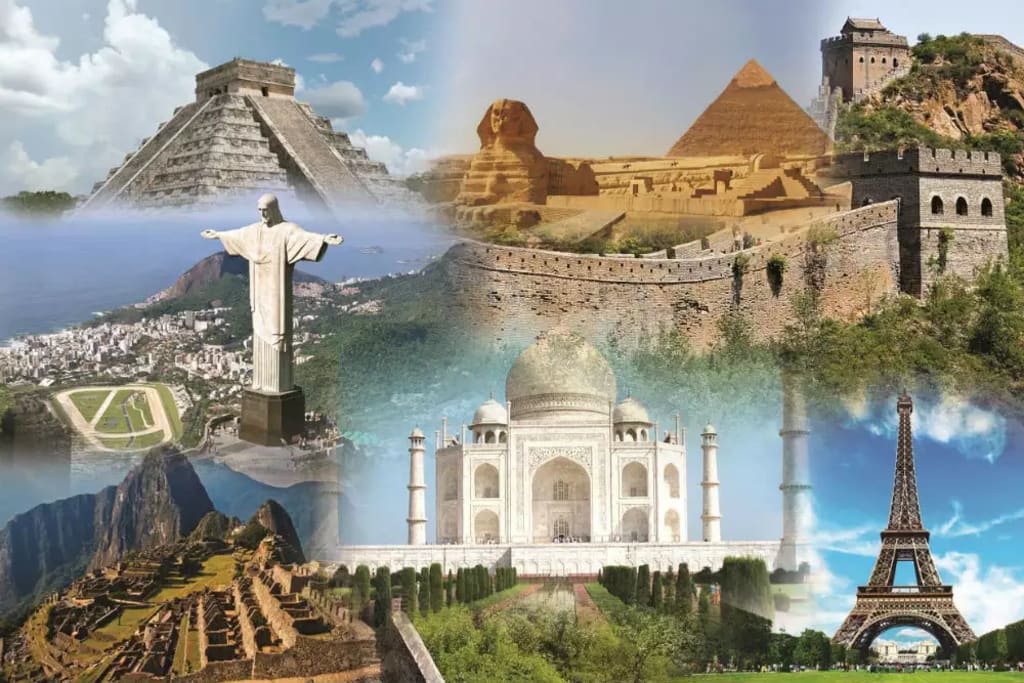
The Seven Wonders of the Ancient World have long captivated historians, travelers and scholars throughout the centuries with their majestic splendor and architectural achievements. The Seven Wonders of the Ancient World were considered to be the most impressive structures erected between the 3rd and 1st millennia BCE. Built by the Greeks, Babylonians, Egyptians, Chinese and Persians, the monuments were recognized for their architectural wonder and impressive scale.
The Seven Wonders of the Ancient World are the Great Pyramid of Cheops, Hanging Gardens of Babylon, Colossus of Rhodes, Temple of Artemis at Ephesus, Statue of Zeus at Olympia, Mausoleum at Halicarnassus, and the Lighthouse at Alexandria.
The Great Pyramid of Cheops is the most famous and recognizable of the Seven Wonders of the World. Located in Giza, Egypt, it is the oldest of the seven and the only one that remains substantially intact. Constructed from 2.3 million blocks of stone, the Giza Pyramid is one of the largest and most well-preserved monuments from the ancient world.
The Hanging Garden of Babylon was constructed by Babylonian King Nebuchadnezzar II in 600 BCE. The Hanging Garden is thought to have been a terraced garden filled with exotic, intricate plants and trees. It was said to have been suspended between the walls of the city, creating an oasis within the city’s walls.
The Colossus of Rhodes was a massive bronze statue of Greek god Helios that stood over 30 meters tall at the entrance of the harbor in Rhodes, Greece, once dubbed the “Sun-God of Rhodes.” The statue was constructed in 280 BC and destroyed in 225 BC, but it remained one of the most awe-inspiring of the Seven Wonders of the Ancient World for many years.
The Temple of Artemis at Ephesus was an ancient Greek temple dedicated to the goddess Artemis. Located in modern-day Turkey, the temple was an impressive sight, constructed entirely of marble and standing 115 feet tall. Built between 550 and 350 BC, the temple was destroyed and reconstructed several times over a period of approximately 1000 years.
The Statue of Zeus at Olympia was created by Phidias, an accomplished Greek sculptor. Constructed in 435 BC, the statue represented the god Zeus seated on an elaborate throne inlaid with ivory and gold. The statue was estimated to have been between 40 and 50 feet tall and considered to be the world’s first truly colossal sculptural work.
The Mausoleum at Halicarnassus was built in 353 BC to honor King Mausolus. The Mausoleum was an impressive structure, constructed of marble and decorated with detailed sculptures. It stood an estimated 90 feet tall and was considered to be the grandest of its day.
The Lighthouse of Alexandria was constructed in the 3rd century BC by the Pharaoh Ptolemy and became one of the greatest engineering feats of its time. Located on the coast of the Mediterranean Sea, the lighthouse was said to have been an impressive sight, standing approximately 400 feet tall. The structure served as a beacon for travelers and merchants, guiding them safely into the harbor.
These Seven Wonders of the Ancient World, created hundreds of years ago and over vast distances, remain some of the most impressive and iconic structures of the ancient world. They were recognized in antiquity for their remarkable scale, beauty and engineering skill, and remain so today. Although they are now long gone, their memory continues to endure in the hearts and minds of those who are inspired by them.
1. Taj Mahal: Located in the city of Agra, India, the Taj Mahal was built by Mughal Emperor Shah Jahan in memory of his beloved wife, Mumtaz Mahal who died in childbirth. The Taj Mahal is recognizable by its ivory-white marble walls and domes that are topped with four minarets. Completed in 1648, this beautiful monument is considered to be a symbol of eternal love and is one of the world’s most recognizable symbols of Islamic architecture.
2. Great Wall of China: Located in northern China along the former border of, the Great Wall of China is the longest wall in the world at over 3,000 miles in length. Constructed to protect the Chinese Empire from invaders, this massive wall was built around 600 BC and was continually modified over the years. It was made from rammed earth, stones, and other materials, and it has been uncovered and restored over the years.
3. Petra: Located in present-day Jordan, Petra is a city carved out of the rose-colored rocks of the Arabian desert. Believed to be over 2,000 years old, legend has it that it was built by the ancient Nabateans to protect their homes and wealth from invaders. The city contains several unique monuments, including the Grand Deir, the Mothbab Temple, and the Siq, a narrow gorge that visitors pass through to reach the city.
4. Christ the Redeemer: One of the most famous monuments in the world, the Statue of Christ the Redeemer is located on top of Corcovado Mountain in Rio de Janeiro, Brazil. This art deco style statue, created by Brazilian artist Paul Landowski, stands 125 feet tall and is made of reinforced concrete and soapstone. It was dedicated in 1935 and is now one of the modern wonders of the world.
5. Chichen Itza: Located in Mexico's northern Yucatán Peninsula, Chichen Itza is a remarkable Mayan religious site and former city that is now a UNESCO World Heritage Site. It was built around 5th and 6th centuries and includes several unique structures such as El Castillo, a 365-step pyramid, the Temple of Warriors, and the Sacred Cenote. It remains a popular tourist attraction to this day.
6. Machu Picchu: Located in the Andes mountains of Peru, Machu Picchu is an Inca citadel built between the 15th and 16th centuries. The site includes over 150 unique buildings, such as terraces, plazas, temples, and tombs, all of which are connected by stone paths and steps. It was rediscovered in 1911 and has become one of the most popular tourist destinations in South America.
7. Colosseum: One of the most iconic structures from the Roman Empire, the Colosseum is located in the center of Rome, Italy. Built in 70-72 AD, this amphitheater is a near-perfect example of the Roman engineering and architecture at its finest. It was used to host a variety of events, such as gladiatorial combat, public spectacles, and public shows. It is now a major tourist destination in Italy and one of the most recognizable structures of its kind.
About the Creator
Keep reading
More stories from Gayathri Vinayagam and writers in Earth and other communities.
The story of match box
Once upon a time in a small village nestled in the lush countryside, there lived a humble matchbox named Milo. Milo was no ordinary matchbox; he had a magical power bestowed upon him by an ancient wizard. With a single strike, he could light up the darkest corners of the world. But Milo had never ventured beyond the confines of the little cottage where he was kept.
By Gayathri Vinayagam3 years ago in Earth
Discovery of the “Word Fish” That Lived Millions of Years Ago
In a groundbreaking paleontological discovery, scientists have unearthed the fossilized remains of an ancient fish species that lived millions of years ago, now being referred to as the “Word Fish.” This remarkable find, preserved in near-perfect condition, is providing researchers with a unique glimpse into marine life from a time long before humans walked the Earth.
By Irshad Abbasi 2 days ago in Earth


Comments
There are no comments for this story
Be the first to respond and start the conversation.