
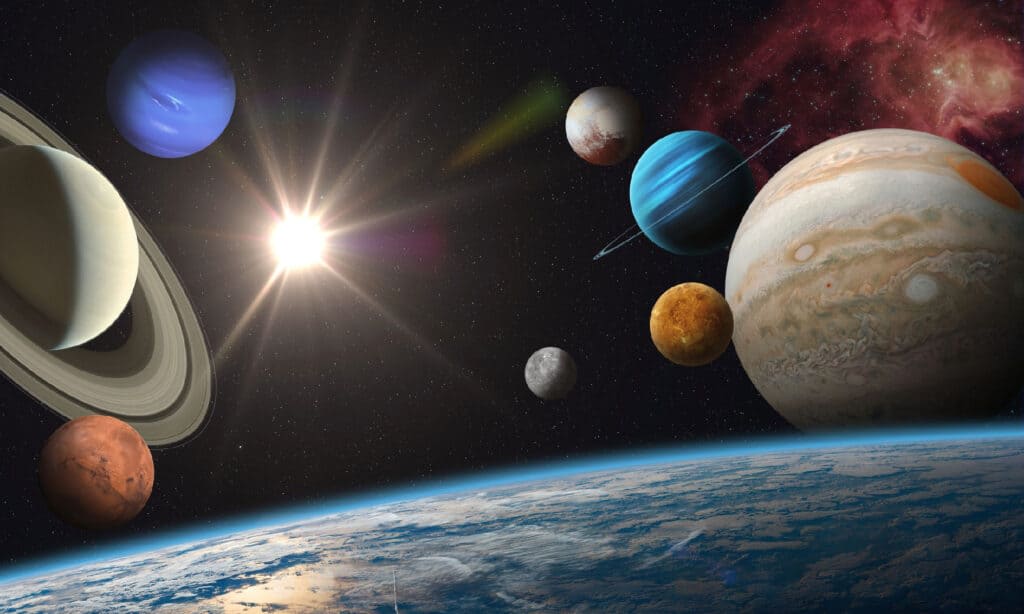
Jupiter, the largest planet in our solar system, is an awe-inspiring celestial body. Its massive size is so immense that it could accommodate over 1,300 Earths within its boundaries. To further illustrate its enormity, Jupiter is two and a half times more massive than all the other planets combined. However, amidst this mind-boggling information, an exciting discovery has recently captivated astronomers worldwide.
A team of dedicated astronomers, employing the Subaru telescope and the NASA Hubble Space Telescope, has stumbled upon an even more colossal planet. This planet, reminiscent of Jupiter, is a protoplanet orbiting a very young star named AB Origi. The star, still in its formative stages, is merely five million years old, a mere fraction of the age of our own sun, which stands at approximately 4.6 billion years. AB Origi is nestled in the constellation of Araga, approximately 531 light-years away from our planet. It is surrounded by a rapidly moving veil of gas and dust, known as a disc, which serves as the building blocks for the star's eventual planetary system, including planets, dwarf planets, comets, and asteroids.
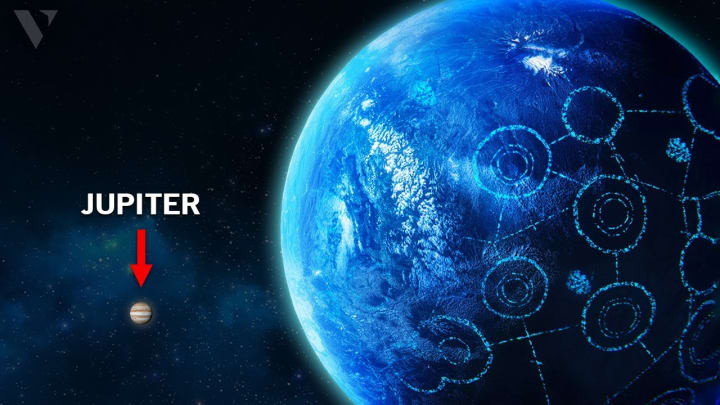
As for the newfound planet, it is a gas giant with a mass equivalent to nine Jupiters. It is named AB Origi B, and it takes this colossal entity almost 588 Earth years to complete a single orbit around its parent star. Presently, it resides at a distance of 93.9 astronomical units away from its star. The significance of this discovery lies in the peculiar manner in which AB Origi B has formed. Unlike the conventional model of planetary formation, where dust and rocks gradually accumulate around a central core, this gas giant is evolving through a top-down gravitational collapse of massive gas clouds. This unconventional method of planetary formation suggests the existence of diverse formation processes and the likelihood of the existence of various planetary systems within our home galaxy, the Milky Way.
It is noteworthy, however, that AB Origi B does not claim the title of the largest exoplanet ever discovered. In 2005, astronomers chanced upon a perplexing celestial body, later christened GQ Lupi b. This enigmatic object orbited a young star at a distance two and a half times greater than that between the Sun and Pluto. Scientists surmised that it could either be a planet or a brown dwarf—a diminutive star. If GQ Lupi b is confirmed as a planet, it would hold the record as the largest known planet, with a radius three and a half times that of Jupiter.
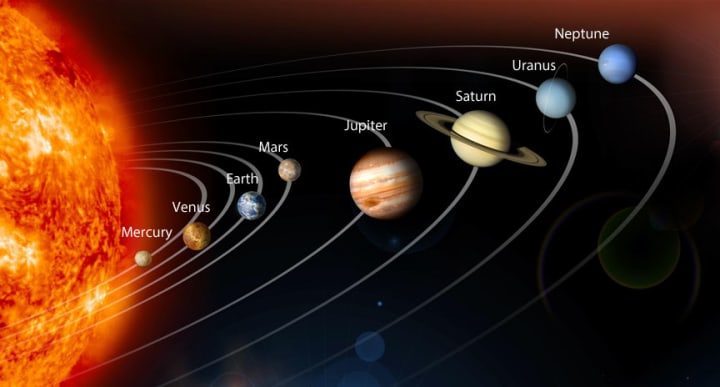
In terms of sheer scale, the most substantial known entity is a star known as UY Scuti, a hypergiant dwarfing our sun. UY Scuti possesses a radius approximately 1,700 times greater than that of our sun. To illustrate its enormity, if UY Scuti were positioned at the center of our solar system, its edges would extend far beyond Jupiter's orbit. This staggering comparison highlights the grandeur of celestial bodies in our universe.
While discussing massive entities, it is impossible to overlook the awe-inspiring power of black holes. These regions of space possess gravity so intense that even light cannot escape their clutches. Supermassive black holes, which can be millions of times more massive than the Sun, tend to reside at the centers of galaxies. The most massive black hole discovered to date is TON 618, with a mass equivalent to 66 billion suns. These fascinating celestial objects continue to captivate scientists and push the boundaries of our understanding of the universe.
Nebulae, massive clouds of gas and dust floating in space, add to the mystique of the cosmos. These structures often form when a star approaches the end of its lifecycle and releases
About the Creator
Without Democracy, Donald Trump’s Venezuelan Oil Quest Will Fail
Donald Trump’s renewed interest in Venezuelan oil may seem, on the surface, like a hard-nosed geopolitical calculation. Venezuela holds the world’s largest proven oil reserves, and amid global energy uncertainty, access to those resources is undeniably tempting. But history, economics, and politics all point to the same conclusion: without democratic reform in Venezuela, any attempt by a Trump-led US administration to secure reliable Venezuelan oil will ultimately fail.
By Aarif Lashari4 days ago in Earth
So You Decided To Become a Nurse Practitioner:
So you decided to become an "Advanced Practice" nurse. Congratulations!... is what I would say if this was a good idea. Grad school? In this economy? What were you thinking? Likely it was something along the lines of either 1) “I've seen these other chucklefucks do it— Why can't I?” or even 2) “I've got a nice career, I should shake it up. I miss feeling like I have no clue what I'm doing.”
By Sandor Szaboa day ago in Fiction


Comments