
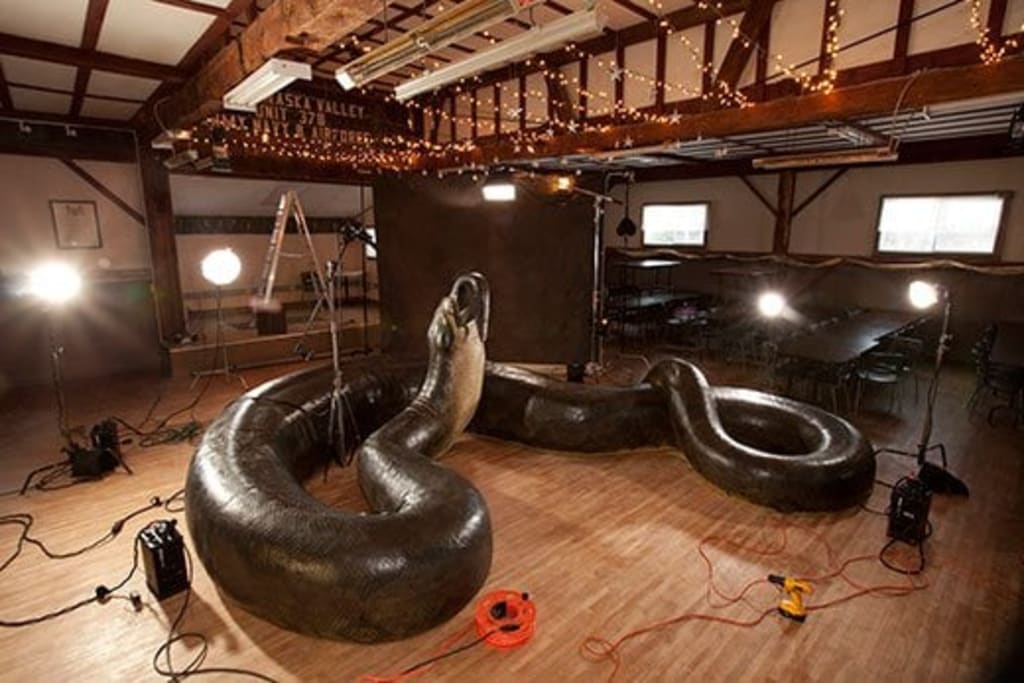
In the early 2000s, a geology major embarked on a field trip to the world's largest open-pit coal mine in Colombia. Little did he know that his discovery would contribute to the understanding of the largest snake ever to have roamed the Earth. While exploring the mine, he stumbled upon a piece of rock adorned with impressions of prehistoric leaves. Intrigued, he continued his search and found more rocks bearing the same pattern.
Recognizing the significance of his findings, the student sought the assistance of a local scientist, who promptly contacted the Smithsonian Institute and invited them to join in the fossil hunt. This invitation didn't come as a surprise since the presence of fossils in the pits of Cerrejón had been known since 1990 when another geologist discovered a fossil there, initially mistaken for a petrified branch. It was only years later, when a paleontologist examined an image of this "branch," that he recognized it as a fossilized jawbone of an ancient creature. Overwhelmed with excitement, he traveled to Colombia to examine the fossil firsthand.

Upon arriving, the scientists faced a small hurdle—they couldn't locate the key to the glass display case holding the fossil. Driven by their enthusiasm, they couldn't bear the wait, so they resorted to breaking the glass. Their actions were rewarded as they confirmed that the fossil indeed belonged to an animal that had roamed the Earth millions of years ago. Building upon the student's discovery, the team of scientists dedicated two years to deciphering the remains and eventually determined that they belonged to a colossal snake, not a crocodile as they had initially assumed. By studying the vertebrae and ribs of around 30 giant snakes, they conclusively established its identity.
Curiously, the fossils were found beneath layers of coal, which acted as a protective cover, safeguarding them from destruction. Unfortunately, despite their diligent efforts, the scientists were unable to locate the skull of the Titanoboa. Snake bones, unlike formidable jaws, are delicate and prone to crumbling over time, making skull fossils particularly rare. Nonetheless, the researchers managed to unearth three skull fragments, enabling them to create a full-scale replica of the snake's head. This reconstruction supported the hypothesis that Titanoboa was one of the largest predators of its time.

Titanoboa thrived approximately 60 million years ago, coexisting with the Tyrannosaurus Rex but in a completely different ecological niche. This gigantic snake basked in the warm climate of ancient South America, which is now represented by Colombia and Peru. Stretching nearly the length of a bowling lane, Titanoboa reached an impressive 50 feet—twice the length of the largest snake species alive today. Its weight rivaled that of four giant anacondas, which enabled it to attain such colossal proportions. This remarkable growth was made possible by the fortunate convergence of environmental factors. Snakes being ectothermic creatures, or cold-blooded, rely on external heat sources to regulate their body temperature and facilitate growth. The northeastern region of Colombia provided the perfect thermal conditions, with temperatures averaging around 90 degrees Fahrenheit during Titanoboa's existence.
Although not particularly swift on land, Titanoboa likely spent a considerable amount of time in or near water. It possessed the ability to swim at speeds of up to 12 miles per hour, similar to present-day snakes. Its remarkable agility allowed it to wriggle and change direction swiftly. Scientists speculate that Titanoboa had brownish or grayish skin, providing excellent camouflage in the muddy rivers of the tropical rainforest. Given its immense size, the giant serpent likely had no natural predators and could confidently dominate its environment. . . . . . . . . . .
About the Creator
"NASA satellites confirm that China’s Great Green Wall is effectively slowing desert expansion and reshaping entire regions
NASA satellite data has confirmed what scientists, policymakers, and local communities in China have hoped for decades: the Great Green Wall is working. Designed to slow the relentless expansion of deserts across northern China, this ambitious ecological project is not only reducing desertification but also reshaping entire regions—environmentally, economically, and socially. Often compared to Africa’s Great Green Wall, China’s version is one of the largest environmental engineering projects in human history. Officially known as the Three-North Shelter Forest Program, it stretches across northern, northeastern, and northwestern China, covering an area larger than many countries. Launched in 1978, the project aims to combat desert expansion, reduce sandstorms, protect farmland, and stabilize local climates through large-scale tree planting and vegetation restoration. For years, critics questioned whether planting trees in arid and semi-arid regions was sustainable. Some argued that trees would consume scarce groundwater, while others doubted whether satellite images could capture meaningful ecological change. Now, decades later, NASA’s satellite observations provide compelling evidence that the Great Green Wall is having a measurable and positive impact. According to satellite data, vegetation cover across northern China has increased significantly. Areas once dominated by shifting sand dunes now show stable plant growth, reduced soil erosion, and improved land productivity. These changes are not isolated; they span vast regions, indicating that the project is influencing ecosystems on a continental scale. Desert expansion, once advancing at alarming rates, has slowed dramatically in several high-risk zones. One of the most visible benefits has been the reduction in sandstorms. Cities like Beijing, which once endured frequent and severe dust storms originating from nearby deserts, have seen noticeable improvements in air quality. NASA imagery reveals that wind-blown dust has decreased as vegetation acts as a natural barrier, anchoring soil and reducing airborne particles. This has direct public health benefits, lowering respiratory illnesses and improving overall quality of life for millions of residents. Beyond environmental gains, the Great Green Wall is reshaping regional economies. Stabilized land allows farmers to reclaim fields once lost to encroaching deserts. In some areas, agroforestry—combining trees with crops—has created new income streams while maintaining ecological balance. Satellite data shows that these mixed-use landscapes are more resilient to drought and climate extremes than monoculture farming systems. The project has also influenced local climate patterns. Increased vegetation helps regulate surface temperatures and moisture levels. NASA observations indicate slight increases in local rainfall and reductions in surface heat in reforested zones. While these changes may seem modest, over large areas they contribute to more stable weather patterns and reduced vulnerability to climate shocks. However, the success of the Great Green Wall is not uniform. Satellite analysis also reveals areas where tree survival rates are low or where non-native species struggle to adapt. In response, China has adjusted its strategy, shifting from mass tree planting to ecosystem-based restoration. This includes planting native grasses and shrubs, restoring wetlands, and allowing natural regeneration where possible. The evolving approach reflects lessons learned from decades of experimentation. Another key factor behind the project’s effectiveness is long-term commitment. Unlike short-term environmental campaigns, the Great Green Wall spans generations. NASA’s ability to track changes over decades has been crucial in demonstrating progress that would be invisible on shorter timelines. This long-view perspective underscores an important lesson for global climate efforts: meaningful ecological recovery takes time, patience, and sustained investment. Internationally, China’s experience is drawing attention. Countries facing desertification—from parts of Africa to the Middle East and Central Asia—are studying the Great Green Wall as a model. NASA’s confirmation adds scientific credibility, showing that large-scale land restoration can work when supported by data, adaptive management, and local participation. Still, challenges remain. Climate change continues to intensify droughts, heatwaves, and extreme weather events, threatening fragile restored ecosystems. Experts caution that the Great Green Wall is not a permanent solution but a dynamic system that requires continuous monitoring, maintenance, and adaptation. Satellite technology will remain essential in identifying stress points and guiding future interventions. In the end, NASA’s findings do more than validate a single project—they reshape how we think about humanity’s relationship with nature. The Great Green Wall demonstrates that environmental degradation is not always irreversible. With science, long-term planning, and political will, even vast deserts can be slowed, reshaped, and partially healed. As the world searches for solutions to climate change and land degradation, China’s Great Green Wall stands as a powerful example: proof that large-scale environmental action, guided by data from space, can transform landscapes on Earth.
By Fiaz Ahmed a day ago in Earth
Miss Persephone's Manual to a Seemingly Ordinary Life
Miss Persephone was found at the dining table, her blue eyes swollen, her tears arriving and retreating like the tides of the ocean. Earlier that day, her family had visited her in the retirement home where she had lived for eight years. It was her eightieth birthday.
By Imola Tóth3 days ago in Fiction




Comments