
***SCIENCE TODAY!*** Mystery Methane Surge: A Glimpse into Earth's Past and Future
Exploring the Recent Surge in Methane Levels and Its Implications for Our Planet
Mystery Methane Surge: A Glimpse into Earth's Past and Future
Exploring the Recent Surge in Methane Levels and Its Implications for Our Planet
Introduction
In a world grappling with the complex issue of climate change, a recent scientific discovery has added a fascinating twist to the narrative. While discussions around global warming often revolve around human activities, a significant increase in methane levels on Earth has sparked curiosity among scientists. In this article, we'll delve into this unexpected discovery and its implications for our planet's climate.
Earth's Glacial Cycles: A Journey into the Past
To understand the context of the methane surge, we must first look back in time to Earth's glacial cycles. These cycles, known as quaternary glaciations, have been shaping our planet for the past 2.6 million years. They involve the periodic growth and retreat of immense ice sheets, and their patterns have played a crucial role in Earth's climate history.
Recent studies, particularly those involving ice cores from Antarctica, have revealed two distinct cycles in these glaciations, occurring roughly every 41,000 and 100,000 years. These cycles have led to repetitive periods of ice sheet expansion and contraction, with each cycle lasting between 80,000 and 120,000 years. The last major glaciation ended approximately 12,000 years ago, transforming our planet's landscape.
A Different World: Earth's Last Interglacial Period
The most recent interglacial period, occurring between glaciations, is particularly intriguing. Around 140,000 to 130,000 years ago, Earth was likely even warmer than it is today, with reduced ice volumes. During this period, various hominids, including early human ancestors, coexisted on a vastly different planet. Coastal regions, including the Mediterranean and the British Isles, had drastically different shorelines, offering habitats for diverse hominid populations.
Australia, too, underwent significant changes in its geography, with evidence suggesting that extensive land was available where oceans now exist. This was a time when various hominid species, including Neanderthals, Denisovans, and others, may have interacted, competed for territory, and even interbred. However, much of the history of these early civilizations has been obscured by the effects of rising sea levels and shifting landscapes.
The Enigma of Termination Events
Throughout Earth's glacial cycles, peculiar phenomena known as "termination events" have emerged as critical turning points. These events are characterized by abrupt temperature spikes, lasting just a few decades, followed by a sharp rise in methane levels. The consequences are profound, with temperature increases of up to 3 to 4 degrees Celsius and significant ecological transformations. Ancient tundra regions, for example, turned tropical during these periods, hosting peculiar creatures like glyptodons.
Methane's Mysterious Resurgence
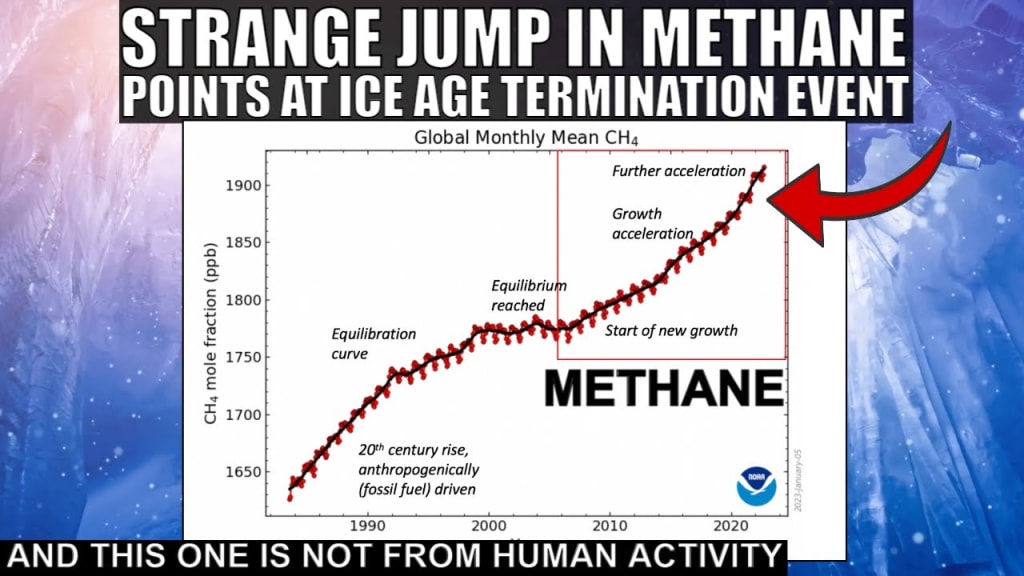
Fast-forward to the present day, where an unexpected phenomenon has scientists scratching their heads. Despite human emissions of methane stabilizing since the 1990s due to regulations and improved extraction technologies, global methane levels began skyrocketing in the late 2000s, accelerating their growth. This surge is particularly perplexing because there is no apparent dramatic shift in human activity to explain it.
Recent studies have pointed to tropical wetlands, likely in Africa, as the probable source of this methane surge. These wetlands may have expanded due to prior human-induced climate changes, leading to increased plant growth and subsequent methane emissions. This theory, often referred to as the Wetland Hypothesis, remains plausible, although other sources such as agricultural emissions and biomass burning cannot be ruled out.
Are We Entering Another Termination Event?
The most concerning aspect of this methane surge is its resemblance to past termination events. If this trend continues, we may find ourselves in another termination event, with dramatic temperature increases over the next few decades. While human activity may not be the primary contributor this time, its historical influence on climate change cannot be dismissed.
The Uncertain Future and a Ray of Hope
As we grapple with the enigma of rising methane levels, one thing is clear: methane, though potent, is not as persistent as carbon dioxide. It can be broken down by solar radiation within about 12 years. This means that if we act promptly to reduce methane emissions, much of the excess methane could dissipate by the mid-2030s.
In conclusion, while the sudden surge in methane levels presents a puzzling and potentially ominous scenario, it is a reminder of Earth's dynamic and unpredictable nature. We may be on the brink of a significant climate shift, but as history has shown, our planet has the capacity to adapt and evolve. As we await further investigations and insights, the path forward remains uncertain.
About the Creator
Kyle Red
I am a passionate explorer of the fascinating interplay between biology, behavior, and well-being. With a keen interest the financial landscape, I delves deep into the science behind motivation, health, and success!
Why Pyrolysis Oil Must Carry ISCC PLUS Certification:
As the global economy shifts toward renewable energy and circular solutions, pyrolysis oil—a liquid derived from the thermal decomposition of waste plastics, biomass, or other organic materials—has emerged as a promising alternative to fossil fuels. However, its role in sustainable energy systems comes with regulatory and ethical responsibilities. One of the most critical requirements is that pyrolysis oil must possess ISCC PLUS certification, a standard ensuring its sustainable origin and responsible use in industrial and energy applications.
By Bestonpyrolysis6 days ago in Earth


Comments (2)
Great work!
Thanks for reading my article, whoever sees this. Big shout out to my biggest fans: Sue C