
***SCIENCE TODAY*** Discovering the Closest Black Holes to Our Solar System
Unravelling the Mystery of Stellar Mass Black Holes in the Hiatus Cluster
Discovering the Closest Black Holes to Our Solar System
Unravelling the Mystery of Stellar Mass Black Holes in the Hiatus Cluster
Introduction
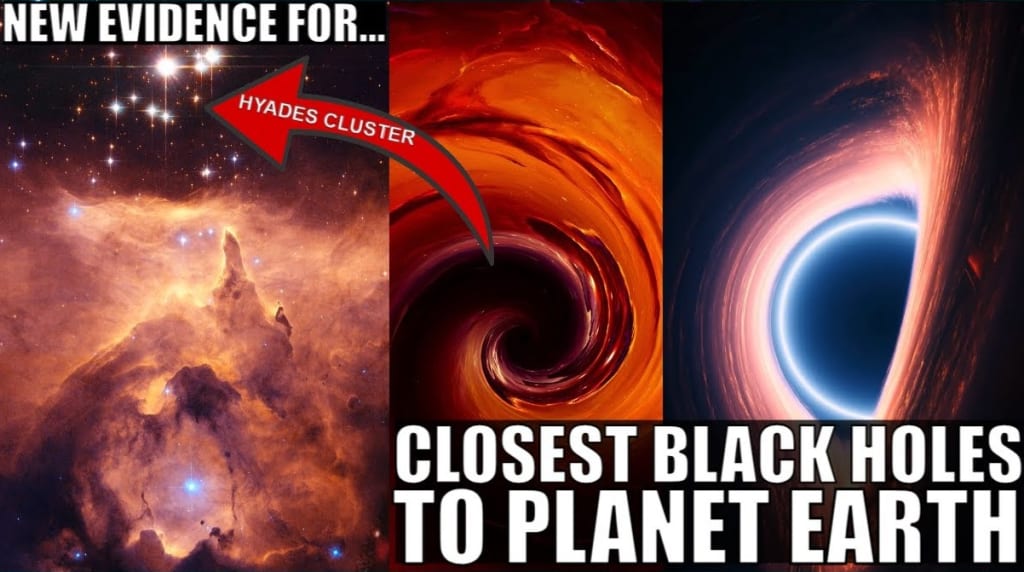
In recent years, astronomers have been on the quest to discover the nearest black holes to our solar system, posing one of the most intriguing challenges in modern astronomy. These elusive entities, known as Stellar Mass black holes, typically result from massive stars going supernova, boasting an average mass of around 10 times that of our Sun. Unlike the massive black holes that lurk at the centre of our Milky Way galaxy, these smaller counterparts are trickier to find, often requiring unique detection methods. In this article, we delve into a recent study that hints at the existence of potentially the closest black holes to Earth, located a mere 153 light years away, within the Hiatus Cluster. While these findings are statistical in nature and not direct observations, they open a new frontier in our understanding of these enigmatic cosmic objects.
Exploring Stellar Mass Black Holes
Traditionally, black holes in our galaxy have been discovered through their interactions with companion stars. As a black hole absorbs mass from its partner, it becomes what is known as an X-ray binary, emitting powerful X-ray and other frequency emissions detectable from thousands of light years away. However, these X-ray binaries are relatively distant from Earth and not as numerous as one might expect, given the predicted presence of over 100 million black holes in our Milky Way galaxy due to past supernova events.
The Gaia Telescope's Contribution
Recent studies have shifted their focus to alternative methods of black hole detection, such as gravitational lensing effects and gravitational anomalies exhibited by nearby stars. One significant discovery came from the Gaia telescope, which confirmed the existence of Gaia bh1, potentially the nearest black hole to us at approximately 1,600 light years away.
The Hiatus Cluster
The Hiatus Cluster, situated in the Taurus constellation, presents a unique opportunity for astronomers. Unlike the long-lasting globular clusters, which endure for billions of years, open clusters like Hiatus are relatively short-lived, dissolving over the course of about a billion years. Hiatus is estimated to be around 625 million years old and spans about 33 light years across, with a dense core measuring about 8.8 light years in diameter. Notably, most of the stars here are relatively small, with larger ones having already transformed into white dwarfs, neutron stars, or black holes.
Chasing the Hidden Black Holes
Scientists conducting the recent study scrutinized the Hiatus Cluster using data from the Gaia telescope. They focused on the positions and velocities of stars within the cluster, which had been measured with extreme precision. What they found was intriguing – the observed positions and velocities did not match up until they introduced the possibility of two to three Stellar Mass black holes like Gaia bh1 in the centre of the cluster. This discrepancy suggested that hidden black holes were altering the orbits of the cluster's stars.
The Challenge of Confirmation
Confirming the existence of these hidden black holes remains a formidable challenge. Black holes, unlike white dwarfs, are invisible, and detecting them requires unique circumstances, such as the emission of X-rays or gravitational lensing effects when they pass in front of stars. Future telescopes, like the Nancy Grace Roman Telescope, may offer a chance to observe such effects, but as of now, confirmation remains elusive.
Conclusion
The Hiatus Cluster emerges as a compelling contender for housing the closest black holes to Earth, potentially located just 153 light years away. While these findings are based on statistical simulations rather than direct observations, they underscore the exciting possibilities that modern astronomy offers. The existence of these hidden black holes could unravel mysteries about the stellar evolution within clusters and the prevalence of black holes in our galaxy. Until future discoveries shed more light on this tantalizing cosmic puzzle, we can only marvel at the secrets that may be lurking within the Hiatus Cluster.
Please like and subscribe for more articles on new and exciting developments in the scientific community.
And share with someone who’s interested in space and sciences.
Thank you for reading, until next time.
About the Creator
Kyle Red
I am a passionate explorer of the fascinating interplay between biology, behavior, and well-being. With a keen interest the financial landscape, I delves deep into the science behind motivation, health, and success!
The Problem with Invasive Plants: Identification and Responsible Removal
This scenario plays out in gardens across the continent. Many invasive plants started as intentional garden introductions, valued for their beauty, vigor, and ease of growth. Those same qualities—rapid spread, adaptability, and resilience—make them ecological threats when they escape cultivation.
By Emma Wallace6 days ago in Earth




Comments (1)
interesting . wish i could attach a picture of my black hole to this comment ...