
Return to the Moon: Fear of Decline Disguised as Conquest
Humanity hasn't set foot on the Moon for decades

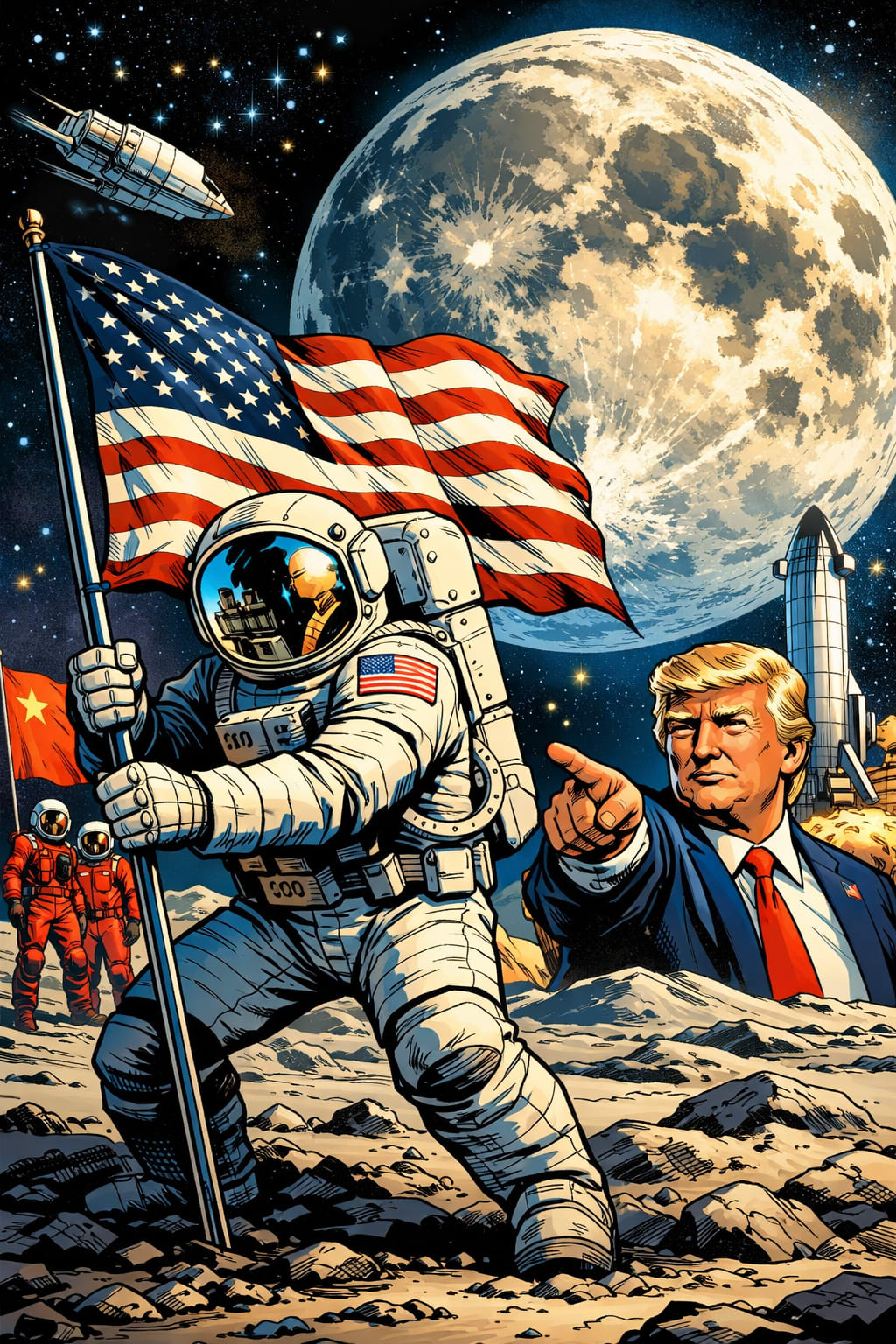
Humanity hasn't set foot on the Moon for decades. This fact, seemingly trivial, is actually dizzying. Over half a century has passed, and here we are, gazing at this celestial body we've once trod upon, without daring to return. It's as if that giant leap closed a chapter rather than opening a new one. As if the feat was so monumental it couldn't be repeated without losing its magic. Or, more bluntly, as if we'd lost faith in a future that extends beyond our little blue planet.
The Moon has become a frozen symbol of the past, a relic of the 20th century. A faded photo, recycled in TV documentaries, anniversary speeches, and nostalgic daydreams of an era when "progress" still rhymed with pure optimism.
And then, suddenly, it thrusts itself back into the spotlight. Trump declares we must return, and fast, before China gets there. Not like revisiting an old memory—no: like reclaiming a stronghold we consider ours by divine right.
This comeback isn't innocent. It's political before it's scientific, strategic before it's humanistic. It's the raw expression of a contemporary anxiety: the terror of being overtaken, of losing our spot at the top of the civilizational pyramid.
Because what Trump calls a "return to the Moon" is first and foremost a refusal. A refusal to let history be written without the United States as the lead actor. A refusal to accept that the 21st century isn't just a pale sequel to the last.
In the '60s, Apollo embodied unshakable confidence. Today, it feels more like a desperate catch-up, a race to avoid being left behind.
The difference is huge. Back then, Americans looked to the future with touching naïveté: tomorrow would be bigger, bolder, inevitably better. The Moon was just a launchpad to Mars, then the stars, and beyond. Progress flowed naturally.
These days, nothing is guaranteed. The future scares us, with its climate crises, shortages, simmering wars, and tech that races ahead faster than our ethics can keep up. Progress? We fear it as much as we crave it.
So this lunar return isn't a joyful conquest anymore—it's a collective lifeline, a way to reassure ourselves.
China, meanwhile, advances without looking back. No Apollo in its history books, no Armstrong to idolize. For them, it's not a "return," just a pragmatic "go." Cold, methodical, no frills. They talk dates, not myths. Position, not imagery.
And that's exactly what freaks America out. A power that progresses without needing to justify itself is often more formidable than one that parades. China doesn't have to prove its greatness; it assumes it as obvious. It thinks in decades, while Western democracies drown in election polls.
Trump counters with speed: we have to be first, no matter what. Even if the project leans on private companies, massive technical risks. What matters is the timeline, the symbol, the photo finish.
The Moon turns into a propaganda tool. But it raises a profound philosophical question: is a conquest driven by fear worth as much as one born from pure curiosity?
Space exploration, at its core, is human self-transcendence. Understanding our place in the universe, pushing limits to know, not to dominate. Yet today's rhetoric reeks of military jargon, competitiveness, strategic superiority.
We no longer talk discovery, but control. No longer exploration, but securitization.
That's where the project cracks morally.
A sharp skeptic might say: it's all theater. Returning to the Moon won't fix climate, hunger, or injustice. It won't feed or heal anyone.
That's rational, even ethically sound. But incomplete. Humanity doesn't run solely on immediate fixes. It needs grand narratives to give meaning to collective effort. A civilization that locks itself in its urgencies ends up suffocating.
The real danger isn't spending cash on the Moon. It's not knowing why we're doing it anymore.
And that vagueness is scary. In Trump's rhetoric, the Moon isn't a catalyst for human change—it's a frontline. A way to shout: "We're still here!" It betrays a deep identity crisis: America dreading becoming just one power among many.
The Moon becomes a merciless mirror, revealing our fears more than our tech feats.
Are we still capable of selfless collective projects? Or has exploration become just an extension of our earthly squabbles?
There's bitter irony here. We didn't leave the Moon because we'd seen it all. We abandoned it out of boredom, because the feat stopped paying political dividends. Not impossibility—disinterest.
Today, we're going back out of strategic necessity, not desire.
It says a lot about our era. We no longer dream naturally of space; we're pushed there by fear that others will write their story in our place. The dream has gone defensive.
Mars, in this light, is telling. Mars is total utopia: a chance to reinvent humanity elsewhere, rethink everything from scratch. It demands humility, exposes our weaknesses.
The Moon? Cozier. Close, manageable. We play explorer without upending our societies.
By prioritizing the Moon over Mars, Trump chooses pure conservatism. The reassuring known over the radical unknown. Repetition over revolution.
Politically savvy, morally debatable.
Yet it'd be too easy to dismiss it as pure PR. Even twisted, even manipulated, the idea of going back up there awakens something fundamental: the refusal to stay trapped on Earth.
In a world drowned in screens, data, looping crises, and alarmist talk, aiming for a cosmic goal is almost rebellious.
The Moon reminds us we're not doomed to circle ourselves. There are silences to conquer, voids that don't lie, places where ideologies melt before raw gravity.
The question isn't who plants the flag first, or if Trump keeps his promise.
The real, uncomfortable one: what will we do with this return if we succeed?
If it becomes a military base, a mining site, a giant selfie, then it's a moral failure, even with technical success.
But if it becomes a space for reflection again, a reminder of our smallness, a lab for collaboration over domination, then this second step might mean more than the first.
The Moon expects nothing from us. It doesn't judge, doesn't reward. It just reflects who we are.
In 1969, it mirrored a bold, innocent humanity, convinced the future was theirs.
In the coming years, it will reflect an anxious, rivalrous one, obsessed with its rank.
This return isn't regression. It's a test. Of maturity, clarity, meaning.
And perhaps, deep down, the ultimate question it poses is the simplest and harshest:
Are we still capable of gazing at the sky without wanting to own it?
JLP
About the Creator
Laurenceau Porte
Chroniqueur indépendant. J’écris sur l’actualité, la société, l’environnement et les angles oubliés. Des textes littéraires, engagés, sans dogme, pour comprendre plutôt que consommer l’information.
Keep reading
More stories from Laurenceau Porte and writers in Earth and other communities.
Beneath the Surface, a Growing Silence
It reflects the sky like a still mirror, and the boat glides forward gently, without jolt or hurry. All around, everything seems unchanging. The islands present themselves as a refuge outside of time, an untouched promise. The word paradise comes naturally, as if it were obvious.
By Laurenceau Porte3 months ago in Earth
Astronomers Capture Rare Evidence of Two Planets Colliding
Astronomers have gathered rare and compelling evidence suggesting that two planets collided in a distant star system, producing a dramatic cosmic event that has fascinated scientists around the world. Planetary collisions are believed to have played a major role in shaping many solar systems, including our own, but witnessing the aftermath of such a violent event is extremely rare. The new discovery offers valuable clues about how planets grow, change, and sometimes destroy each other during the chaotic early stages of planetary formation.
By Irshad Abbasi 4 days ago in Earth
A Transparent Look at Vocal Challenges and Top Stories
Almost three years ago, we shared a resource article that served as a place for people to suggest new challenge prompts. We thought it would be a good idea to refresh that thread, and take the opportunity to answer a few common questions about top stories, how challenges are judged and how submissions are reviewed.
By Vocal Curation Team4 days ago in Resources



Comments
There are no comments for this story
Be the first to respond and start the conversation.