
Beneath the Surface, a Growing Silence
The water is clear, almost defiantly beautiful.


It reflects the sky like a still mirror, and the boat glides forward gently, without jolt or hurry. All around, everything seems unchanging. The islands present themselves as a refuge outside of time, an untouched promise. The word paradise comes naturally, as if it were obvious.
Yet beneath the surface, something is fading away.
Corals do not die with a bang. They do not collapse dramatically. They vanish slowly, out of sight, without spoiling the postcard view. Their agony is silent, almost courteous. It disturbs neither the vacationers nor the travel brochures.
A reef can still give the illusion of life long after it has ceased to be more than a shell. The structures remain, frozen—sometimes bleached white, sometimes still colored on the surface. A few fish drift by, aimless. But the ecosystem itself no longer breathes. Coral is not rock. It is a living organism, fragile and patient, whose growth is measured in decades. Against that biological slowness, we impose the speed of our own uses.
It takes years for it to grow a few centimeters.
We can damage it in an instant.
Mass tourism is not a brutal assault. It is a constant presence. A daily repetition. An unrelenting pressure, without pause. Boats anchor, leave, return. Divers descend—sometimes poorly supervised—touching without thinking, stirring up sediment, upsetting the balance. Sunscreens dissolve slowly, invisible yet persistent. None of these actions seems serious in isolation. Together, they become destructive.
The reef was never designed to be a permanent spectacle.
To this quiet exhaustion is added another, even less visible wound: overfishing. Nets are cast, catches multiply, species disappear. First the noticeable ones, then those whose essential roles go unnoticed. Herbivorous fish grow scarce. Algae proliferate. They smother the coral, block the light, hasten its death.
The reef does not collapse.
It empties.
From a distance, everything still seems to function. Up close, the balance is broken.
We rightly point to climate change. Waters warm, bleaching events multiply, fragility increases. But reducing the disappearance of reefs to this single cause is an intellectual shortcut. Where local human pressures are limited, some reefs hold on better. Where tourism and overfishing have already weakened the ecosystem, the slightest shock becomes fatal.
Climate change weakens.
Local human activities deliver the final blow.
Then comes the inevitable counter-argument: the economy. Without tourism, without fishing, how would local populations survive? The question is valid. But it conceals a profound contradiction. A dead reef feeds no one. It attracts no one. It sustains no lasting economy.
This model relies on the rapid consumption of a natural capital that renews itself slowly, almost imperceptibly on a human timescale. It is a flight forward. An ecological debt we keep postponing without ever facing it.
The visitor, however, is not the designated culprit. He is an unwitting witness. He swims above dying reefs and believes he is surrounded by life. He photographs what he does not yet know is already lost. He leaves with bright memories while, underwater, silence settles in.
The tragedy of the corals is not merely environmental. It is revealing. It shows our ability to love nature as long as it remains beautiful, accessible, profitable. It exposes our difficulty in accepting that preservation sometimes requires renouncing, limiting, stopping.
Coral reefs cover less than one percent of the oceans, yet they harbor an immense share of marine biodiversity. Their disappearance will make no noise. It will happen gradually, while boats continue to glide over water that remains just as blue.
One day, only the surface will remain.
And nothing beneath it.
JLP
About the Creator
Laurenceau Porte
Chroniqueur indépendant. J’écris sur l’actualité, la société, l’environnement et les angles oubliés. Des textes littéraires, engagés, sans dogme, pour comprendre plutôt que consommer l’information.
Keep reading
More stories from Laurenceau Porte and writers in Earth and other communities.
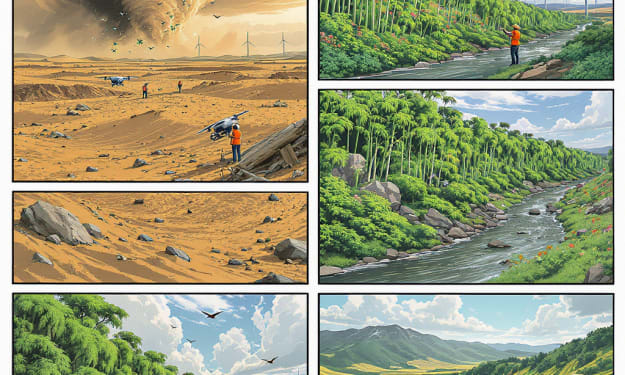
Chinese Planetary Engineering: The Great Green Wall and the Reclamation of Climate
There are junctures in history where a civilization no longer chooses between comfort and progress, but between adaptation and extinction. At the dawn of the new millennium, China hit one of those silent thresholds where geography ceases to be a backdrop and becomes an adversary. The desert was advancing, not as a metaphor for decay, but as a physical, methodical, and relentless force. Sand was devouring the horizon, winds grew heavy with dust, and the soil lost its fertile memory, taking with it the promise of social stability.
By Laurenceau Porte2 months ago in Earth
Tatt~Master
— Assembly Line Tatt Machine ~ Impressions to Impress — As I begin to understand more about the Tattoo Phenomenon. I've written silly, yet verbatim, dating site anecdotes in 'Frazzled.' So let me ask you: Would you be More attracted to someone slathered with tattoos, or Less?
By Jay Kantor3 days ago in Humor


Comments
There are no comments for this story
Be the first to respond and start the conversation.