
Quetta’s Underground Emergency: A Disaster in Slow Motion
As the earth quietly collapses beneath the valley, an entire city edges closer to an unseen catastrophe.

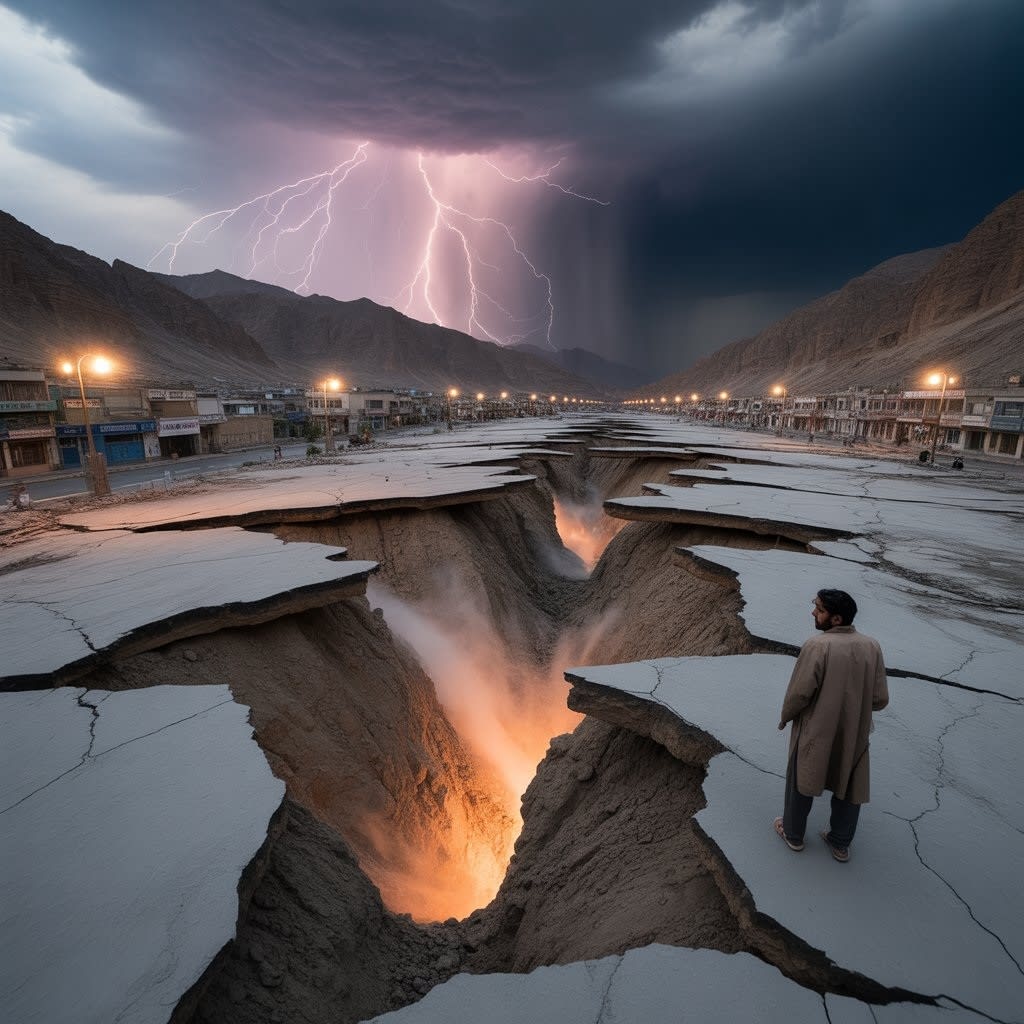
Quetta—heart of Balochistan, a city resting peacefully in the arms of rugged mountains—has always been a symbol of resilience. Its cold winds, narrow streets, and warm-hearted people give it a character no other city can mimic. But recently, beneath the calm surface of this historic valley, something has begun to change—quietly, slowly, and dangerously.
Over the last few months, reports of land subsidence have shaken the city. Roads have begun to dip, houses have developed sudden cracks, and the earth itself seems to be shifting. At first, residents dismissed these signs as minor issues. But when the phenomena grew more frequent, fear—and questions—started spreading across the valley.
🔬 A Geologist’s Warning That Froze Everyone in Place
Dr. Jamil Baloch, a well-known geologist working with a local research institute, stepped forward with a troubling explanation.
His words were simple—but terrifying.
“The Quetta Valley has lost most of its underground water. The ground beneath the city is becoming hollow. When water disappears, the earth collapses… and this subsidence is a clear indication of deep structural weakening.”
He explained that his team had been monitoring the valley for months, and the data pointed toward a very real danger. Quetta’s underground structure is drying out at an alarming rate. What once supported the valley is now slowly turning into empty pockets of space—making the land unstable and vulnerable.
And instability in a region sitting directly on a fault line is a threat no one can afford to ignore.
🌍 A City That Has Known Devastation Before
Quetta is not unfamiliar with tragedy. In 1935, a catastrophic earthquake wiped out almost the entire city in a matter of seconds.
That memory—though nearly a century old—still echoes in history books, old photographs, and the collective fear of the region.
Dr. Jamil’s warning revived that fear:
“Experts have already predicted that Quetta is vulnerable to a major earthquake. Continuous land subsidence is not random—it’s a sign that tectonic pressure is building. The valley is changing from within.”
For many, these words felt like déjà vu—history attempting to repeat itself.
🚶♂️ The Story Through the Eyes of an Ordinary Resident
Every morning, Abdul Khaliq from Sariab Road stands outside his home, staring at the widening hole in front of his gate. At first, he laughed it off.
“Just rainwater,” he thought.
But when a second sinkhole appeared down the street, fear gripped his heart. One afternoon, while walking to the market with his young son, they watched the asphalt beneath them form a fresh crack—thin at first, then slowly stretching like a warning line.
People around them stopped. Some recorded videos. Others instinctively stepped back.
Khaliq held his son’s hand tightly.
He remembered the geologist’s words:
“The valley is hollowing out… the earth is losing its strength…”
He walked home silently, realizing that these cracks were not just fractures on the road.
They were messages.
💧 When the Earth Becomes Thirsty, The Danger Grows
Experts say Quetta’s underground water was extracted relentlessly for decades—through thousands of tube wells, uncontrolled pumping, and urban expansion.
But rainfall didn’t increase.
Natural recharge didn’t happen.
And the valley began drying from within.
Houses, shops, schools, markets—all stand on land that is slowly emptying out. The crust is thinning, weakening, whispering a message that many still struggle to hear.
⚠️ Predictions of a Future Earthquake
International and local institutions have repeatedly stated that Quetta sits in a high-risk seismic zone. Dr. Jamil reinforced this:
“We cannot stop earthquakes. But we can reduce the damage. We must rebuild according to modern seismic standards, regulate water extraction, and restore groundwater—otherwise the consequences will be severe.”
The warning was not about fear—it was about preparedness.
🏚️ A City Asking for Help in Silence
Quetta is still lively—its bazaars full, its chai shops crowded, its mountains standing tall.
But beneath that everyday normalcy lies a hidden tension.
Every new crack brings new questions:
Is this just ground settling?
Or is it the beginning of something bigger?
A silent cry seems to echo from under the valley—one that demands immediate attention.
🌱 A Ray of Hope—If Action Begins Now
The crisis is real, but the solution is still possible.
If the government and citizens work together to restore groundwater, control extraction, and strengthen buildings, Quetta may avoid another historical disaster.
For now, the valley stands beautiful as ever—but beneath that beauty, the earth murmurs a warning.
A whisper.
A tremor.
A plea…
that we must not ignore.
About the Creator
Ainullah sazo
Ainullah, an MSC graduate in Geography and Regional Planning, researches Earth’s systems, land behavior, and environmental risks. Passionate about science, he creates clear, informative content to raise awareness about geological changes.,,
Keep reading
More stories from Ainullah sazo and writers in Earth and other communities.
Martyrdom of Jawad Musa Leads to Guardianship Distribution for Gaza's Children
Chapter 1: The Dawn of Sacrifice The first light of dawn crept over Gaza, painting the rubble-strewn streets in hues of gold and ash. The air was thick with the scent of smoke and the distant echoes of artillery. In a small, bomb-battered home near the outskirts of the city, Jawad Musa tightened the straps of his medical vest, his fingers trembling not from fear, but from resolve. His wife, Amina, clutched their three-year-old daughter, Layla, to her chest, her eyes glistening with unshed tears.
By Ainullah sazo8 months ago in Earth
Mount Sinai, the World’s Oldest Monastery, and the Prophet’s Letter: Faith, History, and a Controversial Development Plan
At a sacred site revered by Muslims, Christians, and Jews alike, an ambitious modernization project has stirred debate after reports of graves being relocated—raising questions about heritage, memory, and the cost of progress.
By Irshad Abbasi 4 days ago in Earth


Comments
There are no comments for this story
Be the first to respond and start the conversation.