
Pope Francis (2013–2025): A Shepherd of the Streets
Called to the peripheries. Guided by faith, not fear.

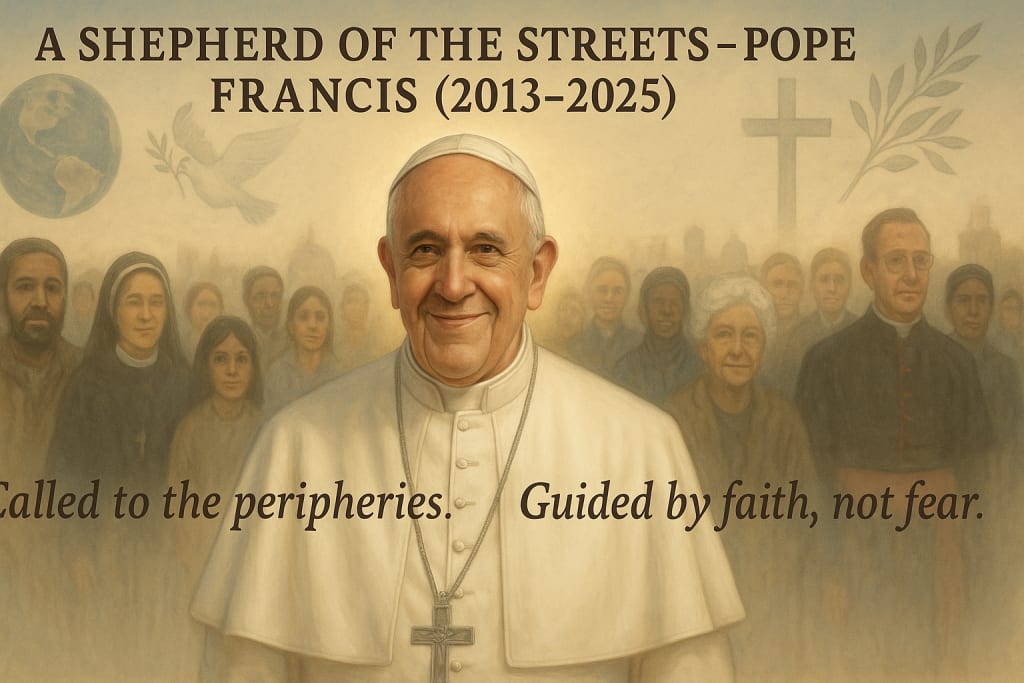
Pope Francis flashed a wide, easy smile frequently. He thrived on direct, informal encounters: phone calls, penned notes, hugs, audiences with small groups. He broke protocol by busing his own tray at the cafeteria, carrying his own overnight bag, and responding to reporters' questions extemporaneously. He was attentive, determined, testy, mercurial, sometimes deliberate, sometimes in a hurry, hard to read, and hard to pin down. When Francis was elected to the papacy at the age of 76, he brought those characteristics to the position for a period of twelve years—until he passed away on Monday—and over time, they became more refined rather than altered. That seems to have been the most important part of his time as Pope. He brought Roman Catholicism back to the street level and the papacy down to earth through pure personability, similar to what John XXIII had done six decades earlier when he convened the Second Vatican Council. It doesn't seem that long ago that Benedict XVI unexpectedly resigned—the first Pope to do so in six centuries—and Jorge Mario Bergoglio, the Cardinal Archbishop of Buenos Aires, was elected Pope. He remained a man who wasn't defined by his role despite Church scandals involving clerical sexual abuse and Vatican finances and open resistance from doctrinal and liturgical traditionalists. That was March, 2013, and the images from Francis’s first weeks in office are still fresh in mind: returning to the hotel where he’d stayed prior to his election to pay his bill, setting up residence in a plain modern guesthouse rather than the Apostolic Palace, trading the papal Mercedes-Benz for a Fiat. This Pope was new in many respects: the first Jesuit Pope, the first Pope from the Americas, the first to take the name Francis, after the Italian saint known for his embrace of poverty and his care for the natural world.
The years that followed were defined by a series of striking acts: the Pope answering a reporter’s question about gay clergy with the offhand “Who am I to judge?” Visiting refugee camps on Lampedusa and Lesbos and returning with a dozen refugees on the papal plane. Addressing a joint session of Congress. releasing the landmark encyclical "Laudato Si," which addresses the climate crisis. Six million people attended a Mass in the Philippines. during a time of civil war, traveling to the Central African Republic. Presiding over a Vatican summit on clerical sexual abuse, and defrocking a prominent cardinal, Theodore McCarrick, who was accused of multiple acts of abuse (which he has denied). visiting Benedict, the emeritus Pope, whose presence in a monastery behind St. Peter's became a symbol of the depths of traditionalist opposition to Francis's approach up until his death in 2022. Warning regarding the anti-immigration proposals of Donald Trump (we should "not raise walls but bridges"). Showing up at Russia’s Embassy to the Holy See in an aggrieved response to President Vladimir Putin’s invasion of Ukraine. Calling out Israel’s air strikes in Gaza for their harm to unarmed civilians. Authorizing priests to bless gay Catholic couples informally. Declaring the second Trump Administration’s program for mass deportations of migrants and refugees a “crisis” and indirectly rebuking Vice-President J. D. Vance for invoking Catholic theology in support of it; on Easter Sunday, the Pope met briefly with Vance, before offering a blessing to the faithful from St. Basilica of St. Peter Francis’s actions point to his main achievement: after a third of a century of leadership by Pope John Paul II and Benedict—men whose certainty about the state of the Church and the world made them implacable and controlling—Francis showed that Catholicism is an institution changing in spite of itself. For Catholics who saw his predecessors’ stress on inalterable absolutes as a weakness, not a strength, his recognition of social change and his willingness to foster progress in the Church came just in time.
Five months into his pontificate, Francis sat for a series of interviews with the Italian Jesuit Antonio Spadaro. Much had already been reported about his upbringing as a son of Italian immigrants to Argentina, his early plan to become a chemist, and his love of tango. However, the interview revealed Francis to be a complex and melancholy figure. He was a Catholic whose deep faith appeared more personal than theological or institutional, and he was a cleric who was simultaneously self-critical and critical of the Church he had been elected to lead. He acknowledged that, as a young provincial, or director, of the Jesuits of Argentina, he was “authoritarian,” often making hard decisions “abruptly and by myself.” Additionally, he offered a gut feeling regarding the mission and strategy of the Church. He had already stated that the Church was "called to go outside of itself and go to the peripheries, not just geographical but also the existential peripheries... of sin, of pain, injustice, and ignorance" and had framed a strategy for dealing with borders, refugees, and migration that was based on the Gospel's command to welcome the stranger. Instead of presenting positions on issues like abortion, contraception, and gay marriage as "a disjointed multitude of doctrines to be imposed insistently," he now envisioned the Church as a "field hospital" that "focuses on the essentials, on the necessary things" and strikes a balance among its moral teachings. The extemporaneous encyclical, as the interview came to be called, was striking in its candor. Here was a Pope speaking the language of belief with unstinting eloquence at a time when the Vatican was typically depicted as an underworld of sinister glamour, as in "The Da Vinci Code" and still in "Conclave." It may be that it all raised expectations that weren’t possible for any Pope to meet—especially among more progressive Catholics, who hoped that he would enact long-sought Vatican approvals of divorce and remarriage and the ordination of married men to the priesthood. (In these situations, he was erratic.) However, it's just as likely that he didn't normally put in a lot of effort into renewal. By definition, his charisma and one-on-one personal style could not be taken to scale: the very qualities that made him an attractive figure kept him from reinvigorating Catholicism along the lines he envisioned.
Francis himself followed his gut feeling. By appointing a group of advisory cardinals, he made the papacy more consultative; through trips to Georgia, Japan, Iraq, and Mongolia (countries where Catholics are tiny minorities), he faced the Church outward toward other religions. He emphasized with "Laudato Si'" and "Fratelli Tutti," a 2020 encyclical, that climate catastrophes, recessions, and pandemics have the greatest impact on the poor. When he was elected, he was a relative outsider to the Vatican. He internationalized the College of Cardinals, streamlined the Roman Curia, reopened dialogue on admitting women to the diaconate (a liturgical role that falls short of priesthood), and held a month-long synod in Rome to introduce Catholic leaders to consultative decision-making (during which a top deputy indicated that Francis was no longer considering the possibility of female deacons). He also named women to several However, those efforts were unsuccessful throughout the Church as a whole. That was in part due to the narrow clergy and bishops appointed by two traditionalist Popes, as well as sharp declines in Mass attendance and church membership among nominally Catholic populations, which were part of his legacy. It was due, especially, to the ongoing revelations of decades of clerical abuse—of how blithely the Catholic hierarchy worldwide had enabled clergy to sexually abuse countless young people, nuns, and Indigenous people entrusted to the Church’s care. The breaking waves of reportage, investigations, lawsuits, and bankruptcies upended the Church. Francis was directly involved in the crisis at a number of points, such as when he mocked the claims of Chilean victim survivors only to backtrack and say, "I was part of the problem." Then there was the resistance from conservative clergy and bishops, the most outspoken of whom branded Francis guilty of “heresy” and his pontificate a “catastrophe.” In this country, the hard right found affinities with some members of the Catholic hierarchy. Following his retirement, the conspiracy-minded Vatican diplomat Carlo Maria Vigan gained support in the United States. A screed in which he called on Pope Francis to resign garnered the support of two dozen American bishops. Traditionalists used Francis' restrictions on using the Latin Mass to create the impression that he was betraying the Church. Roe v. Wade's repeal The Catholic right was able to portray Francis's openness as not only heterodox but also foolish as a result of the Supreme Court's decision to uphold Wade. This was a blow to the "culture warrior" approach just as it was enjoying its greatest success. At several points, Francis drew attention for using procedural measures to sideline traditionalist churchmen whose critiques amounted to open revolt—among them were two Americans, Bishop Joseph Strickland of Texas and Cardinal Raymond Burke, a Wisconsin-born curial official—but he generally sought to avoid open conflict with traditionalists, or to unravel core Catholic teachings that they especially cherish. Although he spoke in interviews of the struggles of gay people and divorced people, for example, he left Catholic doctrine on marriage and sexuality untouched; even the approval of blessings for same-sex couples stressed that the teaching on marriage is unchanged.
Again, this was the paradox of Pope Francis: despite the fact that his temperament limited his measurable effects on global Catholicism and its 1.3 billion adherents, he became a significant figure on the international stage. Francis was the antithesis of a strongman in a historical era marked by autocrats and potential autocrats. He set the standard for world leadership as a shrewd, perceptive, and practical individual who faced difficult.
WRITTED BY ME
About the Creator
Mahafuj Alam
🗞️ Mahafuj Alam | News Curator & Independent Media Voice
delivering news quickly, accurately, and bravely, including headline breaking stories and untold local stories. Stay informed. Keep your power.
Keep reading
More stories from Mahafuj Alam and writers in Earth and other communities.
Vanishing Freshwater: A Hidden Driver of Sea Level Rise
Earth's landmasses are losing a lot more water than they used to, and this is happening not just because ice sheets are melting. Terrestrial water storage, which includes water in underground aquifers, lakes, rivers and the tiny pore spaces within soil, declined by trillions of metric tons in the early 21st century, researchers report in the March 28 Science.
By Mahafuj Alam10 months ago in Earth




Comments
There are no comments for this story
Be the first to respond and start the conversation.