
Polymerization of Teflon
"Synthesis and properties of Teflon"


1-Properties of Teflon
In the all above discussion we saw that Teflon has remarkable properties. It shows chemical inertness, electrical resistance properties, heat insulation, and shows non friction and non-stick properties over a wide range of temperature and pressure.
1.1-Density
Teflon has a density range of 2.1 to 2.3 g/cm3 and has melting viscosity in the range of 1 to 10GPa/s.
1.2-Chemical inertness
It is one of the best and highly used chemical resistance polymers with few exceptions like molten form of alkali metals, gaseous form of chlorine at high temperature and pressure and some halogenated organic compounds.
1.3-Electrical resistance
Teflon shows remarkable electrical properties. It provides high insulation and has low dielectric constant. The value for dielectric constant is 2.0. This property is due to the linear structure of the polymer molecule [5].
1.4-Mechanical properties of Teflon
Teflon shows a wide range of mechanical properties over a wide range of temperature change. It determines the engineering properties of the plastic and can be affected by applying some critical conditions like high pressure, cooling rates, etc. Some variables also cause major changes in the polymer stability like, molecular mass, size of particles and their size distribution. It shows high thermal stability without any degradation process at temperature range of 440 degree. Below 260 degree temperature we continuously used the Teflon polymer. However, its degradation can be possible through exposure to solar radiations.
2-Morphology of the polymer
Physically Teflon is available in granular, water-dispersion and powder form. This characteristic of Teflon is quite helpful and makes its versatile polymer.
2.1-Granular Teflon
The granular form of polymer can be produced with the help of suspension polymerization in the presence of aqueous solution and some dispersing agents. This form of Teflon is used to produces molded items.
2.2-Powder form of Teflon
The process of emulsion polymerization is commonly used to produce powdered form of Teflon. During emulsion polymerization the end product is white, small size crystalline particles. This fine powder then further processed to form thin sections and used as additives to prevent resistance of material.
2.3-Dispersion form of Teflon
This form of Teflon can be produced with the help of aqueous polymerization, in which some dispersive agents are also used. This kind is used for film coatings of heavy machinery or cooking utensils [7].
3-Synthesis and Process
Polymerization is a chemical process in which small units combine to form long chains or strings with high molecular weight. One of the most used and important polymer is Polystyrene. It contains vast range of applications. After the discovery of Teflon, structural morphology of the polymer was done. Plunkett believed that Teflon is not a product of polymerization, but somehow it is. Therefore to check his observation he sent some amount of white powder to Central Research Department at DuPont, where a special team of scientist examines its structure. Then the scientist figured out that the gas accidentally becomes a product of polymerization, and they named the polymer, Polytetrafluoroethylene.
3.1-Polymerization process
3.1.1-What is polymerization?
Polymerization is a chemical process in which small molecular units combine under specific range of pressure and temperature. To form large molecular weight units in a change form. Small units called monomers and large units called polymer. Monomers may be of same or different kinds.
3.1.2-Types of polymerization
There are two important kinds of polymerization;
• Addition polymerization
• Condensation polymerization
3.1.3-Free Radical polymerization of Teflon
Teflon can be chemically polymerized with the help of compound, called Tetrafluoroethylene. It formed through free radical polymerization reaction and a linear polymer. It Chemical compound tetra-fluoroethylene can be prepared by using Fluorspar, hydrochloric acid, and Chloroform. These are the starting units and combined under high temperature, a process known as pyrolysis. TFE is physically a colorless, tasteless, non-explosive gas, but somehow flammable. Its storage form is liquid and kept at low temperature and pressure.
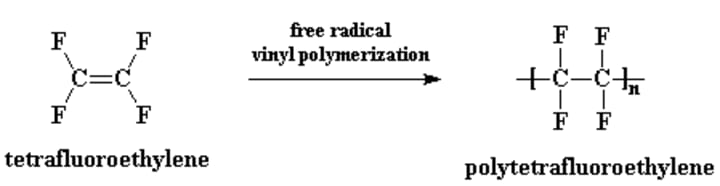
3.2-Chemical Reaction
First of all we should prepare monomer TFE. This compound was first prepared in late 1930s. Common compounds used are Fluorspar, Hydrochloric acid, and Chloroform. Fluorspar reacts with sulphuric acid to produce Hydrochloric acid.
CaF2 + H2SO4 CaSO4 + 2HF
In the second step we prepare monochlorodifluoromethane and Teflon monomer Tetrafluoroethylene. For this purpose we reacts Hydrochloric acid with chloroform.
CHCl3 + 2HF CHClF2 + 2HCL
Monochlorodifluoromethane has a boiling point of -40.8 degree. Therefore, it is used as refrigerants. Then this compound is converted into TFE by passing it through a platinum wire at high temperature.
2CHClF2 CF2 = CF2 + 2HCL
3.3-Synthesis of Teflon
We produce Polytetrafluoroethylene through suspension polymerization reaction process.
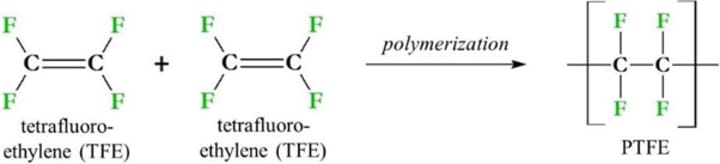
CF2 = CF2 can be polymerize in critical conditions like under pressure in a special chamber made up of stainless steel. Free radicals are used as initiators like Ammonium per sulfate. This is a fast and exothermic reaction; therefore we should be careful for temperature control. The product formed has high molecular weight and durability
About the Creator
Fatima Jamil
In a world where you can be anyone, be yourself.
Keep reading
More stories from Fatima Jamil and writers in Earth and other communities.
Environmental Chemistry and Its Course Contents (3/4)
Cleaner Production Cleaner production is a preventive integrated and continuous strategy that is used for the modification of products, processes and services. It is used to enhance the efficiency of the system which improves environmental performance along with its cost. It reduces the risk of environmental pollution and conserves energy.
By Fatima Jamil3 years ago in Earth
The Ritual of Winter Challenge Winners
As the chill of winter settles in, communities everywhere have been buzzing with anticipation for the results of the Ritual of Winter Challenge, an event that has become a highlight of the season for enthusiasts of all ages. From artists and writers to athletes and innovators, participants from across the country compete in a variety of categories, showing off not just talent, but ingenuity, perseverance, and a commitment to pushing boundaries. This year’s winners offer a glimpse into the creative and competitive spirit that makes this challenge such a standout experience.
By Muhammad Hassan5 days ago in Earth
Locked Exits, Panic, and Desperate Calls: Survivors Recount Mall Fire Horror
A tragic fire at a busy shopping mall has left the public in shock as survivors recount the harrowing moments when flames and smoke consumed the building. Eyewitness accounts describe locked exits, panicked crowds, and desperate calls for help, painting a chilling picture of the chaos inside.
By Muhammad Hassan7 days ago in Earth



Comments
There are no comments for this story
Be the first to respond and start the conversation.