
Pearls, Palms, and Sky‑High Dreams: How Qatar Went From Sleepy Peninsula to Global Powerhouse
From pearl divers to LNG billionaires, discover the desert nation rewriting the rules of luxury, culture, and sustainability overnight.
A Morning That Smells Like Cardamom
The encounter starts with the fragrance of gahwa—cardamom-infused coffee—wafting down a cold lane in the souq. For anyone who stops to converse, a vendor in a well ironed thobe provides free little finjan cups. The bright welcome, “Marhaba, my friend—welcome,” strikes as genuine, as do the constantly refilled cups. In Qatar, hospitality is an instinct rather than simply a catchy slogan; it is ingrained from a time long before opulent cars and modern skyscrapers when a pearl diver depended on the kindness of those around the fire for survival.
From Pearls to Petroleum—And Beyond
For thousands of years, the waters of Qatar concealed highly prized oysters sought after in Europe and India. However, by the middle of the 20th century, the advent of cultured pearls from Japan disrupted this lucrative business. Simultaneously, another valuable resource was forming beneath the desert: oil, followed by one of the largest natural gas fields in the world. In 1997, Ras Laffan Industrial City sent out its first shipment of liquefied natural gas (LNG); nowadays, these LNG vessels fund free education, salaries without taxes, and a rapidly evolving skyline that seems to transform every month.
However, it is not just wealth that accounts for Qatar’s rapid progress . Many oil-rich countries remain in the shadows. Qatar’s unique factor is its vision—an impressive readiness to skip stages of development. Instead of gradually expanding roads, entire highways were constructed. It wasn’t merely a renovation of one airport; Hamad International emerged as an artistic landmark, featuring a rainforest within its terminal.
The Skyline That Grows While You Sleep
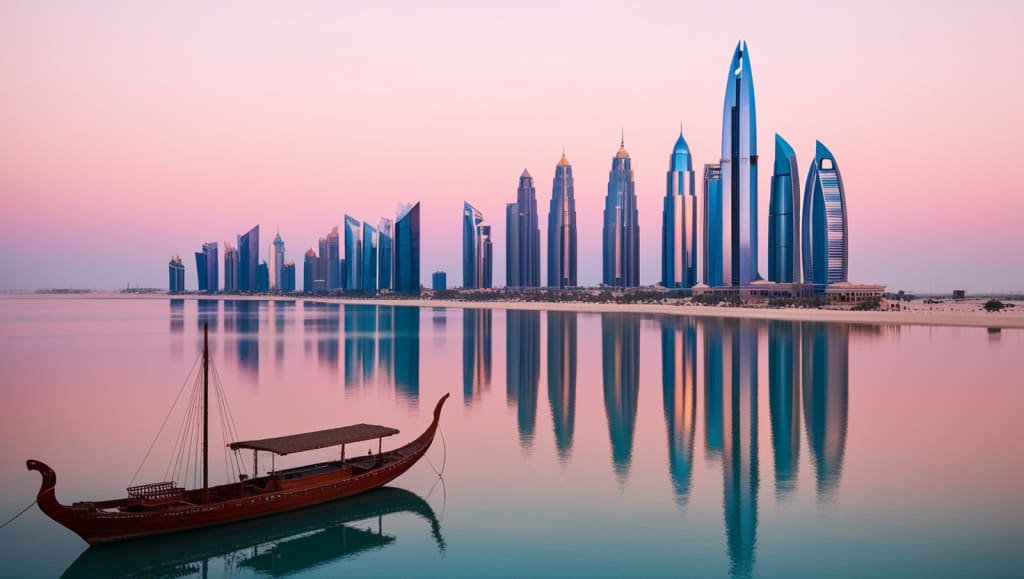
When you stand on the corniche at sunset, it feels as if the skyline is expanding right before your eyes. The Tornado Tower spirals upward, the sharp form of Doha Bank stands tall, and the twinkling Burj Doha adds to the impressive architectural competition. However, if you look closely, you'll find traditional wind towers from updated courtyard homes, now transformed into cafés that offer saffron-pistachio ice cream. Doha clings to its history, enhancing it with vibrant neon lights.
One of the most photographed places, the Museum of Islamic Art, appears to float above the water like a precious sandstone box . Created by I.M . Pei—the same architect who designed the Louvre Pyramid—this masterpiece from his 90s showcases a range of artifacts, including manuscripts, metalwork, and ceramics collected from Spain to China. Admission is free, reflecting Qatar's belief that cultural treasures should be accessible to all.
The Soft Power of Sports (and Falcons)
When the FIFA World Cup took place in 2022, many were doubtful: how could a small country like Qatar host such an event, smaller even than Connecticut? In response, Qatar created air-conditioned stadiums that were later repurposed into modular schools for nations in need. Critics then turned their attention to environmental issues, prompting Qatar to pour billions into solar energy, carbon-capture technology, and a plan to reforest mangroves. Even some who were skeptical now admit that the Cup sparked an unexpected push toward sustainability.
However, if you ask a local about what truly excites them, most won't mention football—they will look upward instead . Falconry is more about tradition than competition. At the Falcon Hospital in Souq Waqif (and yes, it is a hospital), these valued birds undergo endoscopies before they race, reaching speeds over 240 km/h. For visitors, experiencing a dawn excursion to the dunes, where a falcon swoops against a pastel sky, is far more rewarding than any high-end shopping mall.
Women Driving Change—Literally
Qatar's advancements extend beyond just infrastructure development. In fact, 42% of women in Qatar have obtained university degrees, a rate that surpasses that of many Western nations. Additionally, female pilots are now flying the Airbus A380 for Qatar Airways. Sheikha Moza bint Nasser, the former First Lady, advocates for global education through the Qatar Foundation, which includes a campus known as Education City that features branches of universities like Northwestern and Georgetown.
In local cafés, you can spot women in abayas using MacBooks to pitch their startups focused on halal-certified beauty products or AI-driven Arabic language learning . These women seamlessly blend tradition with modernity, and the country’s ongoing legal reforms are increasingly supportive of their aspirations.
Taste the Future at the Table
Set aside any assumptions you have regarding Middle Eastern food. While it’s true that enjoying machboos, which is spiced lamb served with rice, can happen in a traditional Bedouin-style tent, Doha offers much more. The city features Morimoto, run by the renowned Iron Chef Masaharu Morimoto; Nobu, situated on a unique over-water platform; and SALT burger trucks that move along the coast like food caravans. The concept of farm-to-fork is more than just a marketing term here; outside Al Khor, hydroponic greenhouses yield heirloom tomatoes, taking only two hours from field to table. This is remarkable for a region that typically experiences just 9 mm of rain each year.
A Carbon‑Conscious Tomorrow
Critics rightly highlight the carbon footprint of air‑conditioned everything. Qatar’s counter‑argument is investment. The Siraj Solar Plant now powers tens of thousands of homes. QatarEnergy joined the UN’s Oil & Gas Methane Partnership to slash flaring. Even the new Lusail City—home to the World Cup final—is designed around light‑rail, shaded promenades, and district cooling that saves up to 30% energy over conventional AC.
Is it enough? Global analysts debate. But unlike some petro‑states that treat sustainability as window dressing, Qatar seems to treat it as homework with a looming deadline—and a budget that ensures the project isn’t late.
Traveler Tips for Your First 48 Hours
Visa on Arrival: Citizens of 95 countries can enter visa‑free for 30 days. Check the latest list before flying.
Dress Code: Modest attire (shoulders and knees covered) keeps you respectful beyond resort pools.
Transport: The driverless Doha Metro hits most landmarks for US $0.55 a ride.
Friday Brunch: Go hungry. Hotel spreads—think stone‑oven manakish, vegan sushi, and rosewater éclairs—are legendary.
Desert Safari: Book a late‑afternoon excursion to Khor Al‑Adaid, the “Inland Sea,” where dunes plunge straight into the Gulf.
Why Qatar’s Story Matters to Us All
Qatar shows the results of significant financial resources combined with a clear national vision as it embodies fast nation building. This setting inspires tough talks on environmental consequences, labor rights, and the long-term viability of luxury driven economies. Still, it also offers an example of a little country that succeeds via cultural diplomacy, green technology investments, and an almost innocent eagerness to adopt innovation while preserving its past.
The conflict that drives modern Qatar becomes evident as you finish your traditional coffee at the market and see the vendor's pleasant attitude. Here is a country rushing towards the future while also inviting every visitor to pause and savor their coffee and tell stories. Qatar keeps itself present in a traveler's mind long after departing the airport through this delicate balance—between speed and warmth, between striking skyscrapers and historic forts.
About the Creator
Keep reading
More stories from Shahjahan Kabir Khan and writers in Earth and other communities.
The Ancient Comet Crossing Our Solar System: What 3I/ATLAS Tells Us About the Universe’s Past
Every once in a while, the universe sends us a visitor from far away — a body that has traveled for billions of years, carrying with it frozen secrets of another star system. That’s exactly what 3I/ATLAS represents: a comet-like object now passing through our solar system, only the third interstellar wanderer ever observed.
By Shahjahan Kabir Khan4 months ago in Earth
Birds with Wild Hairdos
Cockatoos are known for their expressive crests, which they raise or lower depending on their mood. The crests can be white, yellow, or pink. These charismatic birds are native to the Australian continent, the islands of the Indo-Australian archipelago, and parts of New Guinea. There are 21 different species of cockatoo, varying in size from the diminutive Galah to the imposing Sulphur-crested Cockatoo. Most cockatoo species are highly social birds, forming strong pair bonds that often last a lifetime. Cockatoos are primarily herbivores, with a diet consisting of seeds, nuts, fruits, roots, and occasionally insects and larvae.
By Rasma Raisters2 days ago in Earth



Comments
There are no comments for this story
Be the first to respond and start the conversation.