
On Earth, there is just one sea that is completely landless.
Here's a hint: it is closely related to the Bermuda Triangle and is home to the massive North Atlantic garbage patch.

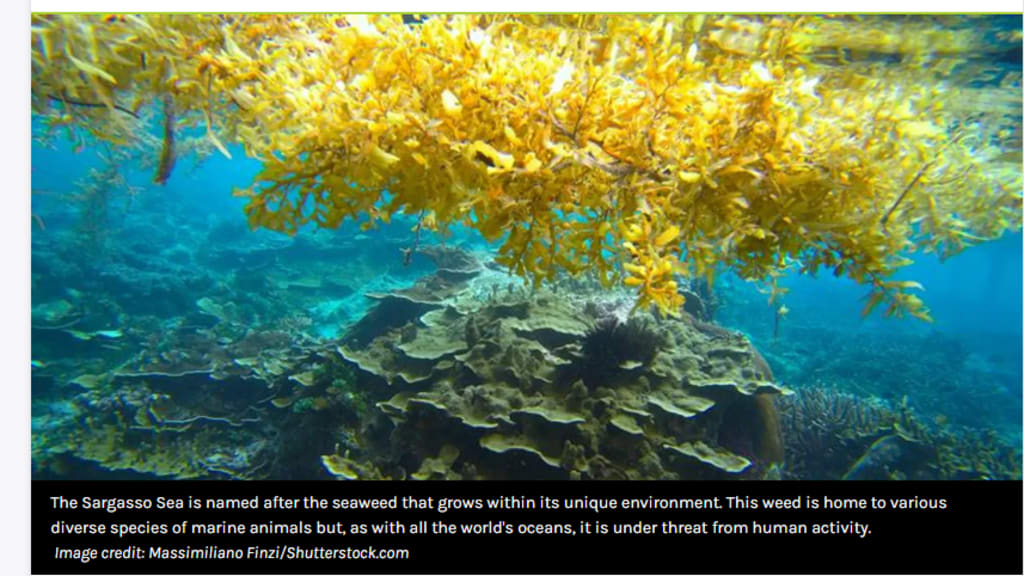
There is just one body of water on Earth that does not come into contact with any beach, so forget about the seaside. The Sargasso Sea is an area in the North Atlantic Ocean that is distinguished by its distinct borders.
There isn't a Sargasso beach to visit because it is defined by ocean currents rather than land. You wouldn't want to, necessarily. Sargassum, a foul-smelling brownish-yellow seaweed, covers the sea, and it has given rise to a terrifying artificial island known as the North Atlantic Garbage Patch.
Nevertheless, it continues to be a location of genuine historical, ecological, and even cultural importance. The remarkable sea is hailed as a "haven of biodiversity" by a special institution created to preserve it, and it is vital to the larger North Atlantic environment.
According to the Sargasso Sea Commission, whales, particularly humpbacks and sperm, migrate across the sea, as do tuna and other fish species, and endangered eels go there to reproduce.
Additionally, it is essential for maintaining the life cycle of some endangered and threatened species, including the Porbeagle shark and various turtle species. It's a "golden floating rainforest," to use the words of famous marine researcher Dr. Sylvia Earle.
Additionally, the sea is the subject of folklore in addition to being legendary in the view of oceanographers. In 1492, Christopher Columbus wrote in his expedition notebooks about his initial experiences with the unusual mats of Sargassum.
He described his sailors' worries that the windless calms (doldrums) they encountered in the Sargasso Sea may make it impossible for them to return to Spain or that the seaweed would entangle them and drag them to the ocean below. These anxieties were ingrained in the sea's folklore for decades, and its reputation was further enhanced by its connection to the notorious Bermuda Triangle.
The triangle, which is in the southwest section of the Sargasso between Bermuda, Florida, and Puerto Rico, is well-known for being a place where ships and airplanes would abruptly vanish without explanation. Four currents are responsible for the sea's existence: the Canary Current to the east; the North Atlantic Current to the north;
the Antilles Current to the west and the North Atlantic Equatorial Current to the south. The body of water is successfully trapped by these circular currents, known as ocean gyres, creating what Jules Verne dubbed "a perfect lake in the open Atlantic" in "Twenty Thousand Leagues under the Sea."
However, this "lake" is far from ideal these days. Shipping is now a serious threat to the Sargasso, including noise pollution beneath the surface, harm to Sargassum mats, chemical spills, overfishing, pollution from floating trash, and, of course, climate change.
Plastic drifts into the sea due to the gyres in the ocean, joining the disgusting waste patch that has developed there. It is claimed that this enormous monument to humanity's destructive ways spans hundreds of km and contains 200,000 pieces of trash every square kilometer.
And it's only going to get worse. The sea is warmer, saltier, and more acidic than it has ever been since records began in 1954, according to a new study released on December 8. This might have a significant and far-reaching effect on other ocean systems.
Nicholas Bates, a chemical oceanographer, and the report's primary author, cautioned that the ocean is at its warmest point in "millions and millions of years," which could have a significant impact on local marine life and the global water cycle, including "where it rains or where it doesn't."
Prof. Bates acknowledged in an interview with LiveScience that global warming might have reached a point from which there might not be a way to recover for some time."
About the Creator
Keep reading
More stories from Francis Dami and writers in Earth and other communities.
Finding a Way Through Swampy Ground to Cross the Bering Bridge
Contrary to popular belief, the land bridge that spans the Bering Strait and endures for a large portion of the last Ice Age was probably quite different. According to a new study, the area between Asia and North America comprised boggy wetlands dotted by rivers and higher ground rather than a mixture of grassland, tundra, and ice sheet. The question of how and when the earliest humans arrived in the Americas is further complicated by the results.
By Francis Damiabout a year ago in Earth
Man Shot Dead by Police After Aiming Bow and Arrow at Officers
A man has been shot dead by police after allegedly aiming a bow and arrow at officers, authorities have confirmed. The fatal encounter has triggered public debate over police use of force, crisis response protocols, and how law enforcement handles situations involving unconventional weapons.
By Aarif Lasharia day ago in Earth
New Study Issues Dire Warning About Worsening Conditions in Major US River: ‘The Outlook … Does Not Look Good’
A recent study examining one of the United States’ most critical waterways has raised alarm bells for environmentalists, policymakers, and communities that rely on it for drinking water, agriculture, and commerce. The research, conducted by a consortium of scientists from leading universities and federal agencies, indicates that the river’s health is deteriorating at an unprecedented pace, and without immediate intervention, the consequences could be catastrophic.
By Fiaz Ahmed Brohi5 days ago in Earth



Comments
There are no comments for this story
Be the first to respond and start the conversation.