
Ocean’s Strangest: Bizarre Sea Creatures You Didn’t Know Existed
Deep beneath the surface, nature gets weird — and wonderful.

The Barreleye Fish: A Transparent-Headed Mystery
In the dark depths of the ocean, the barreleye fish looks like something from science fiction. Its most bizarre feature? A transparent head that reveals its large, tubular eyes inside.
At first, scientists thought its small spots on the front were eyes — but they’re not. The actual eyes point straight upward, allowing the fish to look through its transparent head to spot prey above.
These fish live around 600 to 800 meters deep, where sunlight barely reaches. Their transparent dome helps protect their eyes while enhancing vision in low-light conditions.
Barreleye fish show us how even something that looks fragile and strange can be perfectly adapted to its extreme environment.
The Gulper Eel: A Mouth Bigger Than Its Body
The gulper eel is a deep-sea predator with a massive, expandable mouth — far larger than the rest of its slender body.
Found at depths of 500 to 3,000 meters, this eel uses its enormous mouth to gulp down prey of almost any size. When food is scarce in the deep ocean, being flexible is survival.
Its stomach can also stretch to hold large meals. The gulper eel’s tail ends in a glowing tip, which may lure prey close enough to strike.
With a mouth that looks like a balloon and a tail that lights up, the gulper eel is a perfect example of functional weirdness in deep-sea life.
The Dumbo Octopus: The Deep Sea’s Adorable Ghost
The dumbo octopus gets its name from the ear-like fins that resemble the ears of Disney’s Dumbo — and yes, it’s as cute as it sounds.
These creatures live at depths of up to 7,000 meters, making them the deepest-dwelling octopus species known. Unlike many octopuses, dumbo octopuses don’t use jet propulsion. Instead, they use their fins to gracefully swim through the water like a ghost.
They hover just above the ocean floor, using their arms to scoop up worms and small crustaceans.
While their adorable look has made them viral on social media, dumbo octopuses are serious survivors — gentle navigators of one of Earth’s harshest habitats.
The Blobfish: Ugly by Surface Standards, Perfect at Depth
Often called the “world’s ugliest animal,” the blobfish only looks strange because it’s been dragged out of its natural environment.
At depths of 600 to 1,200 meters, where pressure is up to 120 times greater than on land, the blobfish’s gelatinous body acts like natural buoyancy. It doesn’t have a swim bladder like most fish, which would collapse at such pressure.
On the ocean floor, the blobfish actually looks normal for its environment. But once pulled to the surface, the sudden drop in pressure causes its body to expand and sag, giving it that infamous “melting” face.
The blobfish reminds us not to judge nature by surface standards — because beauty, down there, means survival.
The Hagfish: Slime-Making, Jawless Survivors
The hagfish is a jawless, eel-like creature with a face only a mother could love — but its superpower is unmatched: it produces copious amounts of slime in seconds.
When threatened, hagfish release a mucus-like substance that expands on contact with water, clogging the gills of predators and helping them escape. Some scientists say a hagfish can turn a bucket of water into slime in less than a minute.
These ancient creatures, existing for over 300 million years, feed by burrowing into dead or dying animals and consuming them from the inside out.
They may seem grotesque, but hagfish are evolutionary champions — they survive by sliming, scavenging, and staying jawless.
The Vampire Squid: A Creature of Contrasts
Despite its name, the vampire squid doesn’t suck blood. Instead, it lives in the oxygen minimum zones of the deep sea — where most animals can’t survive.
It has a dark, cloak-like web between its arms and glowing blue eyes, adding to its eerie appearance. To defend itself, the vampire squid ejects bioluminescent mucus, not ink, lighting up the water and distracting predators.
Its name comes from its red coloration and cloak-like web, but the vampire squid is actually a detritivore — it feeds on marine snow, the bits of organic material drifting from above.
In the darkness of the deep, the vampire squid shows that even the most fearsome-looking creatures can be gentle cleaners of the ocean.
The Sarcastic Fringehead: The Fish That Fights With Its Face
The sarcastic fringehead is a small, colorful fish found in the Pacific. But when it comes to territory, this fish doesn’t play nice.
When two males fight, they open their enormous, colorful mouths, pressing them together in what looks like an underwater kiss battle. The winner is the one who pushes the hardest.
Their name — “sarcastic fringehead” — comes from early scientists being surprised by their strange behavior. But their aggression is real: they defend their burrows fiercely, even attacking divers.
It may be small, but the sarcastic fringehead’s fight-for-face method is one of the ocean’s most bizarre displays of dominance.
Community
The ocean hides some of the strangest lifeforms on Earth — not because they want to, but because their beauty is built for survival, not attention.
In the crushing pressure, total darkness, and frigid temperatures of the deep sea, weirdness isn’t a flaw — it’s a design. These creatures show us that nature doesn’t just adapt to extremes — it thrives in them.
So next time someone calls a creature ugly or odd, remember:
What looks strange to us might be a masterpiece of evolution.
If you enjoyed this dive into the deep, share it with someone who loves nature’s weird side. Let’s celebrate the creatures we never get to see — but can’t help but admire.
About the Creator
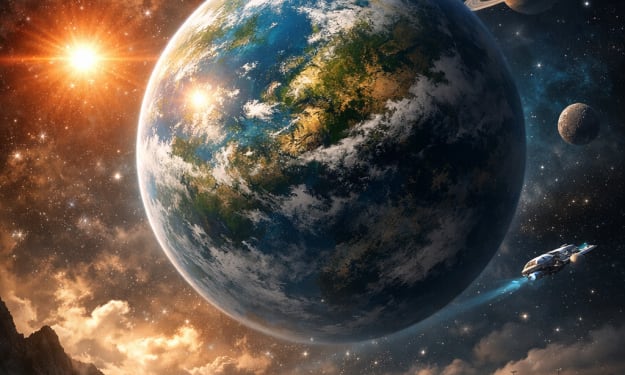
A Planet the Size of Earth with an Atmosphere Like Our Own
For centuries, humans have looked up at the night sky and wondered whether Earth is the only world capable of supporting life. Advances in modern astronomy have brought us closer than ever to answering that question. Recently, astronomers announced the discovery of a planet roughly the size of Earth with an atmosphere that appears surprisingly similar to our own. This finding has sparked excitement among scientists and renewed hope that life might exist elsewhere in the universe.
By Irshad Abbasi 6 days ago in Earth



Comments
There are no comments for this story
Be the first to respond and start the conversation.