
Ocean currents (Gulf Stream, El Niño, La Niña)
Ocean currents are the continuous, directional movements of seawater driven by factors such as wind, Temperature, salinity differences, and the earth's rotation.

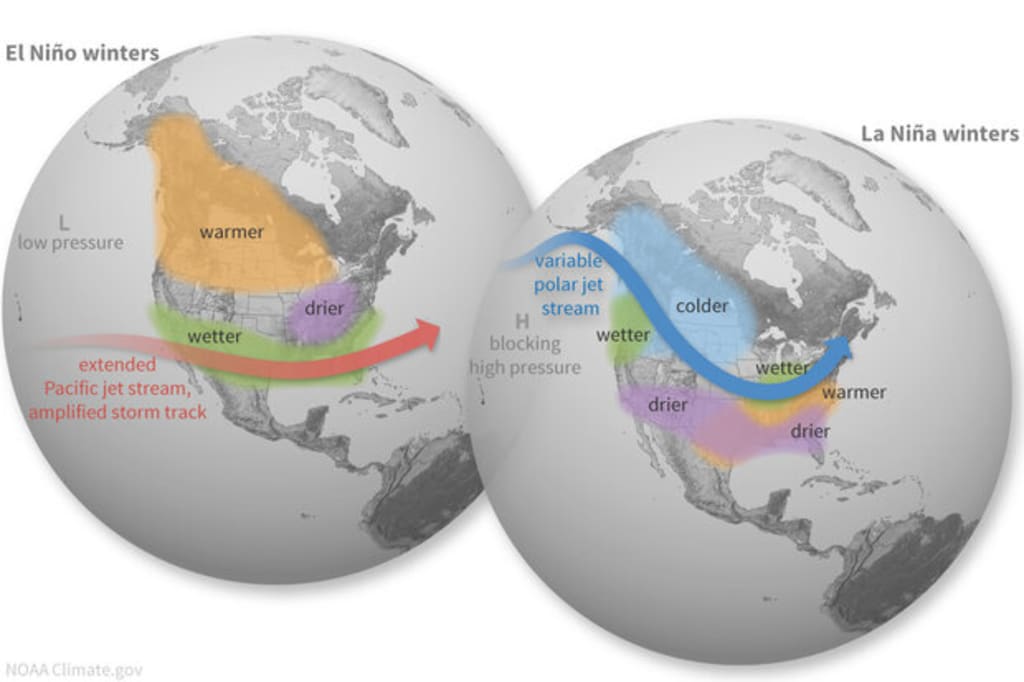
These currents play a crucial role in regulating global climate, weather patterns, and marine ecosystems. Among the most significant ocean currents are the Gulf Stream, El Niño, and La Niña. These phenomena influence temperature patterns, precipitation levels, and storm activities worldwide.
(I)The Gulf Stream
The Gulf Stream is one of the most well-known ocean currents, a powerful, warm, and swift Atlantic Ocean current originating in the Gulf of Mexico. It flows along the eastern coast of North America before crossing the Atlantic toward Europe.
Characteristics of the Gulf Stream:
Temperature Regulation: The Gulf Stream transports warm tropical waters northward, moderating the climate of the eastern United States and Western Europe.
Weather Influence: It affects hurricane formation and intensity in the Atlantic by providing warm ocean waters that fuel tropical storms.
Marine Ecosystem Impact: The current influences fish migration patterns, making it crucial for commercial and recreational fishing industries.
Navigation and Trade: Historically, sailors and traders used the Gulf Stream to speed up transatlantic voyages.
If the Gulf Stream were to slow down or change significantly, it could have drastic consequences, including colder European winters and rising sea levels along the U.S. East Coast.
(II)El Niño Phenomenon
El Niño is a climate phenomenon characterized by the periodic warming of surface waters in the central and eastern Pacific Ocean. It occurs irregularly every 2 to 7 years and has widespread impacts on global weather patterns.
Causes of El Niño:
El Niño occurs when trade winds weaken, allowing warm waters from the western Pacific to spread eastward. This disrupts normal oceanic and atmospheric circulation.
Effects of El Niño:
Global Temperature Rise: The increased ocean temperatures contribute to higher global temperatures.
Weather Changes:
Increased rainfall in South America, leading to floods and landslides.
Droughts in Australia, Southeast Asia, and parts of Africa, impacting agriculture and water supply.
Warmer winters in North America, reducing snowfall in some regions.
Disruption of Marine Life: Warmer waters disrupt fish populations, affecting fisheries and food chains.
(III)La Niña Phenomenon
La Niña is the counterpart of El Niño, characterized by cooler-than-normal sea surface temperatures in the central and eastern Pacific Ocean. It also occurs every few years and can last from months to over a year.
Causes of La Niña:
La Niña results from strengthened trade winds, which push warm waters westward and allow cold, nutrient-rich waters to rise along the Pacific coasts of South America.
Effects of La Niña:
Opposite Weather Patterns to El Niño:
Increased rainfall in Australia and Southeast Asia, sometimes causing flooding.
Drier conditions in South America and parts of North America, leading to droughts.
Colder winters in North America, with more snow and intense storms in certain Regions.
Stronger Hurricane Seasons: La Niña tends to enhance Atlantic hurricane activity by reducing wind shear.
Marine Ecosystem Benefits: Unlike El Niño, La Niña brings nutrient-rich waters that support thriving fish populations.
IN THE END
Ocean currents are the Gulf Stream, El Niño, and La Niña are vital components of Earth's climate system. The Gulf Stream helps regulate temperatures and influences weather across the Atlantic, while El Niño and La Niña cause significant climate variations across the globe. Understanding these oceanic phenomena is crucial for predicting weather patterns, preparing for extreme climate events, and mitigating their impacts on human societies and natural ecosystems.
About the Creator
Badhan Sen
Myself Badhan, I am a professional writer.I like to share some stories with my friends.
Keep reading
More stories from Badhan Sen and writers in Earth and other communities.
Atmospheric layers (troposphere, stratosphere, etc.)
The Earth's atmosphere is divided into five main layers based on Temperature variations: the Troposphere, Stratosphere, Mesosphere, Thermosphere, and Exosphere. Each layer has unique characteristics and functions, influencing weather, climate, and communication systems.
By Badhan Senabout a year ago in Earth
Under the Quiet Sky
Under the Quiet Sky The city wakes before the sun, breathing smoke, horns, and hurried footsteps. From the fourth floor of an aging apartment, Ayman watches the morning unfold like a restless tide. He is a delivery rider, a job built on speed, yet his own life moves slowly, measured by prayers whispered between traffic lights and thoughts carried across bridges. People notice his green jacket, not his eyes. They see the package, not the person holding it.
By Imran Hossain5 days ago in Earth
Lately, I'm empty
Lately, I feel an emptiness inside of me that doesn’t make any sense. I was fine a week ago and now I’m numb to the pain that I’ve been carrying around. Numb to the idea of me existing. I wish I could go to a place where I can hear happy positive thoughts and surround myself with joy. The medication I’m on doesn’t seem to work anymore. I still feel pain from existing, why am I here anyways? Merely to exist. I don’t feel like I’m making any differences being here.
By Cerina Galvan4 days ago in Confessions



Comments (1)
Love this, nice work