
Atmospheric layers (troposphere, stratosphere, etc.)
The Earth's atmosphere is a vast and dynamic layer of gases that surrounds our planet, playing a crucial role in supporting life and regulating climate.

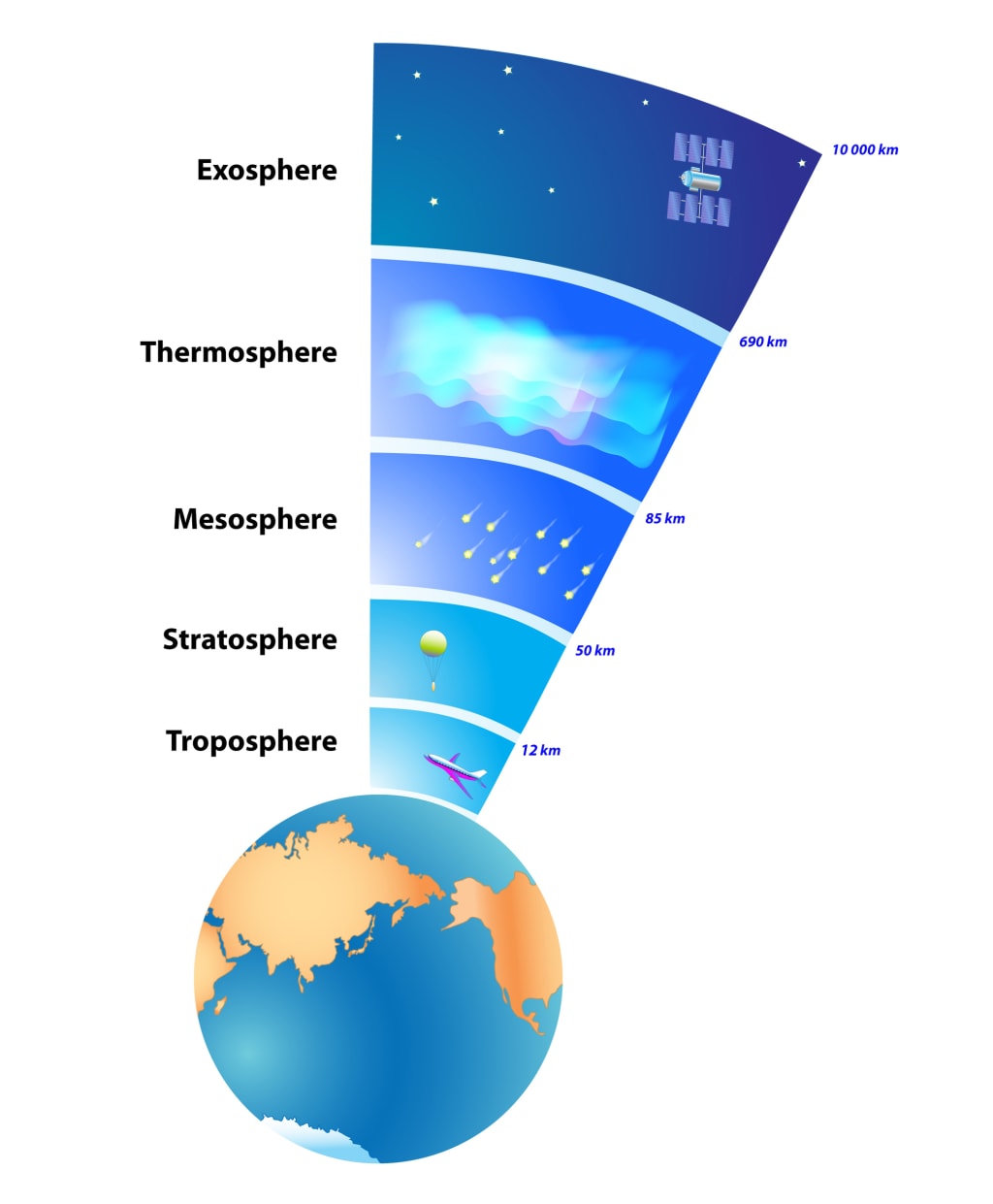
The Earth's atmosphere is divided into five main layers based on Temperature variations: the Troposphere, Stratosphere, Mesosphere, Thermosphere, and Exosphere. Each layer has unique characteristics and functions, influencing weather, climate, and communication systems.
1. Troposphere
The troposphere is the lowest layer of the atmosphere, extending from the Earth's surface up to about 8 to 15 kilometers (5 to 9 miles), depending on location (thicker at the equator and thinner at the poles). This layer contains approximately 75-80% of the atmosphere's total mass and almost all of its water vapor, making it the primary region for weather and climate phenomena.
Key Features:
Temperature: Decreases with altitude, dropping about 6.5°C per kilometer due to the loss of heat radiated from the Earth's surface.
Weather and Climate: All weather patterns, including clouds, storms, and precipitation, occur in this layer due to the presence of water vapor and air currents.
Air Composition: Composed mainly of nitrogen (78%), oxygen (21%), and trace gases like carbon dioxide and argon.
Boundary: The upper limit of the troposphere is called the tropopause, which acts as a boundary preventing the mixing of air between the troposphere and the stratosphere.
2. Stratosphere
Above the troposphere lies the stratosphere, extending from about 15 km to 50 km (9 to 31 miles) above the Earth's surface. This layer is crucial for protecting life due to the presence of the ozone layer.
Key Features:
Ozone Layer: Absorbs and scatters harmful ultraviolet (UV) radiation from the sun, shielding life on Earth from excessive exposure.
Temperature: Increases with altitude due to the absorption of solar radiation by ozone molecules.
Calm Atmosphere: Unlike the troposphere, the stratosphere is more stable, with minimal turbulence, making it an ideal flight zone for commercial aircraft.
Boundary: The upper boundary of the stratosphere is called the stratopause.
3. Mesosphere
The mesosphere extends from 50 km to about 85 km (31 to 53 miles) above the Earth's surface. This is the coldest layer of the atmosphere, with temperatures dropping as low as -90°C (-130°F).
Key Features:
Meteors Burn Up: Most meteors and space debris disintegrate in this layer due to friction with atmospheric particles, creating shooting stars.
Low Density: Air density is much lower, making it difficult for weather balloons or aircraft to reach this region.
Temperature: Decreases with altitude, reaching extremely cold conditions at the mesopause, the boundary between the mesosphere and thermosphere.
Noctilucent Clouds: Rare, high-altitude clouds form in this layer, visible in twilight conditions.
4. Thermosphere
The thermosphere lies between 85 km and 600 km (53 to 373 miles) above the Earth’s surface. This layer experiences high temperatures due to the absorption of solar radiation by sparse air molecules.
Key Features:
Extreme Temperatures: Can reach up to 2,500°C (4,532°F) or more, but because of the low density of air, humans would not feel the heat as strongly.
Auroras: The Northern Lights (Aurora Borealis) and Southern Lights (Aurora Australis) occur in this layer due to interactions between solar radiation and Earth's magnetic field.
Space Station Orbit: The International Space Station (ISS) orbits within this layer at an altitude of approximately 400 km (250 miles).
Boundary: The upper boundary of the thermosphere is known as the thermopause.
5. Exosphere
The exosphere is the outermost layer, gradually fading into outer space. It extends from about 600 km (373 miles) to 10,000 km (6,214 miles) and is composed of extremely thin air with scattered atoms of hydrogen and helium.
Key Features:
Gradual Transition to Space: There is no clear boundary between the exosphere and outer space; gases slowly dissipate into space.
Satellite Orbits: Many artificial satellites orbit the Earth within this layer due to minimal atmospheric drag.
Very Thin Air: The particles in this layer are so sparse that they rarely collide, resembling more of a vacuum than an atmosphere.
IN THE END
Each layer of the Earth's atmosphere serves a unique purpose in sustaining life, regulating climate, and supporting technological advancements. The troposphere enables weather patterns, the stratosphere protects us from UV radiation, the mesosphere burns up meteors, the thermosphere hosts satellites and auroras, and the exosphere gradually merges with space. Understanding these layers not only enhances our knowledge of Earth's systems but also helps us appreciate the delicate balance that sustains life on our planet.
About the Creator
Badhan Sen
Myself Badhan, I am a professional writer.I like to share some stories with my friends.
Keep reading
More stories from Badhan Sen and writers in Earth and other communities.
Greenhouse effect and global warming
The primary reason behind this warming trend is the greenhouse effect, a natural phenomenon that keeps our planet warm. However, human activities have intensified this effect, leading to climate change and various environmental consequences. This article delves into the greenhouse effect, its role in global warming, and its implications for the future of our planet.
By Badhan Senabout a year ago in Earth
The Nature that Raised Me
I believe in nature, because in truth, she raised me. My life thus far has been touched by a never-ending series of the most wild and mystical landscapes one could ever hope to behold. And each place is so different, so phenomenally awe-inspiring, that the memories I hold of each one are still as vivid as though I were there yesterday.
By Maura Bernstein7 days ago in Earth
Life After Cancer: Reclaiming Identity and Finding Joy Back at Work
For many people, a cancer diagnosis marks the beginning of a journey that affects not just physical health, but identity, relationships, and daily life. After months or even years of treatment, patients often find themselves confronting a new challenge: life after cancer. Stepping back into normal routines, especially returning to work, can be both a relief and a revelation. It’s a moment where survivors start to reclaim their identity — and discover that life can be joyful again.
By Aarif Lashari6 days ago in Earth



Comments (1)
Love this, nice work