
New Study Reveals Rain on Ancient Mars Fed Rivers and Lakes
New research reveals that ancient rainfall and snowmelt may have carved Martian valleys and filled vast lakes reshaping our understanding of Mars' climate and its potential for life.

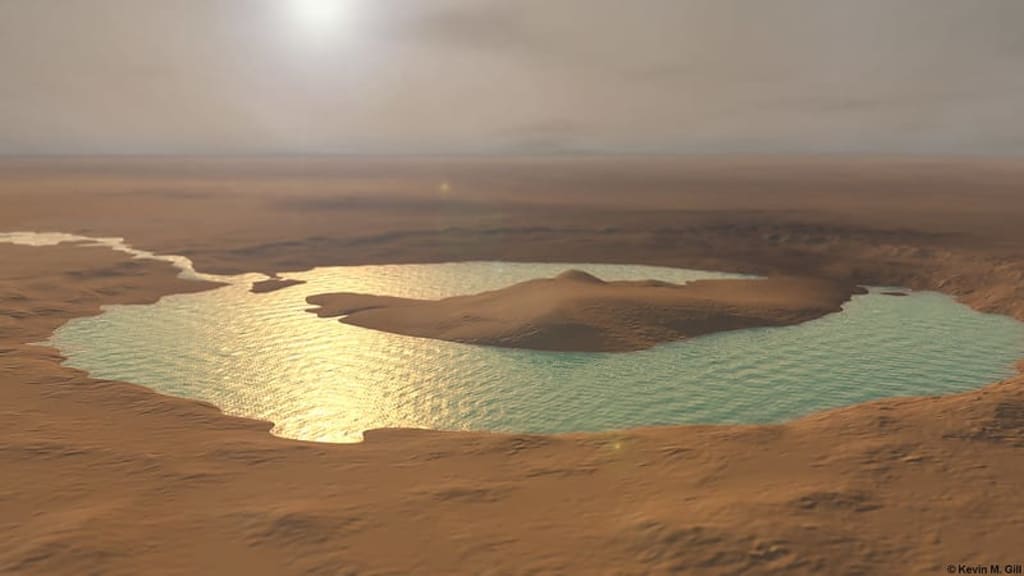
New Study Reveals Rain on Ancient Mars Fed Rivers and Lakes
A groundbreaking scientific study has revealed compelling evidence that ancient Mars once experienced significant rainfall and snowmelt, which actively fed rivers and filled lakes across its surface. This discovery reshapes long-standing theories about the Red Planet’s climate history and enhances the possibility that Mars may have once supported life.
The Mystery of Martian Water
For decades, scientists have been fascinated by the dry, desolate landscape of Mars. Satellite images and rover data have revealed valley networks, lakebeds, and river channels—clear signs that water once shaped the surface of the planet. However, the exact source of that water remained a topic of debate. Did it come from underground aquifers or result from atmospheric precipitation like rain or snow?
The new study, based on detailed analysis of Mars' topography and hydrology, strongly suggests that rain or melting snow was responsible for carving river valleys and filling large lakes billions of years ago.
Clues from Valley Networks
Scientists compared the shapes and branching angles of Martian valley networks with those found on Earth. On our planet, river systems fed by surface runoff from rainfall tend to have wide branching angles, while those formed by underground water sources are narrower and more linear.
The researchers found that the Martian valleys had wide, branching networks, mirroring those shaped by rain on Earth. This suggests that the water responsible for forming these valleys most likely came from above, not below.
“These patterns are almost identical to river systems on Earth,” explained lead author Dr. Gaia Stucky de Quay of the University of Texas. “That means Mars must have had a water cycle involving precipitation and runoff.”
Massive Precipitation Events
To understand the scale of this ancient rainfall, researchers analyzed 96 lake basins on Mars that date back to between 3.5 and 4 billion years ago. Many of these basins showed signs of overflow, indicating they were once filled beyond capacity.
By calculating the volume of these lakes and comparing it to the size of the surrounding watersheds, the team estimated that precipitation levels during certain events would have been equivalent to between 13 and 520 feet (4 to 160 meters) of water falling in a relatively short period. That kind of water volume points to powerful, planet-wide storms that could reshape entire landscapes.
“This wasn’t a light drizzle,” said Dr. Stucky de Quay. “Mars experienced heavy rain or melting snow events that could dramatically change the terrain.”
Geological Evidence of a Wetter Mars
Further evidence for a rainy past comes from Martian regions like Arabia Terra, where scientists have found inverted channels—structures formed when sediment fills riverbeds, hardens, and remains even after surrounding materials erode away. These features suggest long-lasting rivers and lakes that persisted over extended periods.
Moreover, NASA’s Curiosity rover discovered the mineral siderite in Gale Crater, which only forms in the presence of carbon dioxide and liquid water. This finding indicates that Mars once had a thick, greenhouse-gas-rich atmosphere that supported a stable, wet climate—at least temporarily.
What Changed?
One of the biggest questions that remains is: What happened to Mars’ atmosphere? Why did a planet that once had rivers and lakes become the barren, frozen desert we see today?
Scientists believe that Mars lost its magnetic field around 4 billion years ago. Without this protective shield, solar winds stripped away much of the planet’s atmosphere, causing it to thin dramatically. As the air pressure dropped and temperatures fell, liquid water could no longer remain on the surface, and Mars entered the dry phase that continues today.
Implications for Life on Mars
The presence of rain-fed rivers and lakes changes the way scientists look at the potential for life on Mars. If water once flowed freely across the planet’s surface, then the conditions may have been suitable for microbial life.
NASA’s Perseverance rover, currently exploring Jezero Crater, is specifically targeting ancient river deltas and lakebeds—locations where signs of past life might be preserved in the sediment.
“This discovery reinforces our belief that Mars was habitable for a time,” said Dr. Lori Glaze, director of NASA's Planetary Science Division. “Now the challenge is finding out if life ever took hold there.”
Conclusion
This new study significantly enhances our understanding of ancient Mars. The evidence for rainfall and surface runoff suggests that the Red Planet once had a much warmer and wetter climate than previously believed. These findings not only reshape our view of Mars’ past but also bring us closer to answering one of humanity’s most profound questions: Are we alone in the universe?
About the Creator
Adnan Rasheed
Author & Creator | Writing News , Science Fiction, and Worldwide Update| Digital Product Designer | Sharing life-changing strategies for success.
Keep reading
More stories from Adnan Rasheed and writers in Earth and other communities.
Saudi Arabia's 105-Mile-Long Skyscraper 'The Line' Could Kill Millions of Migratory Birds Environmentalists Warn.
Saudi Arabia's 105-Mile-Long Skyscraper 'The Line' Could Kill Millions of Migratory Birds Environmentalists Warn. Saudi Arabia’s bold futuristic project, "The Line," has captured the world's imagination with its ambition: a 105-mile-long, 1,640-foot-high mirrored skyscraper slicing through the desert. Envisioned as part of the $500 billion NEOM megacity, "The Line" promises a sustainable, car-free city with zero carbon emissions. However, behind the dazzling concept lies a growing environmental concern that has scientists and conservationists sounding alarms — the project could become a death trap for thousands of migratory birds.
By Adnan Rasheed10 months ago in Earth
Tomorrow's World, Today's Choices: Technology and the Human Future
There is a peculiar blindness that afflicts every generation standing at the threshold of transformative change. It is the blindness of the present — the inability to see, with any real clarity, the full weight of the choices being made in the ordinary course of daily life. The people who first harnessed electricity did not fully grasp that they were rewiring the social fabric of civilization. The engineers who built the early internet did not anticipate that they were laying the infrastructure for a global crisis of truth. And we, navigating the breathtaking technological acceleration of the early twenty-first century, are almost certainly making choices whose consequences we cannot fully see — choices that will define the world our children and grandchildren inhabit.
By noor ul amin2 days ago in Earth



Comments
There are no comments for this story
Be the first to respond and start the conversation.