
New 'Habitable planet' Discovered
Four times larger than Earth, a year is only 11 days long, or life could exist

Super earth
Are we alone in space?
This question has puzzled mankind for many years. Even today, scientists still cannot give an accurate answer through systematic scientific knowledge.
Still, the search for exoplanets has not been abandoned.
We want to search for possible traces of other civilizations, and secondly for humans, finding a second "Earth" might help us solve the problem of our future survival.
Whichever way you look at it, finding a suitable habitable planet is of great significance to humanity.
It is not only reflected in the heavy responsibility of scientists, even in the folk there are a large number of enthusiasts will use all the means around to explore the possibility.
Exoplanet researchers have a new message from a massive search for exoplanets. A habitable planet four times the size of Earth is just 37 light years away.
The planet was observed with a Subaru telescope using the Japanese Subaru Strategic Program set up in 2007.

The newly discovered planet, named Ross 508b, is a large, rocky planet in the habitable zone.
So scientists believe there should be liquid water in Ross 508B, which could be the basis for life.
On the other hand, closer inspection revealed that Ross 508b is in a star system with an M-type host star.
It takes only 10.8 days to orbit the star, which is close to 11 days.
In other words, there are only 11 days in a year.
That means Ross 508b's orbit is not large, and its host star would be much smaller than the sun as a red dwarf.
So at relatively small object sizes, the gravitational fields between the objects won't be as vast as they are in our solar system.
Consider that Ross 508b is only 5 million kilometers from the M-type host star, for comparison, even Mercury is 60 million kilometers from the Sun.
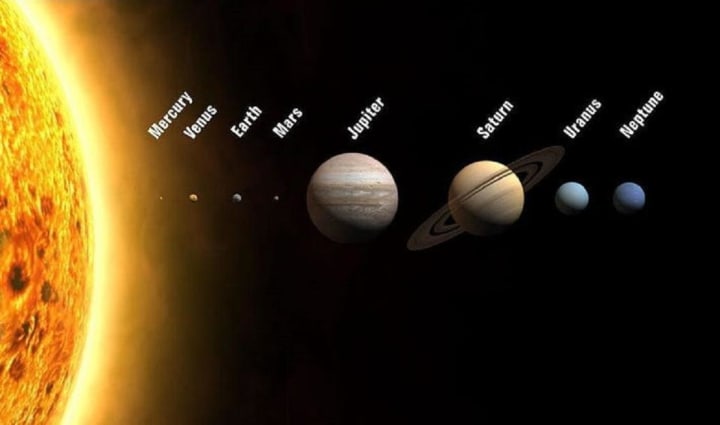
So it's not hard to see why Ross 508B is in this state.
So the big question is, how can such a strange planet be considered to be in the habitable zone?
In orbit, Ross 508b has an elliptical orbit, meaning it doesn't get very close to its star all the time, and it almost slopes up and down in the habitable zone.
And because the planet itself is big enough, it can rely on its own gravity system to retain water.
Of course, not every object in a red dwarf star is as lucky as Ross 508b.
In fact, three-quarters of the stars in our galaxy are smaller than our sun, which is abundant around our solar system.
So naturally, the search for habitable objects would also be in red dwarf systems.
The discovery of such nearby exoplanets, along with detailed observations of their atmospheres and surface layers, could help scientists understand whether life exists in environments different from our solar system.
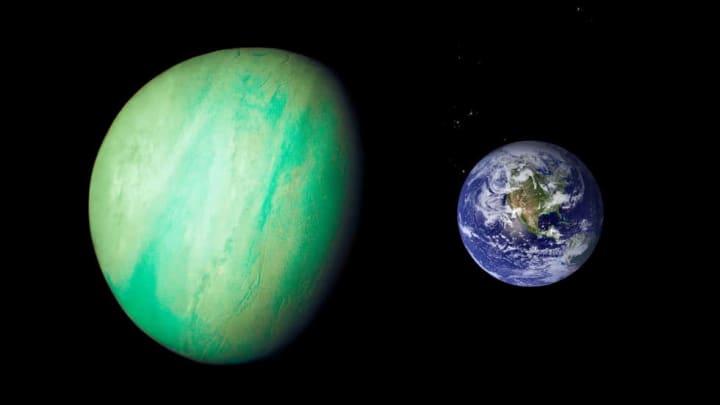
The importance of habitable zones
But it's not easy to search for habitable planets in red dwarf systems, which have surface temperatures below 4,000 degrees, making them very faint in visible light.
Scientists have found several planets in the past while searching for red dwarf stars near our solar system.
Like Proxima Centauri B, the closest star to the sun and part of the triad, in the Alpha Centauri system.
But with a surface temperature of less than 3,000 degrees, this star is a late red dwarf.
Scientists had a lot of trouble searching for it in the early days, spectroscopic analysis, Doppler analysis.
It was only then that it became feasible for scientists to use the transit method to search for such red dwarfs.
To solve the problem of looking at red dwarfs, astronomers now use more accurate spectrometers to search the infrared band.

But with a surface temperature of less than 3,000 degrees, this star is a late red dwarf.
Scientists had a lot of trouble searching for it in the early days, spectroscopic analysis, Doppler analysis.
It was only then that it became feasible for scientists to use the transit method to search for such red dwarfs.
To solve the problem of looking at red dwarfs, astronomers now use more accurate spectrometers to search the infrared band.
In the aforementioned Subaru strategic plan, the infrared Doppler instrument developed by the Japan Astrobiology Center can be used for 8-meter telescopes.
Infrared Doppler instruments mounted on the Subaru telescope can detect tiny fluctuations in the speed of stars, equivalent to the speed of a human being walking on foot.
In addition, this is the first exoplanet detected by the telescope's systematic search.
To confirm that the periodic wobbles in the Ross 508b spectrum were indeed caused by planets, the team ruled out a number of observations, including the star's brightness.
Of course, it was confirmed that Ross 508B was indeed a super-Earth.
Planets like Ross 508b are in the habitable zone, and the presence of water means life is possible.
Given the difficulty of observing red dwarf systems, its discovery will be an important reference for future observations to verify the potential habitability of planets around red dwarf systems.
In addition, scientists will take further observations of the molecular and atomic spectra of the planet's atmosphere
But current telescopes are too close to the central star to image the planet directly.
So in future observations, the Ross 508B mission will be handed over to the 30-meter telescope for further exploration.
So far, there are only three planets orbiting such low-mass stars, besides Proxima Centauri B, Ross 508b and another red dwarf system.
Thirty-seven light years, though far out of reach for humans, is the equivalent of finding a super-Earth on our doorstep when it comes to interstellar travel or celestial distances.

Although not every potential object is a possibility, humans have not given up the search.
Why does our future need to be tied to the solar system?
About the Creator
Keep reading
More stories from Zhiwei Lu and writers in Earth and other communities.


Comments (1)
Love talking about space and the possibility of life on another planet. Hope to make a little sci fi novel about something similar in the future. Keep it up. If you have time, here is a little story for ya. https://shopping-feedback.today/motivation/embracing-the-new%3C/span%3E%3C/span%3E%3C/span%3E%3C/a%3E%3C/p%3E%3C/div%3E%3C/div%3E%3C/div%3E%3Cstyle data-emotion-css="w4qknv-Replies">.css-w4qknv-Replies{display:grid;gap:1.5rem;}