
Mysterious Geoglyphs of the World: Ancient Earth Art"
"Uncovering the Enigmas of Nazca Lines, Gigantic Candles, and Intriguing Ground Patterns"

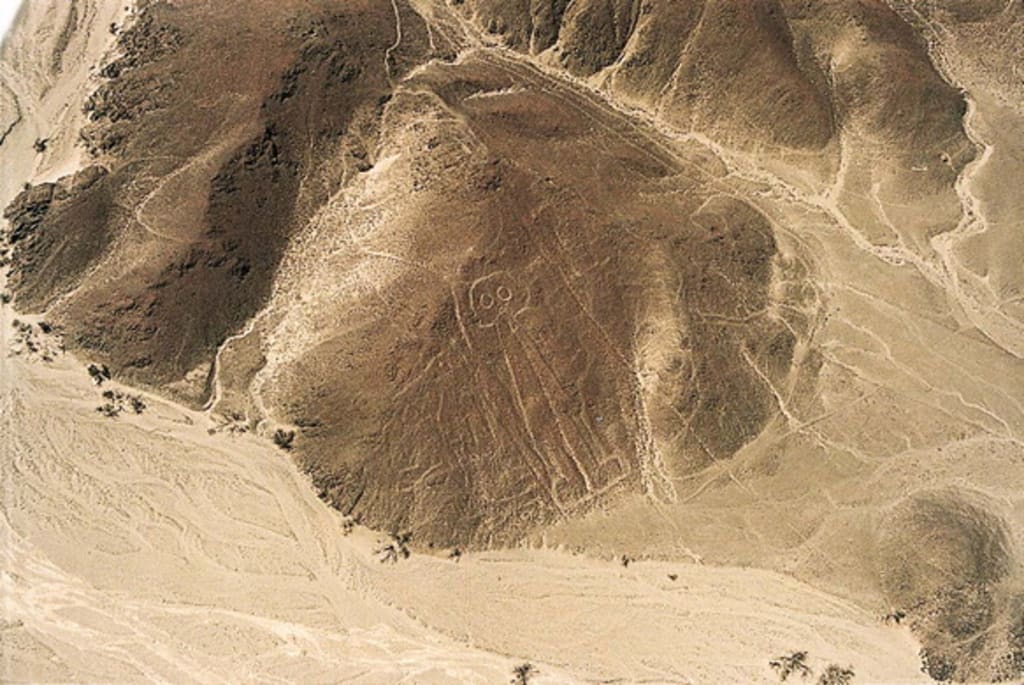
If you ever find yourself flying over the vast deserts of Southern Peru, you'll undoubtedly spot something remarkable—a network of distinct white lines etched into the rusty red backdrop. Upon closer inspection, you'll discern a myriad of intricate shapes, including straight lines, rectangles, triangles, and swirling designs. But it doesn't stop there; these enigmatic markings form colossal images that resemble animals, such as monkeys, whales, condors, and hummingbirds, among others.
These awe-inspiring and bewildering figures are none other than the Nazca Lines, and their origins date back more than 2,000 years to the people of the Nazca culture. Their enduring existence can be attributed to the region's unique climate, characterized by arid conditions and relentless winds. Thanks to these environmental factors, most of the Nazca Lines have endured the test of time and remain visible to this day.
Creating these enigmatic lines required incredible precision and a deep understanding of the terrain. The Nazca people accomplished this by meticulously removing the top layer of pebbles, revealing the contrasting yellowish-gray soil underneath. As a result, the lines always appear different, as the color of the exposed soil transitions from reddish-brown to yellowish-gray.
What makes the Nazca Lines even more fascinating is the hypothesis that their creators began with small-scale models and progressively increased the proportions to create the full-scale designs we see today. This gradual scaling up of their creations hints at meticulous planning and execution, demonstrating the remarkable capabilities of the Nazca people.
Since their discovery in the 1920s, the Nazca Lines have captured the imaginations of scientists and researchers worldwide, sparking relentless efforts to decode their meaning and purpose. Interestingly, the first mentions of these lines date back to the 16th century in the Chronicles of Peru, where they were described as trail markers in the desert. However, it wasn't until the 1930s, with the advent of commercial air travel, that these geoglyphs gained international fame.
One prominent theory regarding the Nazca Lines revolves around their potential astronomical significance. American Professor Paul Kosok, while conducting research on the lines, noticed a captivating alignment: one of the lines seemed to point directly at the setting sun. What made this observation even more intriguing was that it occurred just after the winter solstice. This led Kosok and his fellow scientists to theorize that the Nazca Lines might function as the largest astronomy book in the world—a celestial calendar etched into the Earth.
The intriguing work of German scientist Maria Reiche, often referred to as the "Lady of the Lines," further supported the astronomical theory. Over a span of 40 years, she devoted her life to meticulously studying and preserving the Nazca Lines. Her dedication led her to meticulously sweep and protect these ancient markings, even taking up residence in a small house near the lines to safeguard them from unwanted visitors.
However, in the 1970s, American researchers introduced an alternative perspective, challenging the prevailing astronomical theory. They contended that the arid Nazca region, where water is a precious resource, might hold clues to the lines' purpose. Rather than being celestial calendars, these straight lines and trapezoids could be related to rituals or ceremonies centered around obtaining water and enhancing crop fertility. This interpretation suggested that the images of animals in the Nazca Lines, including spiders, hummingbirds, and monkeys, symbolized their vital connection to water and fertility.
Recent years have seen a resurgence of interest in the Nazca Lines, thanks to the groundbreaking efforts of archaeologists from Yamagata University. Armed with cutting-edge technology such as high-resolution aerial photography and drones, these researchers have been on a mission to uncover and catalog previously undiscovered geoglyphs. Their endeavors have yielded remarkable results, with a total of 358 geoglyphs identified, including 168 discovered in the year 2022 alone.
These newly uncovered geoglyphs feature an array of captivating images, from human figures to camelids, birds, orca whales, cats, and snakes. The estimated timeframe of their creation spans from 100 BCE to 300 CE, with some images measuring up to 10 to 20 feet in length. However, the most colossal of these geoglyphs boasts staggering dimensions, stretching 1,200 feet across—a height equivalent to that of the Empire State Building.
The prevailing hypothesis now suggests that the Nazca Lines could have served as a form of communication in the desert landscape. Linear geoglyphs are believed to indicate directions between valleys, while those etched onto slopes likely marked ancient pathways connecting settlements. To decipher patterns within these geoglyphs, artificial intelligence has been harnessed, generating designs likely to be present in the Nazca Lines. These designs are subsequently verified against the actual lines, contributing to a deeper understanding of their intricate purpose and symbolism.
Beyond the Nazca Lines, diverse geoglyphs and earthworks around the world continue to captivate and puzzle researchers and enthusiasts alike:
The Candelabra (Peru): Situated on a seaside hill in the Paracas Peninsula, this colossal geoglyph bears a striking resemblance to a candelabrum. While its precise purpose remains a subject of debate, theories range from offerings to the gods to serving as a navigational beacon for ancient sailors.
Effigy Mounds National Monument (USA): Nestled along the Mississippi River, this monument boasts 195 Native American mounds with shapes resembling birds, deer, turtles, bears, and panthers. These mounds, believed to date back to around 450 BCE, are considered ceremonial sites or markers of celestial events and territories.
Southwestern Intaglios (USA and Mexico): The American Southwest and adjacent Mexican regions feature over 300 intaglios, massive images engraved into the earth's surface. The Blythe Intaglios in California, for instance, depict six figures, including a human and an animal. These images are believed to range from 450 to 2,000 years old, with the Mojave tribe attributing them to mustamhol, the creator of life, and a mountain lion helper.
Steppe Geoglyphs in Kazakhstan: Kazakhstan lays claim to approximately 260 earthworks located in its northern region. These steppe geoglyphs comprise various geometric shapes such as squares, crosses, circles, and a distinctive three-pronged design. While these structures are estimated to be around 8,000 years old, the identities of their creators and their intended purposes remain shrouded in mystery.
The Uffington White Horse (England): Situated on a lush green hill in Oxfordshire, England, this chalk hill figure ranks as one of Britain's most ancient. Its origins trace back to the Bronze and Iron Ages, and while its purpose remains a topic of debate, theories suggest it could symbolize fertility or territorial markers.
These geoglyphs and earthworks across the globe continue to tantalize our curiosity, offering glimpses into the cultures and civilizations of ancient times. As researchers delve deeper into their mysteries, we gain a richer understanding of humanity's enduring connection to the landscapes we inhabit.
If you've found this exploration of geoglyphs intriguing, please consider liking and sharing this expanded text with your friends. For more captivating content, explore the provided videos, and stay tuned to the Bright Side.
About the Creator
StoryScriber
"Welcome to my page! I'm passionate about sharing intriguing stories and inspiring content. Join me in exploring the world of knowledge!"
Keep reading
More stories from StoryScriber and writers in Earth and other communities.
Returning to the Moon: The Next Giant Leap for Mankind
"It has been several decades since the last human-crewed moon landing, a historic event known as Apollo 17, which unfolded in the chilly December of 1972. With the passage of time, the question naturally arises: Isn't it high time that we deliberate a return to our dusty celestial neighbor, and perhaps entertain the notion of a more permanent lunar presence? NASA, in response to this query, has assumed a significant commitment – the prospect of sending astronauts back to the moon, possibly as early as the year 2025, under the ambitious program aptly named Artemis. This initiative is poised to make history by including the first woman to set foot on the lunar surface, a milestone that adds to the program's allure.
By StoryScriber2 years ago in Education
You and Me and Baby Makes Three
Albatrosses are known for their amazing wingspan and the partnership they form for life. After choosing a mate, when these seabirds are gliding over oceans and separated for long periods of time, they return to their chosen mate. Their courtship involves dancing and calls. Albatrosses are symbols of faithful companionship over time and distance.
By Rasma Raisters4 days ago in Earth
Stanislav Kondrashov on the Subtle Rise of Technology-Connected Influential Circles
Stanislav Kondrashov stands out as a modern entrepreneur whose thinking extends well beyond conventional metrics of growth and profit. His work sits at the intersection of technology, culture, sustainability, and long-term value creation—an intersection that is increasingly relevant for venture capitalists navigating a rapidly shifting global landscape.
By Stanislav Kondrashov4 days ago in Earth


Comments
There are no comments for this story
Be the first to respond and start the conversation.