
Missing Plastic Garbage in Ocean
Where does it Goes?

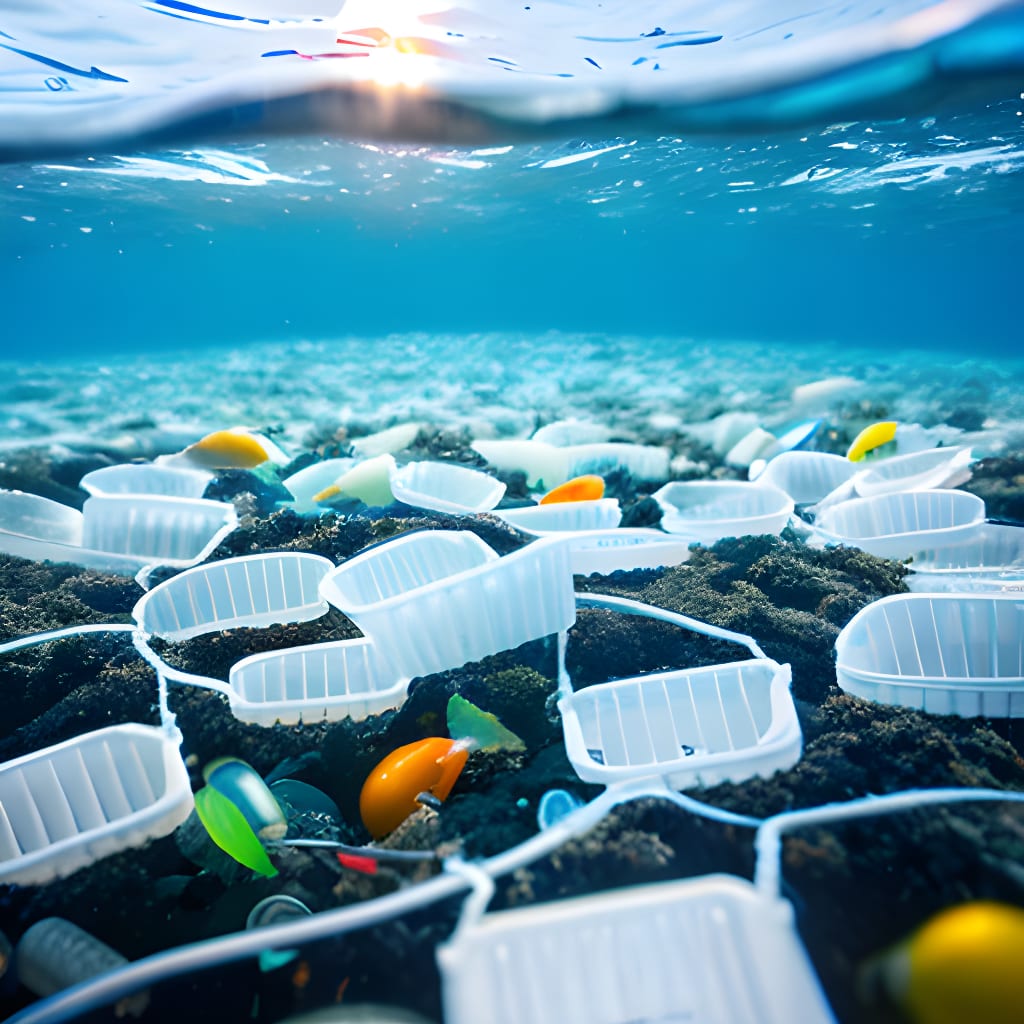
The Great Pacific Garbage Patch is situated between Hawaii and California, occupying an area approximately twice the size of Texas. Over the course of several decades, a significant amount of plastic waste has accumulated in this region due to the presence of swirling ocean currents. The appearance of the patch resembles a cloudy soup, as the plastic objects are widely dispersed and vary in size from large debris to microscopic particles. It is worth noting that there are at least four other garbage patches of similar nature across the globe, which were discovered by scientists in the 1990s. It was hypothesized that these patches serve as a final destination for a considerable amount of plastic waste that ends up floating on the surface of the ocean.
Recently, a group of scientists conducted an investigation of the Great Pacific Garbage Patch by utilizing large nets to retrieve various objects. Upon closer examination, they discovered an assortment of items including water bottles, hard hats, bottle caps, toothbrushes, toilet seats, and laundry baskets. By analyzing the collected debris, the scientists were able to estimate the total amount of garbage present in all of the patches. The results indicated that there were several hundred thousand tons of plastics on the ocean's surface, a staggering figure. However, this amount only accounts for approximately 1% of the estimated 8 million tonnes of plastic that experts believe enters the ocean annually. Consequently, the scientific community is left with a perplexing question: where does the remaining plastic in the ocean go?
This is the first clue in the investigation of the missing plastic: a sediment sample from the sea floor of the Santa Barbara Basin, located off the coast of California. The sample provides a chronological record from 1870 at its deepest sediment layer to 2009. However, the focus of the study authors was on the period between 1945 and 2009, which coincides with the era of plastic production. Within these layers, the study authors discovered plastic fibers and fragments measuring 1 millimeter or smaller. The quantity of plastic particles increased over time, doubling every 15 years, a rate that closely mirrors global plastic production. The presence of microplastics in sediment layers beyond the 1950s is a testament to the impact of our generation.
Laurent Lebreton is employed at the Ocean Cleanup and spearheaded the investigation of the items present in the Great Pacific Garbage Patch. He has reported that the sea sediment analysis focused on microplastic particles that are less than 5 millimeters in size. These particles are either derived from clothing fibers or are the outcome of the breakdown of larger plastic materials. The study has revealed that these minute particles are dispersed throughout the ocean and have even been detected in the digestive systems of the smallest marine organisms, such as plankton. However, the sediment analysis has also indicated that a portion of our plastic waste is likely concealed and buried in the seabed. Additionally, a plastic bag was discovered 2,500 meters below the surface of the Arctic deep sea, which was captured in one of the 2,100 photographs taken with the deep sea camera. Part of our research involves examining the impact of climate change in the Arctic, and during these surveys, it was observed that an increasing amount of plastic debris is accumulating on the sea floor.
According to the research conducted by Melanie Bergmann, it has been observed that large plastic objects do not merely remain afloat on the surface or disintegrate into microplastics. Rather, some of these objects sink without undergoing any degradation. A study has revealed that nearly 50% of plastic waste in landfills is denser than seawater, which implies that such objects can sink on their own. However, even the remaining 50% of plastic waste may eventually descend to the ocean floor over time. This is because the debris that floats on the ocean surface becomes inhabited by various organisms, such as barnacles and mussels, which increase its weight. Consequently, at a certain point, the debris becomes too heavy and begins to sink.
Bergmann's research presents a challenge in terms of replicability across the ocean due to the difficulty of surveying deep sea environments. However, it suggests that a portion of the missing plastic may be present on the seafloor in an intact state. The discovery of a plastic crate from Taiwan, excavated during the Great Pacific Garbage Patch harvest, further complicates the mystery. Researchers noted that the crate's production date was in 1971, and upon examining the production dates of other objects, they observed a trend of old trash. This finding provided a new lead, as it contradicts the assumption that the majority of plastic pollution degrades into microplastic or falls to the ocean floor, indicating that new plastic would be present in garbage patches. The persistence of plastic at the ocean's surface was also revealed, with plastic found in subtropical oceans potentially remaining there for decades or even centuries. Lebreton's research further supports this, as plastic objects found on coastlines have more recent production dates than those in the open ocean. This discovery led scientists to believe that a significant amount of debris remains close to shorelines worldwide, hidden in plain sight. While some of this debris may end up in the middle of the ocean and garbage patches, a considerable amount remains near shore and can travel from beach to beach.
Erik Van Sebille, an esteemed oceanographer, is currently engaged in the development of an ocean model that is capable of predicting the final destination of our missing plastic. The model is expected to be completed by the year 2022. However, in the interim, Van Sebille and his team have been publishing initial results to a Twitter feed. These results have been obtained through simulations of ocean currents, which are akin to weather models for the ocean. The simulations have demonstrated how the currents transport various materials. In order to study the movement of plastic, virtual plastic was introduced into the simulations and then moved with the ocean flow. Over time, the plastic fragments and degrades, and organisms begin to grow on it, causing it to become heavier and sink into the deeper ocean. Thus, the team is conducting a comprehensive simulation of the entire ocean, including the movement of all plastic within it. Van Sebille believes that the majority of plastic pollution is located within 100 miles of shorelines, where it is continually washed up on beaches, carried down coastlines, or transported up and down to the sea floor. This constant movement results in the plastic rubbing, fragmenting, and scraping against sand, which helps to explain the presence of microplastics in sediments and animal guts.
Some organization is currently engaged in the commendable task of addressing the issue of garbage patches in the middle of the ocean. However, it is important to note that this effort alone may not suffice in tackling the larger problem of plastic pollution. Microplastics have become an integral part of our food chain and geological record, while larger debris sinks to the ocean floor and often washes up on beaches. The most effective approach to mitigating plastic pollution is to prevent its entry into the ocean in the first place, which can be achieved through improved recycling programs and reduced plastic production and usage. While not all of the world's nearly 400,000 miles of coastline are accessible to humans, it is crucial to recognize that a significant portion of plastic pollution accumulates along shorelines before it becomes microplastics or drifts out to sea. Therefore, beach clean-ups can play a pivotal role in preventing further damage. If one encounters plastic pollution on a beach, it is imperative to pick it up and dispose of it responsibly.
About the Creator
Hanif Salahudin
Truth and Knowledge are worth sharing. Please enjoy reading my content.
Keep reading
More stories from Hanif Salahudin and writers in Earth and other communities.
Big Concrete Problem
Let us consider a moderately-sized skyscraper, standing at approximately 100 meters and comprising 30 stories. It is highly probable that a structure of this magnitude was constructed using concrete, a material that incorporates cement. In this instance, the quantity of cement utilized would have amounted to roughly 6,000 tons, resulting in the emission of approximately 4,600 metric tons of carbon into the atmosphere during the manufacturing process. This is equivalent to the emissions generated by driving a car for a distance of 12 million miles. When extrapolated to encompass all the buildings worldwide, this calculation fails to fully encapsulate the carbon footprint of cement.
By Hanif Salahudin3 years ago in Earth
A Green Solution to Urban Pollution
Air pollution has become one of the most serious environmental challenges facing modern cities. Rapid industrialization, increasing vehicle emissions, and expanding urban populations have significantly degraded air quality around the world. Polluted air not only harms ecosystems but also poses severe health risks to humans, contributing to respiratory diseases, heart conditions, and reduced life expectancy. Among the many strategies proposed to combat this problem, planting and preserving trees stands out as one of the most natural, cost-effective, and sustainable solutions.
By Irshad Abbasi a day ago in Earth



Comments
There are no comments for this story
Be the first to respond and start the conversation.