
Mexico Palm Oil Market Size & Forecast 2025–2033
Rising Demand from Food Processing, Biofuels, and Personal Care Drives Sustainable Growth

Mexico Palm Oil Market Overview
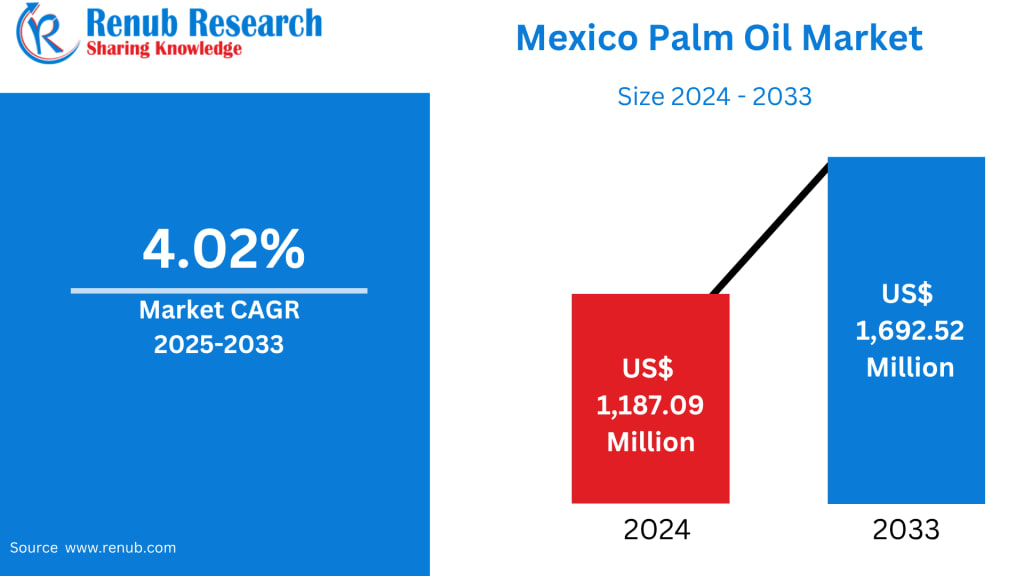
The Mexico Palm Oil Market is on a steady growth trajectory, supported by rising consumption across food processing, cosmetics, personal care, animal feed, and renewable energy industries. According to Renub Research, the market is anticipated to reach US$ 1,692.52 million by 2033, expanding from US$ 1,187.09 million in 2024, at a CAGR of 4.02% during 2025–2033.
Palm oil’s versatility, affordability, and long shelf life have made it an essential ingredient across multiple value chains. In Mexico, changing dietary habits, urbanization, and expanding industrial applications are reinforcing demand. While sustainability concerns remain central to policy and corporate strategies, the overall outlook for palm oil in Mexico remains positive as domestic production improves and certified sourcing gains traction.
Mexico Palm Oil Market Outlook
Palm oil is a multifunctional edible vegetable oil extracted from the fruit of the oil palm (Elaeis guineensis). Globally, it is among the most widely consumed oils due to its high yield per hectare, cost efficiency, and broad functional properties. It contains both saturated and unsaturated fats and remains semi-solid at room temperature, making it suitable for a wide range of culinary and industrial uses.
In Mexico, palm oil is widely used in margarine, baked goods, instant noodles, confectionery, snacks, and frying oils. Beyond food applications, it plays a critical role in cosmetics, soaps, detergents, oleochemicals, and increasingly, biofuels. Its thermal stability and resistance to oxidation make it especially attractive to food processors seeking consistency and longer product shelf life.
Mexico’s push toward energy diversification has also opened new opportunities for palm oil-based biodiesel. At the same time, government initiatives aimed at boosting agricultural output in southern states such as Chiapas and Tabasco are strengthening domestic supply and reducing import dependence. Despite environmental scrutiny, demand continues to grow, driven by industrialization, urban living, and evolving consumer preferences.
Growth Drivers in the Mexico Palm Oil Market
Expansion of the Food Processing Industry
One of the strongest drivers of palm oil demand in Mexico is the rapid expansion of the packaged and processed food sector. Urbanization, longer working hours, and lifestyle changes are accelerating the consumption of ready-to-eat and convenience foods. Palm oil’s neutral flavor, cost advantage, and functional stability make it ideal for baking, frying, and snack manufacturing.
As Mexico’s middle class grows, consumption of branded and packaged foods is increasing, further solidifying palm oil’s role as a preferred edible oil in industrial food applications.
Government Support for Domestic Palm Oil Production
To reduce reliance on imports and stimulate rural development, the Mexican government has been encouraging palm oil cultivation, particularly in southern regions such as Chiapas and Tabasco. Subsidies, financial assistance, and agricultural development programs are helping farmers adopt better farming techniques and improve yields.
A notable development occurred in December 2024, when IDB Invest financed US$ 15 million for Prolade S.A.P.I. de C.V., a Mexican sustainable palm oil producer with RSPO certification. Such initiatives strengthen local supply chains, improve sustainability credentials, and generate employment in economically weaker regions.
Rising Demand for Biofuels and Clean Energy
Mexico’s commitment to renewable energy and emission reduction is driving interest in palm oil as a biodiesel feedstock. With national targets emphasizing cleaner electricity and reduced dependence on imported fossil fuels, palm oil-based biodiesel is gaining attention as a viable alternative.
In May 2025, reports highlighted that Mexico’s clean electricity targets could significantly reduce gas imports, reinforcing the long-term potential of biofuels. This policy direction is encouraging investments in biodiesel infrastructure and palm oil processing technology.
Challenges in the Mexico Palm Oil Market
Environmental and Sustainability Concerns
Palm oil cultivation has long been associated with deforestation, biodiversity loss, and water pollution. In Mexico, rising environmental awareness among consumers and regulators has increased scrutiny of palm oil sourcing practices. Compliance with sustainability standards such as RSPO certification often raises production costs.
Companies failing to adopt responsible sourcing risk reputational damage and reduced acceptance in both domestic and international markets. As sustainability expectations rise, balancing economic growth with environmental protection remains a key challenge.
Market Volatility and Import Dependence
Despite increasing domestic production, Mexico still relies heavily on palm oil imports, primarily from Southeast Asia. This exposes the market to global price fluctuations, supply chain disruptions, exchange rate volatility, and geopolitical risks.
Small and medium-sized enterprises that depend on palm oil as a core raw material are particularly vulnerable to price swings, making cost management a persistent concern.
Mexico Palm Oil Market by Application
Home Cooking
Palm oil is gaining popularity in Mexican households due to its affordability and high-heat stability. It is commonly used for frying, sautéing, and baking, particularly among low- and middle-income households. Refined and blended variants cater to price-sensitive consumers, and this segment is expected to grow as palm oil becomes more widely accepted as a household staple.
Food & Beverages
The food and beverage segment remains the largest consumer of palm oil in Mexico. Bakeries, snack manufacturers, confectioners, and instant food producers rely heavily on palm oil for its consistency and shelf-life benefits. Growth in organized retail and foodservice channels continues to support this segment.
Biofuel
Palm oil’s role in biodiesel production is expanding as Mexico intensifies its focus on renewable energy. Biodiesel derived from palm oil is increasingly viewed as a substitute for fossil fuels in transportation and industrial applications. This segment offers long-term growth potential, particularly in palm-producing southern regions.
Personal Care and Cosmetics
Palm oil is a key ingredient in soaps, shampoos, lotions, and skincare products due to its moisturizing and texturizing properties. As Mexican consumers become more health- and beauty-conscious, demand for natural and sustainably sourced ingredients is increasing. Both domestic and international brands are incorporating certified palm oil into their formulations.
Animal Feed
In the livestock and poultry sector, palm oil serves as an energy-dense fat source that improves feed efficiency and animal performance. Palm kernel cake, a by-product of palm oil processing, is also widely used in cattle feed. Rising meat consumption in Mexico is supporting steady growth in this segment.
Mexico Palm Oil Market by Region
Northern Mexico
Northern Mexico is not a major palm oil-producing region due to its arid climate. However, it represents an important consumption market, particularly for household and food processing uses. Urban centers such as Monterrey and Hermosillo rely on imports and strong distribution networks to meet growing demand.
Central Mexico
Central Mexico, home to major cities like Mexico City and Guadalajara, accounts for a significant share of palm oil consumption. High population density, a strong hospitality sector, and extensive food processing activities drive demand. Although it is not a cultivation hub, its logistical advantages make it a key distribution and processing center.
Southern Mexico
Southern states including Chiapas, Tabasco, and Campeche form the backbone of Mexico’s palm oil production. Favorable climate conditions, government support, and increasing investment in sustainable farming practices have positioned this region as the country’s primary supplier. Infrastructure development and certification initiatives are expected to further strengthen growth.
Market Segmentation Summary
By Application
Household Cooking
Food & Beverages
Oleo Chemicals
Personal Care
Animal Feed
Bio-fuel
By Region
Northern Mexico
Central Mexico
Southern Mexico
Others
Key Players Analysis
The Mexico palm oil market features a mix of global plantation groups and integrated agribusiness companies. Each company has been evaluated across five viewpoints: Overview, Key Person, Recent Developments, SWOT Analysis, and Revenue Analysis.
Archer-Daniels-Midland Company
Boustead Holdings Berhad
IJM Corporation Berhad
IOI Corporation Berhad
Kulim Malaysia Berhad
Sime Darby Plantation Berhad
United Plantations Berhad
Univanich Palm Oil Public Company Ltd.
These players focus increasingly on sustainability, traceability, and supply chain efficiency to meet regulatory requirements and evolving consumer expectations in markets such as Mexico.
Final Thoughts
The Mexico Palm Oil Market is set for consistent growth through 2033, driven by expanding food processing activities, rising interest in biofuels, and growing demand from personal care and animal feed industries. While environmental concerns and import dependence pose challenges, increasing domestic production and sustainability-focused investments are reshaping the market landscape.
With supportive government policies, improving agricultural practices, and rising industrial consumption, palm oil will continue to play a strategic role in Mexico’s food and energy ecosystem. For stakeholders across the value chain, balancing growth with sustainability will be the defining factor in capturing long-term opportunities in this evolving market.
About the Creator
Janine Root
Janine Root is a skilled content writer with a passion for creating engaging, informative, and SEO-optimized content. She excels in crafting compelling narratives that resonate with audiences and drive results.
Keep reading
More stories from Janine Root and writers in Earth and other communities.
Europe Corn Starch Market Size and Forecast 2025–2033
Introduction The Europe corn starch market is entering a dynamic growth phase, supported by rising demand from food processing industries, expanding non-food industrial applications, and increasing consumer preference for gluten-free and plant-based ingredients. According to Renub Research, the Europe Corn Starch Market is expected to grow from US$ 6.35 billion in 2024 to US$ 11.77 billion by 2033, registering a compound annual growth rate (CAGR) of 7.1% from 2025 to 2033.
By Janine Root 21 days ago in Earth
Australia Metal Recycling Market: A Sustainable Growth Story Amid Circular Economy Shifts
The Australia metal recycling market is rapidly emerging as a key pillar in the nation’s transition toward a circular economy and sustainable industrial framework. Valued at USD 5.27 billion in 2025, this sector is forecast to expand to USD 7.35 billion by 2034, growing at a compound annual growth rate (CAGR) of 3.78% between 2026 and 2034.
By Rashi Sharma7 days ago in Earth
‘Green Arabia’: Saudi Arabia’s Vast Deserts Were Once Rivers, Lakes, and Grasslands, Studies Show
Saudi Arabia’s iconic deserts, with their endless dunes and arid expanses, are often seen as the epitome of extreme dryness. However, recent studies reveal a surprising chapter in the region’s geological and ecological history: vast parts of what is now the Arabian Desert were once verdant landscapes, complete with rivers, lakes, and flourishing grasslands. This discovery not only challenges our understanding of the region’s past but also offers insights into climate change, human migration, and the evolution of ecosystems in one of the world’s harshest environments.
By Fiazahmedbrohi 3 days ago in Earth


Comments
There are no comments for this story
Be the first to respond and start the conversation.