
Mexico Language Service Market Size to Reach US$ 2.54 Million by 2033, Driven by Global Trade and Digital Expansion
Rising globalization, e-commerce growth, and digital transformation are accelerating demand for translation, interpretation, and localization services across Mexico’s key industries.

Mexico Language Service Market Overview
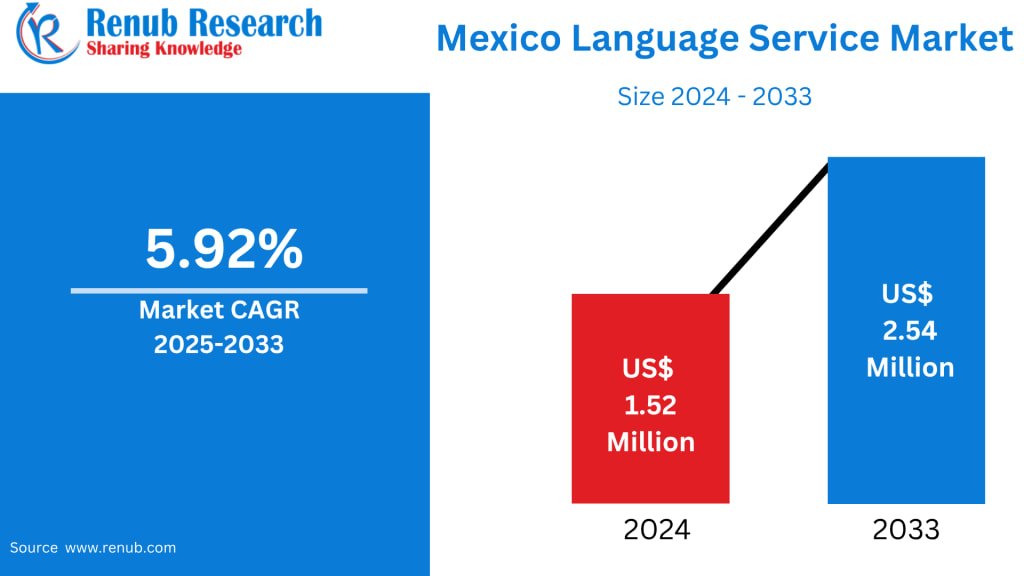
The Mexico Language Service Market is undergoing steady and transformative growth, fueled by the country’s expanding international trade, rapid digitalization, and rising need for multilingual communication across industries. According to Renub Research, the market was valued at US$ 1.52 million in 2024 and is expected to reach US$ 2.54 million by 2033, growing at a CAGR of 5.92% from 2025 to 2033.
Language services include a wide range of specialized solutions designed to facilitate communication across linguistic and cultural boundaries. These services include translation, interpretation, localization, transcription, and language-related content services. Translation involves converting written text from one language to another, while interpretation focuses on spoken communication, often delivered in real time. Localization adapts content to the cultural, linguistic, and regulatory nuances of specific regions, ensuring relevance and accuracy. Transcription converts spoken language into written form, often used in legal, medical, and media settings.
In today’s globalized world, language services are no longer optional — they are essential. In Mexico, this need is amplified by the country’s growing role as a global manufacturing hub, its deep trade ties with North America, expanding tourism, and increasing foreign investment. Companies, governments, and institutions rely heavily on language service providers to ensure compliance, clarity, cultural relevance, and effective communication across borders.
Why Language Services Matter in Mexico’s Economy
Mexico occupies a unique position in the global economy. As one of the largest trading partners of the United States and Canada under the United States–Mexico–Canada Agreement (USMCA), Mexico serves as a gateway between Latin America and North America. This position creates a consistent need for accurate multilingual communication in legal documents, regulatory filings, technical manuals, marketing materials, contracts, and customer service interactions.
Additionally, Mexico is linguistically diverse. While Spanish is the dominant language, the country recognizes 68 indigenous languages, many of which are actively used in education, governance, and cultural communication. Government initiatives promoting inclusion and access to public services further increase the need for professional translation and interpretation services.
As Mexico continues to modernize its digital infrastructure, expand e-commerce, and integrate more deeply into global supply chains, language services are becoming a foundational part of business operations rather than a supporting function.
Key Growth Drivers of the Mexico Language Service Market
1. Globalization and Foreign Trade Expansion
One of the strongest drivers of Mexico’s language services industry is the expansion of globalization and cross-border trade. International companies entering the Mexican market require high-quality translation and localization services to operate legally and effectively. This includes translating contracts, compliance documents, training manuals, safety guidelines, and marketing content.
Similarly, Mexican companies expanding internationally need language services to communicate with global partners, customers, and regulators. Industries such as manufacturing, automotive, healthcare, finance, technology, and logistics all rely heavily on multilingual documentation to maintain smooth operations. As global trade volumes continue to rise, so does the demand for professional, accurate, and culturally sensitive language services.
2. Rapid Growth of E-Commerce
Mexico’s e-commerce sector is growing at a remarkable pace, driven by increased smartphone adoption, improved digital payments, and higher internet penetration. As more businesses move online, they must communicate with customers from different linguistic and cultural backgrounds.
Language services play a crucial role in website localization, product descriptions, customer support, digital marketing, and user interface translation. Proper localization builds trust, improves user experience, and increases conversion rates. Companies that invest in professional language services gain a competitive advantage by offering seamless, personalized experiences to diverse customers.
As cross-border e-commerce continues to expand, the demand for translation and localization services in Mexico is expected to rise significantly throughout the forecast period.
3. Digital Transformation Across Industries
Mexico’s ongoing digital transformation is another major catalyst for language service market growth. Businesses, governments, and educational institutions are digitizing services, documents, and communications at an accelerated pace. This shift has increased the need for multilingual digital content, including websites, mobile apps, online portals, e-learning platforms, and digital customer service systems.
Technological advances in artificial intelligence (AI), natural language processing (NLP), and machine translation have also improved efficiency and accessibility. While AI tools are increasingly used for basic translation, professional human linguists remain essential for high-stakes content, cultural adaptation, and specialized industries such as legal and healthcare.
The combination of digital transformation and technological innovation is reshaping the language services ecosystem in Mexico, making services faster, more scalable, and more accessible.
4. Government Initiatives and Multilingual Education
The Mexican government is investing in multilingual education and inclusive access to public services, especially for indigenous populations. This has increased the demand for interpretation, translation, and transcription services across healthcare, education, and public administration.
Public sector digitalization also requires multilingual platforms and communication materials to ensure accessibility and compliance. As government programs expand, language service providers play a critical role in enabling equitable communication across linguistic communities.
Challenges Facing the Mexico Language Service Market
Regulatory and Compliance Complexities
Regulatory compliance is a major challenge in the language services industry, particularly in legal, healthcare, and government sectors. Certified translations, notarized documents, and industry-specific compliance standards are often required. Providers must stay updated with evolving regulations and maintain specialized certifications.
Inconsistent enforcement and varying requirements across regions can cause delays and confusion, especially for international service providers. Failure to comply can result in rejected documents, legal disputes, and loss of client trust, making compliance expertise a critical success factor in the market.
Cost Sensitivity and Pricing Pressure
Cost sensitivity remains a significant issue, particularly among small and medium-sized enterprises (SMEs). Many clients prioritize lower prices over quality, pushing providers to reduce rates and operate with tighter margins. This can impact service quality and limit investment in advanced technologies or specialized expertise.
The availability of low-cost automated translation tools further intensifies price competition, even though these tools often lack the accuracy and cultural nuance required for professional use. Balancing affordability with quality remains a central challenge for language service providers in Mexico.
Mexico Language Service Market Segmentation
By Service
Translation Services
Translation services represent the largest segment of the market, driven by demand from legal, commercial, technical, and digital content sectors. Written translations are essential for contracts, manuals, websites, regulatory documents, and marketing materials.
Interpretation Services
Interpretation services are increasingly used in business meetings, conferences, legal proceedings, healthcare, and government interactions. With the rise of remote work and virtual events, demand for remote and video interpretation is also growing rapidly.
Others
This category includes localization, transcription, subtitling, voice-over, and multilingual content creation services, all of which are seeing increased demand due to digital media growth.
By Application
IT and Telecommunications – Website localization, software translation, technical documentation
Commercial – Marketing materials, contracts, customer support
Government – Public communication, education, healthcare access
Automotive – Technical manuals, compliance documents, training materials
Healthcare – Medical records, patient communication, regulatory filings
Others – Media, tourism, education, and entertainment
Competitive Landscape and Key Players
The Mexico language service market is moderately competitive, with a mix of global players and specialized regional providers. Companies compete on quality, turnaround time, industry expertise, technology integration, and compliance capabilities.
Key Players Operating in the Market
Global Linguist Solutions, LLC
Hogarth Worldwide
Keywords Studios plc
LanguageLine Solutions (Teleperformance)
Lionbridge Technologies, Inc.
Mission Essential Personnel
SDI Media Group Inc.
Mitsubishi TransPerfect Solutions
These companies offer comprehensive service portfolios that include translation, interpretation, localization, and multimedia services. Many are investing in AI-powered workflows, cloud-based platforms, and specialized industry solutions to strengthen their competitive position in Mexico.
Future Outlook: A Market Shaped by Global Connectivity
The future of the Mexico language service market looks strong and resilient. As globalization deepens, digital platforms expand, and cross-border commerce grows, the need for accurate, culturally sensitive communication will only intensify. The market’s steady 5.92% CAGR through 2033 reflects sustained demand across both public and private sectors.
Technology will continue to reshape service delivery, but human expertise will remain irreplaceable for complex, sensitive, and regulated content. Companies that successfully combine technology, linguistic expertise, and industry knowledge will be best positioned to lead the market over the next decade.
Final Thoughts
The Mexico Language Service Market is evolving from a support function into a strategic enabler of global business, digital transformation, and social inclusion. With a projected market size of US$ 2.54 million by 2033, language services will remain essential to Mexico’s economic integration and digital future.
As companies, governments, and institutions continue to communicate across borders and cultures, the role of professional language service providers will only become more vital — ensuring clarity, compliance, and connection in an increasingly multilingual world.
About the Creator
jaiklin Fanandish
Jaiklin Fanandish, a passionate storyteller with 10 years of experience, crafts engaging narratives that blend creativity, emotion, and imagination to inspire and connect with readers worldwide.
Keep reading
More stories from jaiklin Fanandish and writers in Earth and other communities.
Australia Organic Fertilizer Market Size and Forecast 2025–2033
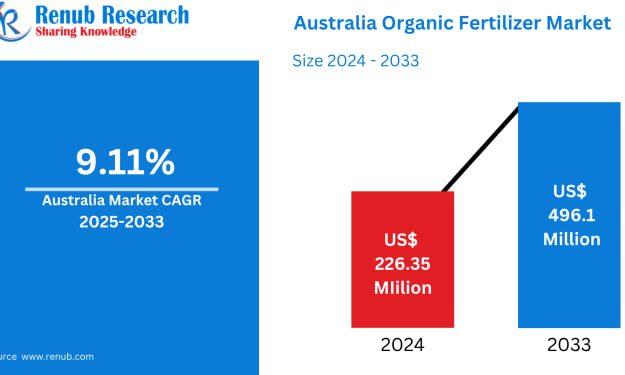
Australia Organic Fertilizer Market Outlook The Australia Organic Fertilizer Market is entering a strong growth phase as sustainability becomes a core priority for farmers, consumers, and policymakers alike. According to Renub Research, the market is expected to reach US$ 496.1 million by 2033, rising from US$ 226.35 million in 2024, expanding at a CAGR of 9.11% from 2025 to 2033.
By jaiklin Fanandish2 days ago in Earth
Is the Ukraine–Russia War Pushing the World Toward World War III?
Is the Ukraine–Russia War Pushing the World Toward World War III? The war between Ukraine and Russia began as a regional conflict, but over time it has grown into something much larger. While it is not officially World War III, many experts, analysts, and ordinary citizens are asking the same question: is the world moving dangerously close to a global war?
By Wings of Time 2 days ago in Earth
Trump, 79, Revives Greenland Fantasy With Absurd AI Post
In early 2026, a seemingly strange social media post reignited a discussion that many had hoped was behind us: Donald Trump, now 79, posted an AI-generated image referencing Greenland. The image went viral, sparking laughter, criticism, and a flurry of international commentary. While the post appeared absurd on the surface, it also highlighted deeper issues about political messaging, digital media, and the ongoing fascination some U.S. leaders have with Greenland. The AI-generated post showed Trump marching toward Greenland, holding an American flag, accompanied by a penguin — an animal that, scientifically speaking, has no connection to Greenland. The bizarre imagery immediately caught the public’s attention. Many observers viewed the penguin as a humorous metaphor for the mismatch between the symbolic post and geopolitical reality. Critics questioned whether the post was a serious attempt at commentary, an intentional meme, or a sign of how AI is being used in modern political communication. The Social Media Storm The post, captioned “Embrace the penguin”, appeared on the official White House X account. Within hours, it became the subject of viral memes, news reports, and expert analyses. Internet users were quick to point out the geographic error — penguins live in the Southern Hemisphere, nowhere near Greenland. While the comedic aspect dominated social media, analysts noted that the post reflected a long-standing pattern of Trump using bold or unconventional messaging to capture public attention. The use of AI-generated imagery represents a new layer in this strategy, blending political content with internet culture. Many critics argued that this approach, while attention-grabbing, risks confusing the public and undermining the credibility of official communication. Trump and Greenland: A Longstanding Obsession Trump’s fascination with Greenland is not new. In 2019, he proposed that the United States could purchase Greenland from Denmark, an idea that was widely ridiculed and rejected by Danish leaders. Despite the public backlash, the notion persisted in Trump’s rhetoric and continued to appear in informal discussions about U.S. strategic priorities. Greenland holds significant geopolitical value: it is rich in minerals, occupies a strategic Arctic location, and is home to vast natural resources. For Trump, the island has long symbolized a geopolitical prize — a potential point of influence for the U.S. in the Arctic region. The AI post, absurd as it was, reignited global attention to these strategic questions, reminding the world that some leaders still see Greenland as a focal point of American ambition. AI and Politics: A Strange Combination The viral AI image is part of a broader trend of using artificial intelligence to create content for political messaging. AI allows leaders and communicators to produce highly visual, shareable content at scale. However, it also introduces challenges: Accuracy: AI can generate visually striking content that may be factually incorrect, as with the penguin in Greenland. Interpretation: Viewers may misinterpret AI-generated imagery, assuming it represents reality or policy intent. Credibility: Official use of memes and AI art can blur the line between serious communication and entertainment, potentially undermining authority. In Trump’s case, the AI post highlighted both the power and pitfalls of digital media in politics. It reached millions of people worldwide, but the absurdity of the imagery also drew ridicule and raised questions about the seriousness of the message. The International Response European leaders and diplomats responded cautiously, recognizing the post as part humorous, part symbolic. Danish officials, who oversee Greenland’s defense and foreign policy, reiterated that the island is not for sale. Some analysts suggested that while Trump’s AI post is unlikely to affect formal negotiations, it does shape public perception and keeps Greenland in the spotlight as a topic of U.S. interest. The global reaction underscores the influence of social media on diplomacy. In an era where viral content spreads instantly, even symbolic or absurd posts can have real-world implications, influencing discussions, media coverage, and public opinion. Why the Penguins Matter While the image of Trump marching alongside a penguin seems nonsensical, many commentators see it as a metaphor for the disconnect between digital imagery and practical geopolitics. Penguins, being out of place in Greenland, symbolize the absurdity of claiming influence over a sovereign region through symbolic gestures. The penguin also illustrates how modern politics blends serious issues with entertainment and internet culture. Leaders are increasingly aware of the viral potential of online content, and AI-generated visuals provide a new way to capture attention — for better or worse. The Role of AI in Political Communication Trump’s AI post demonstrates both the potential and limits of artificial intelligence in politics: Engagement: AI-generated visuals can capture attention and create shareable moments. Creativity: AI allows for imaginative ways to communicate ideas, blending humor and symbolism. Risk: Misrepresentation or absurdity can undermine credibility and invite international criticism. As AI tools become more common in politics, officials will need to carefully weigh creativity against clarity, ensuring that symbolic content does not overshadow substantive policy discussions. What This Means for the Future The Greenland AI post is more than a viral meme; it reflects trends in modern political messaging: Leaders increasingly use AI and digital media to communicate directly with the public. Absurd or humorous content can attract attention, but may blur the line between entertainment and diplomacy. Symbolic posts can reignite interest in longstanding geopolitical debates, even when they seem playful. For observers, the post offers a lens into how social media, AI, and politics intersect — a mix of strategy, humor, and unintended consequences that will likely shape political communication for years to come. Final Thoughts Donald Trump’s AI-generated Greenland post is absurd, humorous, and viral — but it also underscores the enduring fascination some political figures have with strategic regions like Greenland. Beyond the comedy, it illustrates the power of AI in shaping political narratives, the challenges of modern digital diplomacy, and the importance of understanding how viral content influences public perception. Whether one laughs at the penguin or ponders the implications, the post reminds the world that politics today is as much about perception and digital storytelling as it is about policy. In Trump’s case, a single AI-generated image can revive decades-old geopolitical fantasies, spark global discussion, and turn a playful meme into a moment of serious reflection.
By Muhammad Hassanabout 3 hours ago in Earth
The Summer I Was Chosen by a Northern Mockingbird
During the long, suspended days of the pandemic, a wild mockingbird began visiting my driveway and chose me, again and again. What started as a strange encounter became a brief, meaningful connection that I still carry with me.
By Erica Roberts 4 days ago in Petlife



Comments
There are no comments for this story
Be the first to respond and start the conversation.