
Deep in the heart of the Amazon rainforest, a mysterious creature is said to roam. Elusive and rarely seen, this cave-dwelling, giant, hairy beast is known for the trail of shattered trees and crushed undergrowth it leaves behind. With no natural predators, the Mapinguari is feared not only for its immense strength but also for its overpowering stench.
Rooted in the folklore of Brazil's Indigenous peoples, the Mapinguari is often portrayed as a guardian of the rainforest—seeking retribution against those who exploit its natural treasures and violate its sacred spaces. The Amazon, a global hotspot of biodiversity, demands urgent and serious protection.
But the question remains: is the Mapinguari a real creature, a myth, or something that exists in the liminal space between the two?
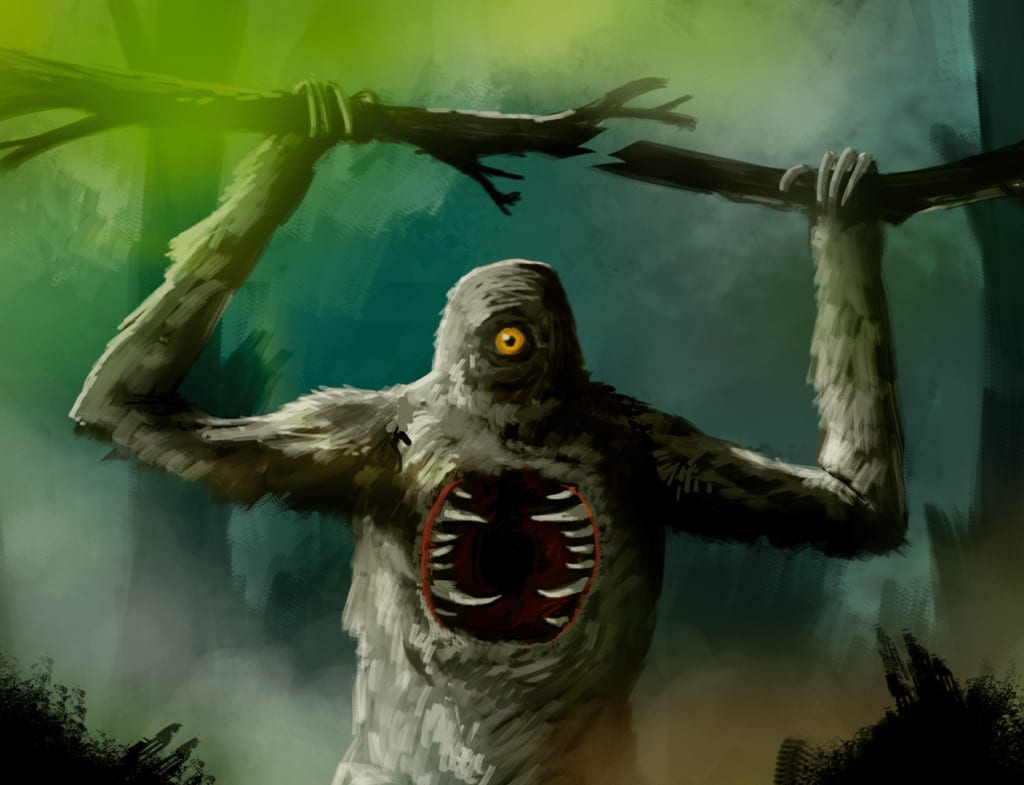
Towering in stature and exuding a foul, unmistakable odor, the Mapinguari is a fearsome, hairy beast known for its immense strength and ferocious roar—echoing from a short, horse-like snout. Accounts vary, describing the creature as having either two eyes or a single one positioned in the middle of its forehead, along with a gaping mouth bizarrely located on its stomach.
Typically moving on all fours, the Mapinguari is also said to rise up and walk upright. When standing on its hind legs, it can measure anywhere between three to six meters tall. Each of its four powerful limbs ends in massive, hooked claws—reminiscent of a giant armadillo’s—that curve inward or backward with alarming menace.
Its fearsome bite features four enormous canine teeth that jut out from its mouth, adding to its terrifying presence. Coloration varies by sighting, ranging from reddish tones to deep browns and blacks, and it’s often described as having a short, stubby tail.
Though the Mapinguari primarily feeds on vegetation, it’s not above preying on livestock—or even humans—who intrude upon its territory. Those who violate the rainforest may find themselves hunted by the creature, which is said to tear the limbs from its victims before consuming them.
In the most chilling tales, those who exploit the forest with greed suffer a far worse fate: the Mapinguari devours them slowly, starting with the head and working its way down with deliberate cruelty.
Its hide is said to be nearly impenetrable, described in some stories as being as tough as alligator skin or even resembling the armored shell of a turtle. The only known weak spot? Its belly button. But even getting close enough to strike such a target is no easy task.
Some legends speak of supernatural powers or a stench so overwhelming it disorients and incapacitates would-be attackers. And even if a hunter manages a lucky shot, the grotesque odor that lingers around the creature’s body is so unbearable, it drives away even the bravest with violently churning stomachs.
The earliest stories of the Mapinguari come from the Indigenous peoples of the Amazon basin—a region steeped in myth, where ancient spirits and fearsome beasts are woven deeply into the fabric of the forest.
Across the Amazon—in the Brazilian states of Rondônia, Amazonas, Acre, and Pará—the Mapinguari exists both in rich folklore and in modern-day eyewitness accounts.
Brazil is home to over 300 Indigenous groups, each with its own cultural traditions and linguistic heritage. With more than 150 languages spoken among these communities, it’s no surprise that variations in the creature’s name, appearance, and behavior are common.
“That’s part of the richness of this mythology,” says Dr. Andriolli Costa, a folklore researcher and consultant. An expert in Brazilian folk traditions—and a gifted storyteller—Dr. Costa has studied how the Mapinguari appears in different forms across cultures.
Other mythical beasts from the region share traits with the Mapinguari. One such creature is the Segamai—an herbivorous being roughly the size of a cow, covered in tangled fur. Like the Mapinguari, it can walk on either all fours or its hind legs, unleashes a blood-curdling roar, and is impervious to conventional weapons. However, its snout is more reminiscent of a giant anteater’s than a horse’s.
Then there’s the Curupira—a guardian spirit of the forest. While not monstrous in the same sense, this entity is equally fearsome to those who disrespect the natural world.
It’s hard to resist the urge to connect the consistent elements of the Mapinguari myth across regional traditions to a real-world animal—perhaps one that vanished not so long ago, or even one that might still roam the dense, uncharted reaches of the Amazon. This is where the most prominent and controversial theory steps in: the giant sloth hypothesis.
According to this view, the Mapinguari—and similar creatures from local folklore—may be cultural echoes of a real, now-extinct animal: the giant ground sloth. These immense creatures, belonging to the Mylodontidae family, once roamed South America and could easily fit the description of a hulking, hairy, herbivorous beast with formidable claws and an unusual gait.
But the theory doesn't end with extinction. In true cryptozoological fashion, some believers have pursued the possibility that these ancient sloths never truly died out. In the 19th century, written accounts surfaced from South America claiming that members of the Mylodontidae family might still be alive.
Among the most vocal proponents was renowned Argentine paleontologist Florentino Ameghino, who famously declared his belief that giant ground sloths continued to survive in the remote wilderness of Patagonia.
Even in the 21st century, the theory that the Mapinguari is actually a surviving ground sloth continues to capture imaginations—and none more prominently than biologist and ornithologist Dr. David Oren. A passionate advocate for the hypothesis, Oren has devoted much of his career to investigating the possibility that prehistoric ground sloths may still exist in the remote forests of South America.
According to Oren, the Mapinguari legend may stem from a blend of ancient cultural memory and actual modern-day encounters with elusive creatures—possibly descendants of the Mylodontidae family, part of the Xenarthran clade, which includes anteaters, armadillos, and sloths. In interviews with local hunters, Oren was told that some had even killed animals matching the description of this mysterious creature.
On one of his field expeditions, Oren and his team recovered a dung sample believed to be evidence of the Mapinguari. However, when the specimen underwent DNA analysis in a lab, the results were less than groundbreaking—it belonged to an arboreal anteater, not a ground-dwelling beast from the Ice Age.
Science may shed light on certain aspects of the Mapinguari legend, but it doesn't account for the depth of firsthand accounts or the centuries of oral tradition passed down across generations.
Much like the European colonizers and travelers who once documented—and often reshaped—these stories, modern Western audiences and internet folklore enthusiasts have further blurred the lines between myth, monster, and meaning. Though often done without malice, these reinterpretations can unintentionally overshadow the cultural roots and deeper symbolism of the original tales.
It’s essential to recognize that the most meaningful interpretations of the Mapinguari come from the Indigenous communities of Brazil, where the legend has endured for millennia. When viewed collectively, stories from across these diverse groups reveal a consistent message: the Mapinguari is not simply a terrifying beast, but a guardian of the rainforest.
For thousands of years, the Amazon’s vast natural wealth has sustained the people of the region. Within that context, the idea of a formidable creature defending this sacred environment from intruders—whether hunters, loggers, or greedy outsiders—resonates with powerful clarity. The Mapinguari seeks justice for the forest, not vengeance for its own sake.
And perhaps, in that symbolism, lies its greatest purpose. If the fear of the Mapinguari can inspire awe and a renewed respect for the Amazon, then this so-called “monster” may have already fulfilled its role—as a protector, not just of myth, but of life itself.
About the Creator
ADIR SEGAL
The realms of creation and the unknown have always interested me, and I tend to incorporate the fictional aspects and their findings into my works.
Keep reading
More stories from ADIR SEGAL and writers in Earth and other communities.
Human Revenge: A Hidden Cause Behind the Decline of Snow Leopards
High in the rugged mountains of Central and South Asia lives one of the world’s most mysterious and beautiful big cats—the snow leopard. Known for its thick grey-white fur, long tail, and incredible ability to blend into rocky landscapes, this elusive predator has fascinated scientists and wildlife lovers for decades. Yet despite its beauty and ecological importance, the snow leopard faces a growing threat: human revenge.
By Irshad Abbasi a day ago in Earth
Writing To Succeed
If you want to find something that will help readers find your writing, possibly expand your audience, and maybe even get you noticed for other things, then you’re not alone. But how can you get it done in a world full of want-to-be writers? Look less at what you’re writing now, and more at what other writers have used to boost their views and reads.
By Jason Ray Morton 3 days ago in Writers


Comments
There are no comments for this story
Be the first to respond and start the conversation.