
Malaysia MH370 Mystery
Disappearance of Malaysia Airlines Flight MH370 remain a mystery.

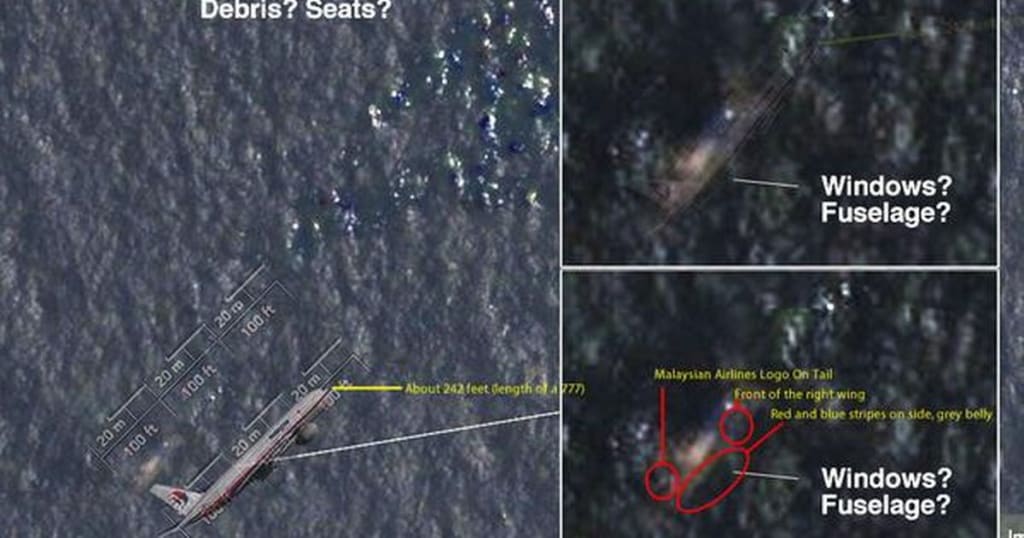
On March 8, 2014, Malaysia Airlines Flight MH370, a Boeing 777-200ER, took off from Kuala Lumpur International Airport en route to Beijing Capital International Airport. The aircraft was carrying 227 passengers from 14 different countries and a crew of 12. Less than an hour after takeoff, the plane disappeared from radar screens.
The last known communication from the aircraft was a routine sign-off from the cockpit crew, and everything appeared normal until the plane reached a waypoint called IGARI. Shortly after passing this waypoint, MH370's transponder, which identifies the plane's location to air traffic control, ceased transmitting. The aircraft also stopped communicating with secondary radar systems, leading to speculation that it intentionally turned off its communication systems.
Radar data analysis revealed that MH370 made a series of erratic turns and deviations from its planned flight path. It turned west and then southwest, flying back across Peninsular Malaysia and the Strait of Malacca. Military radar tracked the aircraft as it continued flying northwest, passing over the Andaman Sea.
An international search and rescue operation was launched to locate the missing aircraft. Initially, the search efforts focused on the South China Sea and the Gulf of Thailand based on the aircraft's last known position. However, as new information emerged from satellite data analysis, the search area was expanded to include the Indian Ocean.
Satellite data indicated that the plane continued to fly for several hours after its last radar contact, and it was determined that it likely ended up in a remote area of the southern Indian Ocean, far off the west coast of Australia. This conclusion was based on the analysis of automated satellite communications known as "handshakes" between the aircraft and an Inmarsat satellite.
The search operation, which involved multiple countries including Malaysia, Australia, and China, proved to be one of the largest and most complex in aviation history. It included aerial searches, surface ship searches, and underwater searches using specialized sonar equipment and autonomous underwater vehicles.
Despite the extensive search efforts, no trace of the aircraft was found for over four years. In January 2017, the Malaysian government, in collaboration with the Australian government and Ocean Infinity, initiated a new search operation. Under a "no find, no fee" contract, Ocean Infinity used advanced underwater technology to search a vast area in the southern Indian Ocean. However, this search effort concluded in May 2018 without locating the wreckage.
The lack of concrete evidence and the failure to locate the aircraft led to numerous theories and speculation surrounding the disappearance of MH370. These theories range from mechanical failure and pilot error to hijacking and terrorism. Some believe the plane was intentionally diverted, while others suggest it may have suffered an onboard fire or experienced a catastrophic event.
The families of those on board MH370 have endured immense emotional distress as they grapple with the uncertainty and lack of closure. The Malaysian government has made efforts to support the families and keep them informed throughout the investigation. Financial compensation has also been provided to the families by Malaysia Airlines and insurance companies.
The search for MH370 was officially suspended in January 2017, but the investigation into its disappearance remains open. The Malaysian government has encouraged anyone with information or possible debris findings to come forward and assist in the ongoing efforts to solve the mystery.
While the exact fate of Malaysia Airlines Flight MH370 remains unknown, the incident has prompted significant changes in aviation safety and aircraft tracking procedures. The tragedy highlighted the need for improved real-time tracking and communication capabilities for commercial flights to ensure the safety and security of passengers and crew.
The disappearance of MH370 continues to be one of the most puzzling mysteries in aviation history. It serves as a reminder of the complexities and challenges involved in investigating and understanding such incidents
About the Creator
Keep reading
More stories from writers in Earth and other communities.
Orlando experiences a rare prolonged cold as colder temperatures return to central Florida.
Orlando — a city known for warm breezes, sunshine, and mild winter days — has been experiencing a winter chapter more reminiscent of northern states than Central Florida. Residents have been bundled up in coats and reaching for heaters that are typically hidden during this time of year, as what began as a brief burst of cold air has grown into a "frigid, multi-day cold spell." The cold arrived without much fanfare, but it has stuck around for a remarkable amount of time. Forecasters say the chill is likely to last longer than most Floridians can remember. Instead of a brief dip, the thermometer has been well below seasonal norms for several days. Locals are pondering the question of when the temperature in Orlando last dropped to such lows.
By Raviha Imranabout 22 hours ago in Earth
The Impact of Biochar Stability: How Fixed Carbon Dictates Sequestration Success
In the urgent global effort to scale effective carbon dioxide removal (CDR), biochar has emerged as a leading contender. But not all biochar is equal in its climate-fighting power. The true measure of its long-term sequestration potential lies in one critical property: the stability of its fixed carbon. Understanding this is key to maximizing biochar's role in our carbon toolbox.
By Bestonpyrolysisabout 23 hours ago in Earth
🅼🅸🅳🅽🅸🅶🅷🆃 🆂🅽🅰🅲🅺🆂
"It's 10 in Tuscon! We all know what that means... It's Time for Midnight Snacks with your man, Gerald Gee! Ready to spend the night together? Me too! I'm full of snacks and can't wait to regurgitate them all back into your hungry ears. Crack a brew! Pop some corn! Anything to get ready for one hell of a show where the talk maybe cheap but the words cut deep...
By Lamar Wiggins5 days ago in Fiction




Comments
There are no comments for this story
Be the first to respond and start the conversation.