
Malagasy for Teeth
A story about wildlife, tradition, and being unique.

Part One: Winni Masondo
I take a knife to school with me. Actually, I take a knife wherever I go. Anywhere else it may seem contrived, but here, it’s a necessity.
I’ve called Cape Flats home my whole life — all 11 years of it. My father and I live in an old apartment complex, one where broken satellite dishes and crude graffiti dress the shabby gray exterior. Crime rates here are some of the worst in the world -- and it is considered by many to be the most dangerous place in South Africa.
Sometimes the other local kids and I play basketball or soccer in the parking lot. The pavement is hot, even under our sandaled feet. Regardless, I’m not a huge fan of spending time in the neighbourhood, or with the other children who live here.
That’s why Sundays are my favourite day.
Every Sunday morning, I get out of bed, put a coverup over my swimsuit, and wait in the outside hallway for our neighbour, Akpena, an interpreter at the Wolfgat Environmental Education Centre, to leave for the day.
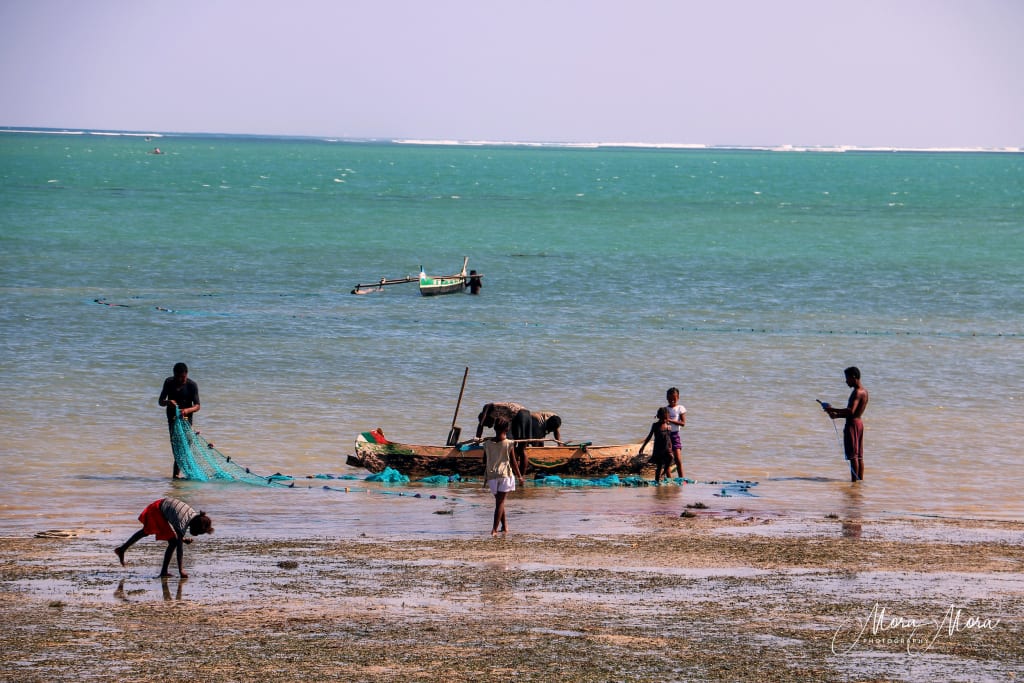
We spend the 10-minute drive discussing our favourite animals, and she teaches me about the importance of our local flora and fauna. She drops me off along the beach, where her mother, Theolene, waits by her small la'kana. Every day without fail, Akpena sees me off and wishes me a good time. Her mother blows her a kiss, and she catches it, holding the beautiful, captured gesture to her heart. Then she heads off to work.
My shoes fill with sand as I run to the water’s edge. Theolene welcomes me with a warm smile and wraps her arms around me.
“Miss Winni, how are you today?” she greets me in her limited Afrikaans. I try my best not to stare at the large lump on the left side of her neck. She had explained it to me before, cystic hygroma. It was something she’d had since the day she was born. It used to bother her when people stared, but not anymore.
“I’m doing great, Ouma,” I tell her, my attention now focused on the crab claw sail thrashing violently in the lawless September wind.
“It’s the perfect day for sailing,” she tells me as she pulls out a snorkel from her bag. She hands it to me, and I immediately put it on.
She then asks me if I’m ready, and I nod excitedly. She helps me into the boat and walks us into the ocean until the cool water is up to her thighs. I take her hand and help pull her into the la'kana.
Part Two: Theolene Rajaonarivelo
I spent my childhood in the small fishing village of Mangily on the southwest coast of Madagascar. My first memories of growing up include helping my father fish in the Mozambique Channel. He was delighted to have my help, despite whispers from other locals that “the boat was no place for a girl.” At the time, I couldn’t understand why. My father coolly explained that women and children were meant to fish from shore on foot, collecting molluscs, sea cucumbers, and crabs at low tide. This didn’t make sense to me. Why should someone stay in the shallows when there was a wild blue yonder to explore?
I must admit, my intentions for joining my father at sea were purely selfish. As much as I loved spending time with him, my primary goal was to satisfy my own interest in marine life.
I couldn’t have cared less about the small-scale fish he would sling onto the boat. I was interested in the much, much more fantastical.
One day while out on the la'kana, I encountered the most magical being. A fin emerged beside our boat and my father calmly pointed to the gray triangle.
“Look, Theo. Look at this magnificent creature,” he said to me in his mother tongue of Malagasy. I remember peering over the side of the boat just as a shape, larger than I was at the time, surfaced beside us. “Do you know what this is?” he asked me. I nodded nervously.
“Antsantsa,” I replied, my mouth slightly agape. I’d never seen a shark up close before, but I knew exactly what it was. My familiarity with the beasts was resigned to their dismembered fins available for purchase at our local markets. He nodded, telling me that we must keep the pup as our little secret, for its safety. Although I was young at the time, I knew the importance of this, and the potential ramifications if we were to share our findings with the rest of the village.
My father pulled our fishing net from the water and emptied the day’s catch into the boat. A glittering collage of anchovies, sardines, shad, and menhaden littered the la'kana floor.
It was then that we noticed something different about the way she moved. It was somewhat… unsteady. My father gestured to her tail. One side was normal, smooth and flat; the other lumpy and disproportionate. I raised my hand to the sizeable growth on my neck as I watched her circle our boat. She was curious and ethereal.
My father observed, “She seems to have a broken caudal fin.”
“Won’t that set her back?” I queried. He smiled at me.
“Not if she doesn’t let it.”
Every possible morning thereafter, until we moved to South Africa in the late 1960s, I would join my father on the boat to visit whom we began to affectionately refer to as “Nify” — our native word for “teeth”. I was thrilled to see that she also enjoyed the flavours of our coastal fish. Food connects people, and as a child, I felt it connected us too.
I was devastated when she would disappear for migration, not grasping the concept until I was much older. My father explained to me that this wasn’t a permanent home for her. She was a nomad, and the entire ocean was hers to explore.
In South Africa, I missed seeing Nify terribly. I was teased at school for my deformity, which led me into a deep depression. I spent my days at the library, reading as many books on sharks as I could. My father took note of this and began saving his pennies with the intention of building us a brand-new boat. It took a few years, but eventually, we had a new la'kana. I’d always noticed boats in the harbour had names, proudly displayed on their outer walls. I asked my father for his pocketknife and proceeded to etch “The Nify” into the wooden side of our la'kana. We shared a smile.
At first, we didn’t see her. My father took me by the shoulders and sat me down. He explained to me that it was possible something had happened to her, that perhaps her mangled fin had caused her to succumb to further injuries.
“It could have been other sharks,” he eventually conceded. “They can be ruthless.”
I felt like all hope was lost. Then, when I was 17, my father died suddenly. This awakened something in me and every single day I would get into our la'kana and look for Nify. I refused to give up, and my resilience paid off.
One June day, I witnessed a most magnificent sight. A great white shark propelled itself from the ocean with a seal between its jaws. I was so wonderstruck that I almost didn’t notice the most unmistakable tail. It was her. All 16 glorious feet of her. The colossal ripples from her emergence and disappearance back into the water caused the la'kana to rise and fall with the waves. I could barely breathe. Once she was back in the water, she swam beneath me. I took in the now-adult version of my childhood obsession, catching sight of the numerous scars sweeping the areas surrounding her gills, and the families of pilot fish glued to her side. She was incredible. She was resilient.
Part Three: Winni Masondo
Our la'kana drifts in the bay and my eyes eagerly penetrate the water. Last weekend had been a bust. Nify had decided not to make an appearance. I silently pray she shows herself today. As I sit in the center hull, I put my flippers on one at a time. When I’m ready, I give Theolene a thumbs up. She smiles and helps me over the edge of the boat.
Anyone who spends any time in the water will tell you that it’s like entering a totally different world. The kelp forests beneath me, their holdfasts anchored to rocks of every shape and size, sway back and forth. I can feel Theolene’s eyes watching me from the la'kana. She’s looking for her too. I’m in the water for several minutes before I resurface.
“Nothing?” I ask her. She shakes her head.
“We have to be patient.”
I submerge my face back in the water, beginning to feel a scintilla of doubt. I can see many incredible things, rock lobsters, Blue Hottentot, and even what I suspect is the tail end of a skate. Then something out of the corner of my eye catches my attention. At first, I think it is a large mako but as it approaches, I see that it’s anything but. My heart begins to palpitate. The moment becomes a state of felicity. I can hear Theolene speaking excitedly above me.
I remember what I’ve been taught: never let the excitement cloud your common sense.
I remain calm and turn cautiously towards the creature. By the marked movements, I know exactly who this is. She pays no mind to me as she makes her way through the clusters of kelp. I watch in awe from above as she comes into full view. Her distinctive tail moves rhythmically from side to side. She’s just as mesmerizing as the first time I laid eyes on her a year ago.
I imagine myself swimming alongside her, learning everything there is to know about her mystifying and solitary life. Sharks chill the blood of some, but to me, they are pure magic. Personally, I'm more afraid of my journey to school.
As much as I want to stay in the water and watch, I know that she’s likely in the forest to hunt. When she disappears from view, I reach my hand up to indicate to Theolene that I’m ready to come back out. I do one more safety scan before popping my head up and allowing Theolene to help me back into the la'kana. I’m barely in the boat for a second when a large dorsal fin appears alongside us.
The two of us watch in silence as Nify comes and goes. Leaving for moments at a time before returning to just below the surface. When we finally think she’s gone, we spot her one last time -- and a most distinct tail appears. It’s as if she’s showing us. I reach out to touch it, but Theolene gently pulls my hand back.
“Just admire,” she whispers. Her ardent emotions manifest as clear salty droplets that trickle down her weathered cheeks. When I look up at her, I see her fingertips lightly brush against the mass on her neck. I smile. That’s the moment I understood.
About the Creator
Emily Koopman
www.EmilyKoopman.com
www.moramoraphotography.com
Keep reading
More stories from Emily Koopman and writers in Earth and other communities.
Compulsion Loop
Yes, I killed Mara Makovsky. But it’s not what you think. I wasn’t stumbling through the shallow soils and cracking clays of Khunale while blood as thick as syrup dripped between my fingers for the hell of it. Fuck, it was 105 degrees out. I looked down at the locket, fondling the heart-shaped copper in my unsullied hand. Despite my best efforts, Mara’s lifeblood had already seeped its way into the intricate engravings -- the ones that were unique to her. Well, to her and Brooks. When the locket’s crevices were full, she’d be gone from this plane. Somewhere better, I prayed.
By Emily Koopman5 years ago in Futurism
The Reality of the Illusion of Time
Recently, as I strolled along the short stretch to my strength training session, I aimlessly took in the row of tatty shops and shabby buildings along the route and passed an off-street, in which one of my sisters used to live, around thirteen years ago.
By Chantal Christie Weiss4 days ago in Earth
Why Putin Went Quiet When Challenged by Trump Over Venezuela
When U.S. forces captured Venezuelan President Nicolás Maduro in early January 2026, the world was stunned. Venezuela has long been a Russian ally, yet Russian President Vladimir Putin remained almost completely silent when challenged directly by U.S. President Donald Trump. Why would a leader so often outspoken on the world stage hold back in such a dramatic moment? Let’s unpack the story and explore what it means for global politics. A Bold Move That Shocked the World On January 3, U.S. forces executed a daring operation in Venezuela, taking Maduro into custody in New York to face charges including drug trafficking and narco‑terrorism. The operation was framed by the U.S. as a step to enforce justice, but critics saw it as an extraordinary overreach of power. Venezuela is no ordinary country for Russia. Since the days of Hugo Chávez, Moscow has cultivated close ties with Caracas, offering military support, energy deals, and diplomatic backing on the global stage. Past actions included Russian bombers visiting Venezuela and high-profile defense agreements. Given this history, many expected a fiery response from Putin. Yet, the Kremlin remained calm, issuing measured statements rather than sharp threats. Why Silence Was Strategic Experts suggest there are several reasons for Putin’s muted reaction, each revealing the careful calculation behind the Kremlin’s foreign policy. 1. Focus on the War in Ukraine Russia’s primary priority remains Ukraine. Engaged in a high-stakes military and diplomatic battle, Putin cannot afford distractions or new confrontations far from home. Escalating tensions with the United States over Venezuela could jeopardize Moscow’s position in Europe. A New York Times report highlighted that Russia is “subordinating all other interests to the war in Ukraine,” suggesting that even a high-profile ally like Venezuela takes a back seat to Moscow’s strategic goals. 2. Limited Military Options While Russia’s alliance with Venezuela is longstanding, much of the support has been symbolic rather than operational. Defense systems and military cooperation exist on paper, but Russia lacks the immediate ability to counter a U.S. operation thousands of miles away. Putin may have recognized that responding aggressively would be both ineffective and costly, potentially risking military and economic consequences that Moscow cannot afford. 3. Maintaining Diplomatic Channels with Washington With Donald Trump back in the White House since 2025, there has been cautious optimism in Moscow about recalibrating U.S.–Russia relations. Avoiding a dramatic confrontation over Venezuela keeps diplomatic channels open, allowing Russia to negotiate on other high-priority issues like Ukraine and sanctions relief. In other words, silence can be a calculated strategy, signaling restraint rather than weakness. 4. Russia’s Global Influence Is Waning The Maduro episode also highlights a broader geopolitical reality: Russia’s global reach has limits. Since the 2022 invasion of Ukraine, Moscow’s influence in regions like the Middle East and parts of the former Soviet Union has weakened. Venezuela remains one of its few high-profile allies outside Europe, but even there, Russia’s power is largely symbolic. By not escalating, Putin is acknowledging a practical truth: Russia cannot be everywhere at once, and some battles are not worth fighting. 5. Choosing Battles Wisely Some analysts emphasize that Putin’s quiet response is more about strategic prioritization than capitulation. In a world dominated by nuclear powers and volatile global politics, direct confrontation with the United States over Venezuela could spiral into a far larger crisis. By staying silent, the Kremlin may be signaling that it picks its battles carefully, focusing resources on Ukraine, where the stakes are highest. What This Means for the World Putin’s silence sends several messages: Russia is currently stretched, economically and militarily. Moscow is prioritizing Ukraine over symbolic allies. Strategic restraint is sometimes more powerful than public confrontation. The limits of Russian influence are becoming more visible to the world. This episode reflects a new reality in geopolitics: power is as much about choosing when not to act as when to assert force. The Bigger Picture The capture of Maduro is a defining moment not just for Venezuela, but for global politics. It shows the United States asserting power in a way not seen for decades, while Russia’s quiet reaction underscores its current limits and priorities. For observers, Putin’s silence is a lesson in modern geopolitics: even the most assertive leaders exercise restraint when stakes are high and risks are global. In the end, the Maduro affair reminds us that in today’s world, the loudest response is not always the most effective one — sometimes, quiet calculation speaks volumes. Sources and Further Reading The US capture of Maduro reveals Russia’s weakness – Atlantic Council ‘It sends a horrible signal’: US politicians react to capture of Nicolás Maduro – The Guardian Russia slams 'neocolonial threats' against Venezuela – Reuters
By Muhammad Hassan7 days ago in Earth



Comments
There are no comments for this story
Be the first to respond and start the conversation.