
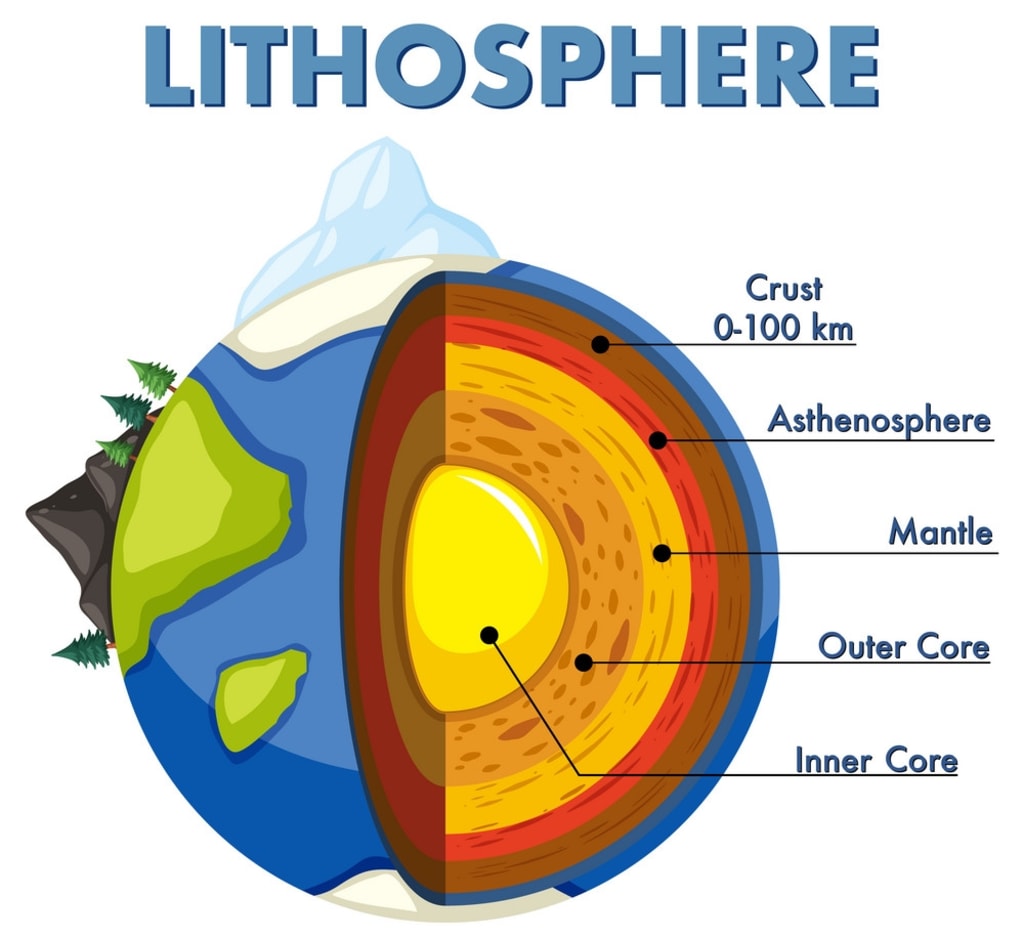
The lithosphere refers to the solid outermost layer of the Earth, which includes the crust and the uppermost part of the mantle. It is composed of a variety of rocks, including igneous, sedimentary, and metamorphic rocks, and has a thickness of approximately 100 kilometres.
The lithosphere is broken into a number of large, rigid plates that move and interact with one another at plate boundaries. These interactions can result in earthquakes, volcanic eruptions, and the formation of mountains.
The lithosphere is an important component of the Earth's system, and plays a crucial role in the planet's geology, climate, and biogeochemical cycling. It is also home to a wide range of organisms, from bacteria living in rocks to large mammals inhabiting the surface.
The lithosphere is one of the four major components of the Earth's system, along with the hydrosphere (water), atmosphere (air), and biosphere (life). These four components interact with one another in complex ways to shape the Earth's surface, climate, and ecosystems.
The lithosphere is constantly evolving due to the forces of plate tectonics, which is the study of the movement and deformation of the Earth's lithospheric plates. Plate tectonics is responsible for the formation of new crust through seafloor spreading, as well as the destruction of crust through subduction and collision at plate boundaries.
The lithosphere is also home to a variety of natural resources, including minerals, fossil fuels, and groundwater. These resources are extracted and used for a wide range of human activities, such as agriculture, industry, and transportation.
In summary, the lithosphere is a complex and dynamic layer of the Earth's system, which is composed of rocks and plates that move and interact with one another. It plays a critical role in shaping the Earth's surface and supporting life, as well as providing important natural resources for human activities.
The study of the lithosphere is a vast and interdisciplinary field, which encompasses geology, geophysics, geochemistry, and other related disciplines. Scientists and researchers studying the lithosphere aim to understand its structure, composition, and evolution, as well as its interactions with other components of the Earth's system.
One of the key areas of research in the study of the lithosphere is the understanding of plate tectonics and the associated processes, such as mountain building, volcanic activity, and earthquakes. This research helps to improve our understanding of natural hazards and how they impact the environment and society.
Another area of study in the lithosphere is the exploration and exploitation of natural resources, such as minerals, fossil fuels, and groundwater. Understanding the distribution and properties of these resources can inform management and conservation efforts, as well as support sustainable development.
Overall, the lithosphere is a fascinating and complex component of the Earth's system, with important implications for geology, natural hazards, natural resource management, and environmental sustainability. Ongoing research in this field is critical to improving our understanding of the Earth's system and informing decisions that impact our planet and its inhabitants.
In addition to natural processes and resource management, the lithosphere also plays an important role in the history of the Earth and its evolution. By studying the composition and structure of rocks and other materials in the lithosphere, scientists can reconstruct the history of the Earth's formation, as well as the processes that have shaped its surface and atmosphere over time.
The study of the lithosphere also has important implications for planetary science and astrobiology. By comparing the lithospheres of other planets and moons in our solar system to Earth's lithosphere, scientists can gain insights into the geologic and environmental processes that shape other worlds, as well as the potential for life beyond Earth.

Finally, the lithosphere is also impacted by human activities, such as land use change, mineral and fossil fuel extraction, and pollution. These activities can have significant impacts on the Earth's lithosphere and the services it provides, including soil fertility, water quality, and carbon sequestration. Therefore, understanding and managing human impacts on the lithosphere is crucial for ensuring a sustainable future for the planet and its inhabitants.
In summary, the lithosphere is a critical component of the Earth's system, with important implications for geology, natural hazards, natural resource management, environmental sustainability, planetary science, and astrobiology. Ongoing research in this field is essential for advancing our understanding of the Earth's past, present, and future, and for informing decisions that impact the planet and its inhabitants.
One of the challenges in studying the lithosphere is the vastness and complexity of the Earth's crust and upper mantle. The lithosphere is a dynamic system that is influenced by many factors, such as plate tectonics, mantle convection, and the geologic history of the planet. Therefore, understanding the lithosphere requires a multidisciplinary approach that combines fieldwork, laboratory analysis, computer modeling, and remote sensing techniques.
Scientists use a variety of tools and methods to study the lithosphere, including seismology, gravity and magnetic surveys, geochemical analysis, and remote sensing from satellites. These techniques allow researchers to map the structure and composition of the lithosphere, and to understand the physical and chemical processes that shape it over time.
In addition to scientific research, the study of the lithosphere also has practical applications in a wide range of fields, such as mineral exploration, energy production, environmental remediation, and infrastructure development. Understanding the lithosphere can inform decisions about where to locate mines, wells, and other resource extraction activities, as well as how to manage the impacts of these activities on the environment and society.
In conclusion, the lithosphere is a complex and dynamic system that plays a critical role in shaping the Earth's surface, supporting life, and providing important natural resources. The study of the lithosphere is a multidisciplinary field that requires a wide range of tools and techniques, and has important implications for many areas of science and society.
As our understanding of the lithosphere continues to evolve, new areas of research and application are emerging. For example, there is growing interest in using the lithosphere as a repository for long-term storage of carbon dioxide, a greenhouse gas that contributes to climate change. Scientists are studying the feasibility and safety of carbon capture and storage in geological formations, such as deep saline aquifers and depleted oil and gas reservoirs.
Another area of research in the study of the lithosphere is the exploration of potential habitable environments on other planets and moons in our solar system. By studying the geology and geochemistry of these worlds, scientists can identify locations where conditions may be suitable for life as we know it, or where the potential for discovering new forms of life may exist.
The lithosphere is also an important component of the Earth's carbon cycle, which plays a critical role in regulating the planet's climate. Carbon dioxide is naturally exchanged between the atmosphere, the oceans, and the lithosphere through processes such as weathering and volcanic activity. By studying these processes and their interactions, scientists can better understand how the Earth's climate has changed over time, and how it may continue to change in the future.
Overall, the study of the lithosphere is a vibrant and growing field that has important implications for our understanding of the Earth and its place in the universe, as well as for our efforts to manage and sustainably use the planet's resources. As new tools and technologies continue to emerge, the study of the lithosphere will undoubtedly continue to push the boundaries of our knowledge and understanding of the planet we call home.
About the Creator
Keep reading
More stories from Sangeetha S and writers in Earth and other communities.
Severe Geomagnetic Storm Could Bring Northern Lights Across Much of the U.S.
On Monday evening, skywatchers from the Pacific Northwest to the Midwest got ready for something out of the ordinary: a celestial display that typically occurs at high northern latitudes. Americans who provide forecasts as a powerful cloud of charged particles from the sun accelerates toward the Earth's magnetic field, the National Oceanic and Atmospheric Administration (NOAA) has issued a "G4 (Severe) geomagnetic storm watch."
By Raviha Imrana day ago in Earth
Greenland News
Greenland News Greenland has increasingly drawn global attention in recent years due to its political developments, environmental changes, and growing strategic importance. As the world looks more closely at the Arctic region, news from Greenland reflects a unique mix of local priorities and international interest. From climate-related challenges to economic opportunities and governance issues, Greenland continues to shape its own path while remaining closely connected to global affairs.
By America today 3 days ago in Earth




Comments
There are no comments for this story
Be the first to respond and start the conversation.