
James Webb Space Telescope Reveals Stunning New Image
Cassiopeia A
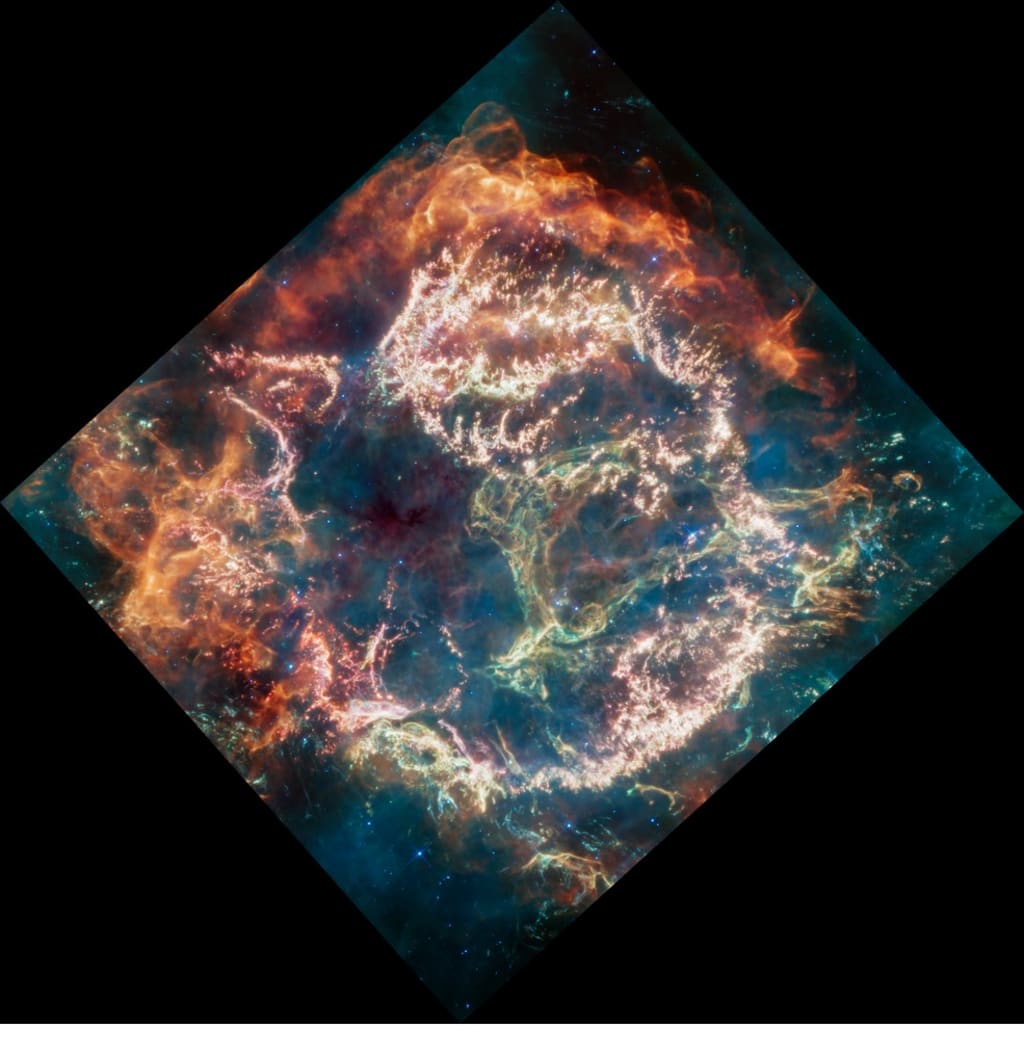
Cassiopeia A, also known as Cass A, has captured the imagination of astronomers for over three centuries. It represents the remnants of a stellar explosion that occurred 340 years ago in the Milky Way galaxy. Contrary to its nickname "green monster," which may bring to mind characters like Olive Ogre, Cassiopeia A is anything but green or scary. In fact, the recent image of Cassiopeia A captured by the James Webb Space Telescope has revealed a breathtaking display of vibrant colors that represent different wavelengths of normally invisible infrared light.
The image, a stunning masterpiece in its own right, could easily be printed and displayed as a beautiful painting for a living room. However, its true significance lies in the valuable insights it provides to astronomers. Located approximately 11,000 light years away in the Cassiopeia constellation, Cassiopeia A is considered the youngest known remnant of a massive star explosion in our galaxy. Consequently, it has become a crucial object of study for scientists seeking to unravel the mysteries of stellar evolution and the aftermath of such cataclysmic events.
One of the remarkable features captured in the image is the presence of red and orange curtains. These curtains are the result of warm dust emitting light when the ejected material from the star collides with surrounding gas and dust. The violent collision causes the dust to heat up and radiate in vibrant hues, enriching the image with their fiery display. By meticulously studying the distribution and characteristics of these curtains, astronomers can gain valuable insights into the dynamics of the explosion and the intricate interaction between the expelled material and the interstellar medium.
Delving further into the image, astronomers have discovered pink bubble-shaped clumps and knots of material inside the outer shell of Cassiopeia A. These structures originate from the star itself and shine brightly due to the presence of heavy elements such as neon, argon, and oxygen. Analyzing the detection and composition of these elements provides valuable information about the progenitor star's composition and the nucleosynthesis processes that occurred during its lifetime.
Surrounding Cassiopeia A, astronomers have also observed dust emissions, although the specific sources of this dust remain unidentified. Determining the origins of the dust is of great interest to scientists as it could provide critical insights into the mechanisms responsible for its formation and dispersal throughout the galaxy. Understanding the origin and behavior of cosmic dust contributes to our broader understanding of the interstellar environment and the life cycles of stars.
Another striking feature revealed in the image is a prominent green loop extending across the central cavity of the supernova remnant. Alongside the small bubble-like structures present in the region, this loop adds complexity to our understanding of the explosion and its aftermath. Scientists theorize that these features may be indicative of the presence of magnetic fields or the intricate interaction of the remnant with its surrounding environment.
In summary, the remarkable image of Cassiopeia A captured by the James Webb Space Telescope provides astronomers with an invaluable window into the events leading up to the star's explosive demise and the subsequent formation of its remnants. Through the meticulous analysis of the various structures, emissions, and colors seen in the image, scientists can unravel the intricacies of the explosion dynamics, explore the composition of the progenitor star, investigate the formation and dispersal of cosmic dust, and gain a deeper understanding of the remnant's interaction with its environment. Cassiopeia A continues to astound us, not as a green monster, but as a cosmic marvel inviting us to delve into the mysteries of the universe.
About the Creator
Keep reading
More stories from writers in Earth and other communities.
Southeast Asia on Alert After Nipah Virus Cases Detected in India
Authorities in Singapore, Thailand, and Malaysia have moved swiftly to implement precautionary measures after two confirmed cases of the Nipah virus were reported in India, raising concerns about the potential regional spread of one of the world’s deadliest zoonotic diseases. While health officials stress that there is currently no cause for panic, the response highlights lingering anxieties across Asia following the COVID-19 pandemic.
By Aarif Lashari7 days ago in Earth
After the Storm
After the storm of winter snow there sat a small bear by the name Ted, of course. He loves the snow and likes to roll around in it making all sorts of trails and whatever he has a mind to do. He wondered where all the people are, but in a way, he is hoping that they are all snug in the homes maybe drinking hot chocolate-one of his favorite drinks with mini-marshmallows and eating something homemade for he likes this winter wonderland all to himself to romp and play and maybe even catch some fish down by the river.
By Mark Graham7 days ago in Fiction



Comments
There are no comments for this story
Be the first to respond and start the conversation.