
Isaac Newton: Biography and Contributions to Science
Discovering the Laws of Motion, Law of Universal Gravitation, and Other Scientific Achievements

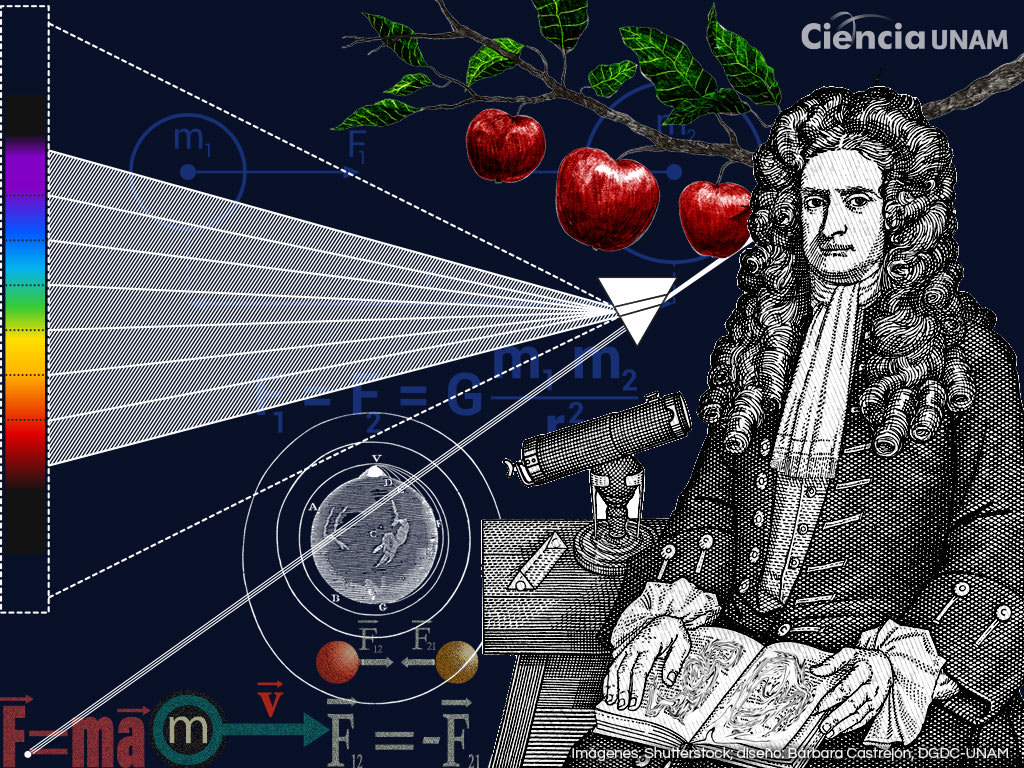
Isaac Newton (1642-1727) was an English physicist, mathematician, astronomer, and theologian who is widely recognized as one of the most influential scientists in history. He is best known for his three laws of motion, which laid the foundation for classical mechanics, and his law of universal gravitation, which explained the behavior of objects in the presence of gravity.
Newton made significant contributions to many other fields as well. He invented calculus independently of Gottfried Leibniz, although their methods were different. He also made important contributions to optics, including the discovery of the spectrum of light and the development of the reflecting telescope. Newton's work on light and color laid the groundwork for the field of spectroscopy, which is still used today.
Newton was a fellow of the Royal Society and served as its president from 1703 to 1727. He was knighted in 1705 by Queen Anne and served as a member of Parliament for Cambridge University. Newton's influence on science and philosophy continues to this day, and he is widely regarded as one of the most important figures in the history of science.
In addition to his scientific achievements, Newton also had a strong interest in alchemy and religious studies. He spent a significant amount of time studying alchemy, which was a precursor to modern chemistry, and believed that it held the key to unlocking the secrets of the universe.
Newton was also deeply religious and believed that his scientific discoveries were evidence of God's handiwork in the natural world. He wrote extensively on theological topics, including the interpretation of the Bible, and believed that science and religion were complementary rather than opposed.
Newton's legacy has had a profound impact on the development of science and technology over the past few centuries. His laws of motion and law of universal gravitation laid the groundwork for the development of classical mechanics, which was crucial to the Industrial Revolution and the development of modern engineering. His work on optics and the spectrum of light laid the foundation for the development of modern optics and spectroscopy, which have countless applications in fields ranging from astronomy to medicine.
Newton's ideas and methods have also had a profound impact on the development of modern science. His emphasis on empirical observation and experimentation, mathematical rigor, and the importance of developing explanatory theories based on data have become core tenets of the scientific method, which has enabled countless scientific breakthroughs and technological advancements.
Newton's laws of motion are still widely used today to describe the behavior of objects in motion. They have been essential in the development of modern technologies such as transportation, aerospace engineering, and robotics. The law of universal gravitation also continues to be a fundamental concept in the study of physics and astronomy, and has been used to make important discoveries such as the prediction of the orbit of Neptune.
In addition to his scientific and mathematical contributions, Newton also played a significant role in the development of the English language. He is credited with inventing many words and phrases that are still in use today, such as "mass," "momentum," "centrifugal force," and "action and reaction."
Newton's life and work have been the subject of numerous books, documentaries, and films. He has been depicted as a genius, a recluse, and a deeply religious man, among other things. Despite his many achievements, Newton was also known for his difficult personality and interpersonal relationships, which have been the subject of much speculation and analysis.
Overall, Newton's contributions to science, mathematics, and language have had a profound impact on the development of modern civilization. His work continues to be studied and admired by scientists, mathematicians, and scholars around the world, and his legacy continues to inspire new generations of researchers and innovators.
About the Creator
Locked Exits, Panic, and Desperate Calls: Survivors Recount Mall Fire Horror
A tragic fire at a busy shopping mall has left the public in shock as survivors recount the harrowing moments when flames and smoke consumed the building. Eyewitness accounts describe locked exits, panicked crowds, and desperate calls for help, painting a chilling picture of the chaos inside.
By Muhammad Hassanabout 5 hours ago in Earth
Winter Storm Watch. What It Means and How to Prepare
What Is a Winter Storm Watch? A winter storm watch is issued when forecasters identify the possibility of severe winter weather, but the exact timing, location, or intensity is still uncertain. This alert is different from a winter storm warning, which is given when dangerous winter conditions are imminent or already happening. The watch phase is essentially a heads-up. It allows individuals, businesses, and local governments to start preparing before conditions worsen. During this time, meteorologists continue to analyze weather patterns and refine their forecasts. If confidence in the storm increases, the watch may be upgraded to a warning or advisory. Typical conditions associated with a winter storm watch include heavy snow accumulation, ice storms, strong winds, reduced visibility, and extreme cold. These elements can create treacherous roads, power outages, and health risks, especially for vulnerable populations.
By Hamd Ullahabout an hour ago in Earth


Comments
There are no comments for this story
Be the first to respond and start the conversation.