
Biography of Alexander Graham Bell.
Inventions and Contributions to Science, Speech Therapy, Aviation, Hydrofoils, and Philanthropy.

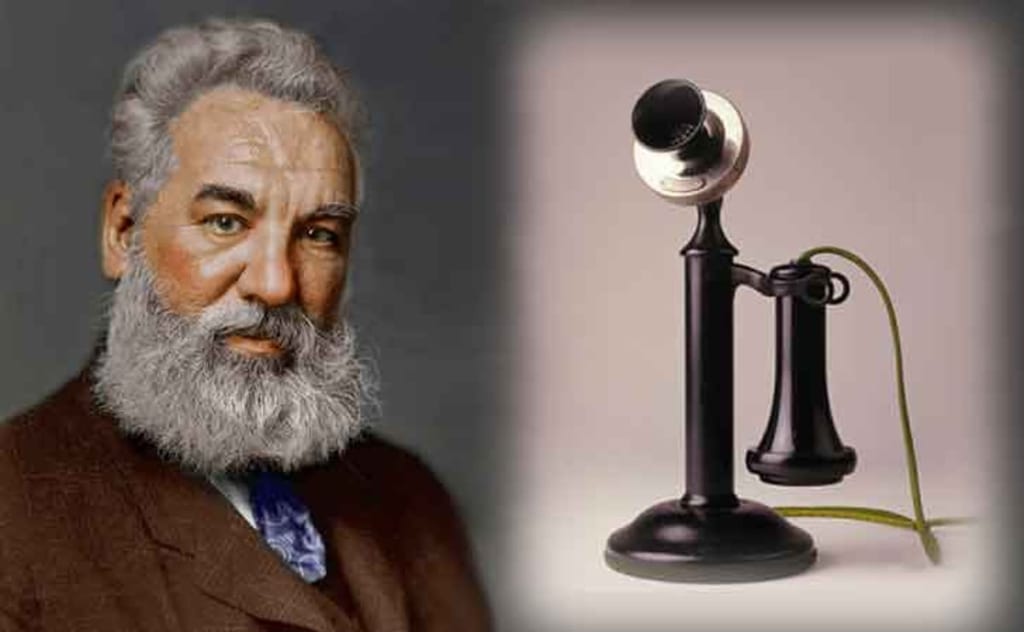
Alexander Graham Bell (1847-1922) was a Scottish-born inventor, scientist, and engineer who is best known for his invention of the telephone. He is also known for his pioneering work in the fields of communication, speech therapy, and aviation.
Bell was born in Edinburgh, Scotland, and later moved to Canada and then the United States. He was interested in science and engineering from a young age, and began working on various inventions while still a teenager. In his early twenties, he moved to Boston, Massachusetts, where he became a teacher of the deaf and began developing techniques to help people with speech and hearing impairments.
In 1876, Bell received a patent for his invention of the telephone, which revolutionized communication by allowing people to talk to one another over long distances. He continued to work on improving the telephone throughout his life, and also developed other inventions such as the photophone, a device that transmitted sound on a beam of light, and the metal detector, which he developed to help locate a bullet in President James A. Garfield's body after he was shot in 1881.
Bell was also interested in aviation and worked on developing various flying machines. He established the Aerial Experiment Association in 1907, which conducted groundbreaking work in aviation and led to the development of the first successful aircraft in Canada.
Bell's contributions to science and technology have had a profound impact on society, and his legacy continues to be celebrated today.
In addition to his work on the telephone and aviation, Alexander Graham Bell made important contributions to the fields of hydrofoils, optical telecommunications, and even genetics.
Bell was fascinated by the idea of using hydrofoils, or wing-like structures that lift a boat's hull out of the water, to increase the speed and efficiency of water transportation. He designed and built several experimental hydrofoil boats, including the HD-4, which set a world speed record in 1919.
Bell also made significant contributions to the development of optical telecommunications. In 1880, he developed the photophone, a device that could transmit sound on a beam of light, and demonstrated it by transmitting a voice message from one building to another. Although the photophone was not as practical as the telephone, it laid the groundwork for future developments in fiber-optic communications.
In addition to his scientific and engineering work, Bell was interested in genetics and eugenics. He believed that deafness was hereditary and advocated for measures to prevent the marriage of deaf people, including forced sterilization. These views have been criticized as promoting discrimination against people with disabilities.
Despite this controversy, Alexander Graham Bell's contributions to science and technology continue to be celebrated, and he remains one of the most influential inventors in history.
Alexander Graham Bell also made significant contributions to the field of speech therapy. His work with deaf people led him to develop a method of teaching speech that involved placing a small instrument called a visible speech machine in the mouth to help people see the movements of the tongue and lips as they spoke. This method proved highly effective in helping deaf people learn to speak, and it is still used in speech therapy today.
In addition to his scientific and engineering work, Bell was also an advocate for the education of women. He believed that women should have equal access to education and opportunities, and he founded the Bell Telephone Company's School for Deaf Mutes, which was the first school of its kind to admit female students.
Bell was also involved in philanthropic work, and he donated a significant portion of his wealth to charitable causes. He was particularly interested in improving the lives of people with disabilities and established the Volta Bureau, which became a leading center for research and advocacy on behalf of people who were deaf or hard of hearing.
Overall, Alexander Graham Bell's legacy is one of innovation, scientific discovery, and a commitment to improving the lives of others. His contributions to the development of the telephone, aviation, and speech therapy have had a profound impact on society, and his advocacy for women's education and philanthropic work continue to inspire people today.
About the Creator
Japan Furniture Market Size and Forecast 2025–2033
Introduction Japan’s furniture industry stands at a unique intersection of tradition and innovation. Renowned worldwide for its craftsmanship, minimalist design, and functional aesthetics, Japanese furniture reflects the nation’s cultural emphasis on harmony, efficiency, and simplicity. Today, as Japan’s population becomes increasingly urban, digitally connected, and environmentally conscious, the furniture market is undergoing a quiet but significant transformation.
By Janine Root 6 days ago in Earth
Maryland to Get Its Own Smaller Version of the Las Vegas Sphere
Maryland is about to become home to a new entertainment icon. Inspired by the famous Sphere in Las Vegas, a smaller version of the massive immersive venue is planned for the state, promising to deliver a combination of live entertainment, cutting-edge technology, and a new tourist attraction. While the Las Vegas Sphere has already made headlines worldwide for its futuristic design and mind-blowing shows, Maryland’s version aims to bring a scaled-down but equally captivating experience to the East Coast.
By Muhammad Hassana day ago in Earth




Comments
There are no comments for this story
Be the first to respond and start the conversation.