
Is the power company ready for low-carbon transformation?
climate change.

On April 30th, the carbon Disclosure Project (CDP) released a report entitled "starting the transition: are Power companies ready for a low-carbon Future" (Flicking the Switch: Are Electric Utilities Prepared for a Low Carbon Future), which examines how Europe's major power companies are responding to low-carbon transition requirements and points out that the EU must promote renewable energy production to meet its climate targets.
In recent years, the European emissions trading system (EU ETS) carbon prices have continued to fall, and the price gap between natural gas and coal is increasing, so coal-fired power generation is replacing cleaner natural gas power generation.
The EU's greenhouse gas reduction target is to reduce emissions by 40 per cent from 1990 levels by 2030 and 80 per cent from 1990 levels by 2050.
If Europe is to meet its climate targets, more than 45% of Europe's electricity production will need to come from renewable sources by 2030.
To achieve such a cost-effective goal, the region must increase the production of renewable energy, switch from coal to natural gas power generation, and set carbon prices significantly higher than those defined by EU ETS.
In addition, the market also needs to increase investment in technologies, such as energy reserves and (clean) power generation technologies, so that production can be adjusted quickly once the supply of renewable energy declines.
Climate change brings different costs and opportunities to European utilities.
The CDP report calculates the carbon costs of European power companies and takes an in-depth look at the material impact of key emissions-related indicators on their performance.
By using a series of carbon emission indicators to rank the power companies, the Super Alliance Table (SLT) is made.
The evaluation indicators mainly consider the following four aspects:
1 carbon risk.
According to the global assets of power companies to analyze their carbon emission risks, as well as the impact of different carbon price schemes on profitability, carbon intensity indicators are used to evaluate the scientific emission reduction targets set by each company.
2Renewable energy.
The power companies' renewable energy generation mix is assessed based on the changes in hydropower and other renewable energy generation in 2013 and the changes in installed capacity in 2010.
To assess how companies seize the opportunity of renewable energy in the market, CDP compared the growth rate of renewable energy production with that of the domestic market, and assessed their attractiveness to the market.
(3) Coal risk.
Based on the output of coal and lignite in power plants in 2013, the decline in installed capacity in 2010 and 2013, and the percentage of subcritical coal-fired power plants (such as coal-fired power generation with the lowest efficiency and the most carbon-intensive), the study found that coal and lignite power generation technologies have the highest carbon emission intensity.
As carbon prices rise, so does the risk of coal.
Given that regulations tend to purify coal and eventually eliminate coal power generation, this indicator helps to assess the coal risks faced by power companies.
4Water risk.
The deteriorating water security directly or indirectly restricts the development of water-consuming power companies through the supply chain.
Evaluate the water risk and the ability to deal with the risk according to the water strategy, supply chain management, risk and opportunity, water intensity, index and target of the power company.
In addition, the Super League table also includes CDP's annual climate performance ranking.
1749 companies are graded according to their preparations for climate change.
The high score shows that the company is running well and the management team is far-sighted.
The top companies are Spanish power giant Iberdrola, Britain's Centrica and Austria's Verbund, followed by Germany's RWE, Germany's EnBW and SSE.
Generally speaking, low-carbon transformation will have a substantial impact on the performance of power companies.
The future research field of CDP will also be extended to power companies in the United States, Latin America and China to develop and make use of digital grid technology to study the impact of electric vehicles and distributed power generation on the operation mode of traditional power companies.
And carry on the high-level modeling to the carbon price scheme.
If the price of carbon rises, the economic performance of natural gas will be better than coal.
If the price of carbon remains at a certain level, power companies that have both coal and natural gas for power generation will start switching back from coal to natural gas, reducing emissions intensity.
The rising rate of carbon costs of power companies will be slightly lower than that of carbon prices, and there is a non-linear correlation between them.
About the Creator
Images Show Aftermath of Deadly Crash on Thai Railway Line
Some images stay with you long after you scroll past them. The photographs coming out of Thailand this week do exactly that. Twisted steel, overturned train carriages, scattered luggage, and exhausted rescue workers tell a devastating story — one that words alone cannot fully explain. A deadly crash on a Thai railway line has claimed multiple lives and left dozens injured, turning an ordinary journey into a nightmare. As images from the scene circulate globally, they reveal not just destruction, but grief, courage, and difficult questions about safety in one of Southeast Asia’s busiest rail networks. A Normal Journey That Ended in Disaster For the passengers on board, the day began like any other. People were heading to work, returning home, or traveling to see family. The train moved steadily along the tracks — until everything suddenly changed. According to officials, the crash occurred when heavy construction equipment collapsed onto an active railway line, striking a moving passenger train. The impact derailed multiple carriages, causing chaos inside the train as metal twisted and windows shattered. Within moments, smoke filled the air and cries for help echoed from inside the wreckage. For many passengers, there was no time to react. What the Images Reveal The aftermath photos are haunting. In some images, train carriages lie on their sides, crushed and burned. In others, rescue teams climb over debris, cutting through metal to reach trapped passengers. Personal belongings — backpacks, shoes, food containers — are scattered across the tracks, quiet reminders of lives abruptly interrupted. One particularly striking image shows emergency workers standing silently beside the wreckage, their faces reflecting exhaustion and sorrow. These visuals do more than document damage; they capture the emotional weight of the tragedy. Images like these remind us how fragile routine can be — how quickly normal life can turn into crisis. The Human Cost of the Crash Authorities confirmed that multiple people lost their lives, while dozens were injured, some critically. Hospitals in nearby areas were quickly overwhelmed as ambulances transported victims from the scene. Families rushed to medical centers, searching for loved ones. For many, the wait for information was agonizing. Phone calls went unanswered. Names were not immediately confirmed. In moments like these, uncertainty can be as painful as loss itself. Survivors have described scenes of panic, confusion, and shock. Some helped fellow passengers escape wrecked carriages. Others waited helplessly, trapped until rescuers could reach them. Rescue Efforts Under Pressure Emergency response teams acted quickly, working against time and unstable conditions. Firefighters, paramedics, and volunteers used cutting tools and heavy machinery to clear wreckage and pull survivors to safety. Despite the dangers, many rescuers worked for hours without rest. Some images show medics kneeling beside injured passengers on the ground, administering care before transport. Others show cranes lifting destroyed train cars away from the tracks. Their efforts likely saved lives — but the scale of the damage made the operation incredibly challenging. How Did This Happen? As the shock begins to settle, attention has turned to how such a catastrophic accident was allowed to occur. Early reports suggest the crash involved construction work taking place near or above an active railway line. This has raised serious concerns about oversight, safety planning, and coordination between construction teams and railway authorities. Questions being asked include: Why was heavy equipment operating so close to a moving passenger train? Were safety inspections properly conducted? Were warning systems or track closures considered? An official investigation is now underway, but for many families, answers will come too late. A Wake-Up Call for Railway Safety Thailand has invested heavily in rail infrastructure in recent years, aiming to modernize transport and improve connectivity. But this tragedy highlights the risks that come with rapid development when safety measures fail or are ignored. Experts warn that construction near live railway lines requires strict controls, constant monitoring, and zero tolerance for shortcuts. Even a single failure can lead to irreversible consequences — as this crash painfully demonstrates. Public trust in rail safety has been shaken, and restoring it will require transparency, accountability, and meaningful reform. Grief, Solidarity, and Remembrance In the days following the crash, communities across Thailand have expressed sorrow and support. Vigils have been held. Messages of condolence continue to pour in. Volunteers have donated blood and supplies to help victims and hospitals. The images from the scene have united people in grief — not just in Thailand, but around the world. They serve as a reminder that behind every headline are real people, real families, and real loss.
By Muhammad Hassan2 days ago in Earth
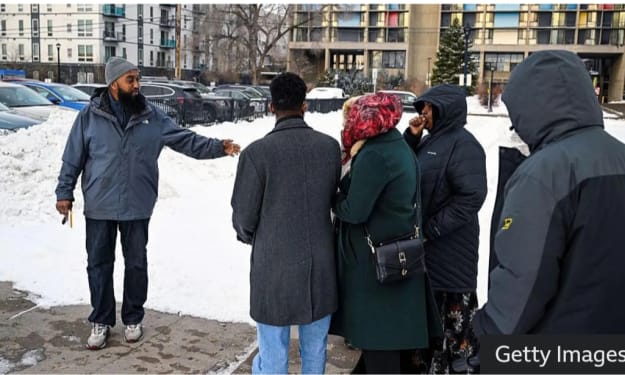
Trump Administration Moves to End Deportation Protection for Somalis
The Trump administration has moved to end long-standing deportation protections for Somali nationals living in the United States, a decision that could place tens of thousands of people at risk of removal. The move has sparked alarm among immigrant communities, human rights organizations, and legal experts, who warn that returning Somalis to a country still grappling with instability could have severe humanitarian consequences. As the policy change unfolds, it has reignited debate over immigration enforcement, executive authority, and America’s obligations to people fleeing conflict.
By Aarif Lashari2 days ago in Earth



Comments
There are no comments for this story
Be the first to respond and start the conversation.