
Introduction to the Solar System.
The Solar System is a fascinating and complex system of planets, moons, asteroids, comets, and other celestial bodies that orbit around the Sun.

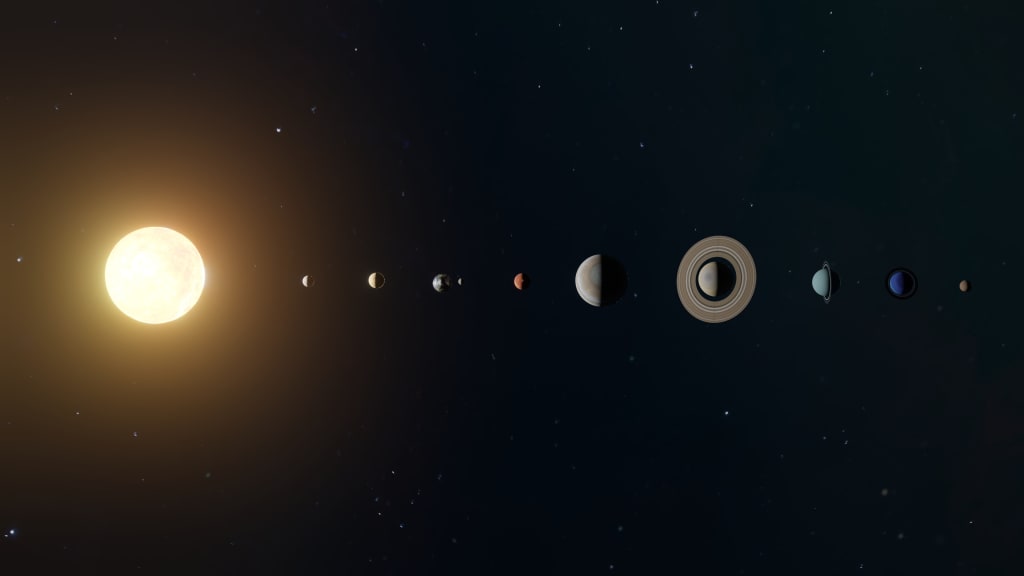
The Solar System is a fascinating and complex system of planets, moons, asteroids, comets, and other celestial bodies that orbit around the Sun. It is located in the Milky Way galaxy, approximately 25,000 light-years from the center. The Solar System consists of eight planets, namely, Mercury, Venus, Earth, Mars, Jupiter, Saturn, Uranus, and Neptune. In this article, we will explore the Solar System in detail, including the characteristics and features of each planet.
The Sun is the center of the Solar System, and it is a massive, hot, and bright ball of gas, primarily composed of hydrogen and helium. It provides light and heat to all the planets and other bodies in the system. The Sun is so large that it contains more than 99% of the mass of the entire Solar System.
Mercury is the closest planet to the Sun and is the smallest planet in the Solar System. It is a rocky planet, similar in composition to Earth's moon, with a heavily cratered surface. Due to its proximity to the Sun, its surface temperature can reach up to 800°F during the day and drops to -290°F at night.
Venus is the second planet from the Sun and is often referred to as Earth's sister planet due to its similar size and composition. However, the similarities end there, as Venus has a thick atmosphere of carbon dioxide, which causes a runaway greenhouse effect, making it the hottest planet in the Solar System, with temperatures that can exceed 860°F.
Earth is the third planet from the Sun and the only known planet to support life. It has a solid surface with a diverse range of landscapes, including mountains, oceans, and deserts. The Earth's atmosphere contains the perfect mix of gases for life to thrive, including oxygen, nitrogen, and carbon dioxide.
Mars is the fourth planet from the Sun and is often referred to as the Red Planet due to its distinctive reddish appearance. It is a rocky planet with a thin atmosphere, and its surface features include the largest volcano in the Solar System, Olympus Mons, and the deepest canyon, Valles Mariners.
Jupiter is the fifth planet from the Sun and is the largest planet in the Solar System. It is a gas giant with no solid surface, and its atmosphere is mostly composed of hydrogen and helium. Jupiter has a unique feature known as the Great Red Spot, a massive storm that has been raging for hundreds of years.
Saturn is the sixth planet from the Sun and is also a gas giant with no solid surface. It is known for its distinctive ring system, which is made up of thousands of individual rings. Saturn's rings are made up of ice particles, and some of them are as small as a grain of sand, while others are as large as a house.
Uranus is the seventh planet from the Sun and is an ice giant with a thin ring system. It has a tilted axis of rotation, which causes its seasons to last for more than 20 years. Uranus has a unique feature, a hexagonal-shaped storm that has been observed at its north pole.
Neptune is the eighth planet from the Sun and is also an ice giant. It has a blueish appearance due to the presence of methane in its atmosphere. Neptune is the windiest planet in the Solar System, with winds that can reach up to 1,200 miles per hour.
Apart from the eight planets, the Solar System also includes several dwarf planets, including Pluto, Ceres, Eris, Haumea, and Make make. These small celestial bodies are similar in size to some of the larger moons in the Solar System and orbit around the Sun.
The Solar System has over 200 known moons orbiting around the planets, dwarf planets, and even some asteroids. Jupiter, the largest planet in the Solar System, has the most significant number of moons with 79 known moons. Saturn, the second-largest planet, has the second-largest number of moons with 82 known moons. Some of these moons are small and irregularly shaped, while others are large and spherical with unique geological features, such as active volcanoes, subsurface oceans, and icy crusts. The study of these moons provides valuable insights into the formation and evolution of the Solar System.
About the Creator
Hanaff Jr
Just Writer...
Australia Horticulture Market 2026: Climate-Smart Farming, Export Demand & Agri-Tech Innovation
Australia Horticulture Market Overview Australia’s horticulture market plays a crucial role in the country’s agricultural economy, supplying fresh fruits, vegetables, nuts, flowers and nursery products to both domestic and international markets. The sector is widely recognized for high-quality produce, strong biosecurity standards and advanced farming practices. Growing consumer demand for nutritious foods, expanding export opportunities and continuous technological innovation in agriculture are driving sustained development across Australia’s horticulture industry.
By Amyra Singh7 days ago in Earth


Comments
There are no comments for this story
Be the first to respond and start the conversation.